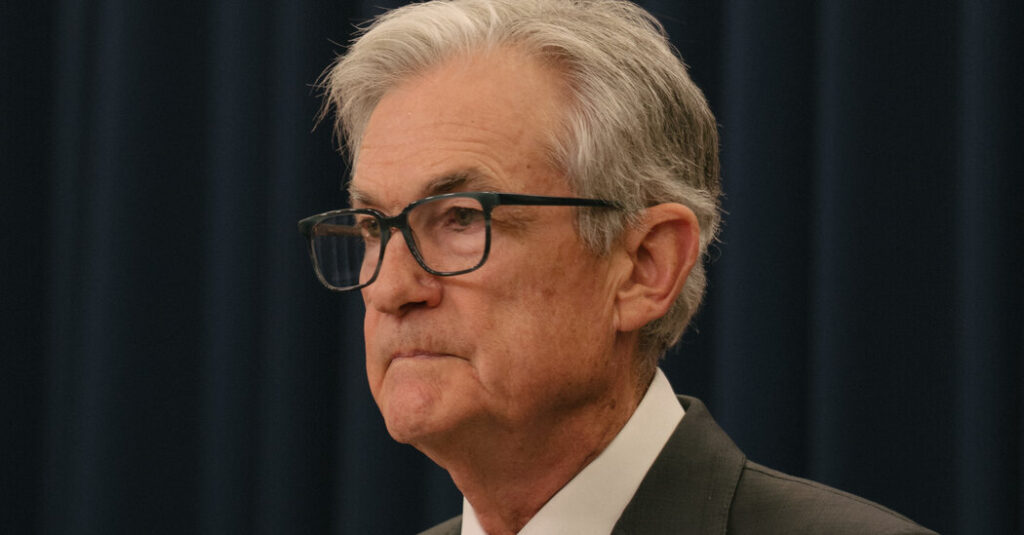
The investigation of Jerome H. Powell, chair of the Federal Reserve, has prompted fierce blowback from Republicans, international policymakers, Wall Street and some Trump allies, and now threatens to undermine President Trump’s effort to assert dominance over economic decision-making.
The swift and overwhelmingly negative response came after the U.S. attorney in Washington, Jeanine Pirro, informed Mr. Powell her office was initiating a criminal inquiry into the $2.5 billion renovation of the Fed’s headquarters and whether Mr. Powell had lied to Congress about the project.
The backlash is occurring at a time when Mr. Trump has become increasingly emboldened, declaring to The New York Times last week that the only limits on his power are his own “morality.” The Powell inquiry also laid bare some rare dissension within the top ranks of the Trump administration and public opposition from some of the president’s most loyal supporters.
The targeting of Mr. Powell threatens to upend the process of selecting and confirming his replacement in an orderly manner this year, potentially making it more difficult for Mr. Trump to achieve his goal of packing the Fed’s board with members who support substantially lower interest rates.
For months, Bill Pulte, the director of the Federal Housing Finance Agency, has been encouraging Mr. Trump to make Mr. Powell’s handling of the renovation a criminal matter — after making a similar case about other Trump enemies.
When Treasury Secretary Scott Bessent, who is leading the process to find Mr. Powell’s replacement, caught wind of a potential investigation into the Fed chair late last year, he tried to prevent it. He thought he had been successful until last week.
When Mr. Bessent found out the investigation was moving forward, he called Mr. Trump directly. The two men spoke last Friday night and Mr. Bessent expressed frustration, telling the president the investigation could impede their plans to confirm a new chair of the Federal Reserve.
Mr. Bessent’s call to Mr. Trump was reported earlier by Axios. A Treasury spokeswoman did not respond to requests for comment.
A person with knowledge of Ms. Pirro’s actions, speaking on condition of anonymity to discuss internal discussions, said that the U.S. attorney, a former television judge and longtime Trump friend, had never interacted with Mr. Pulte about Mr. Powell or the Fed — and had never met him.
Her decision to move ahead with the case came after she read news reports about cost overruns in The New York Post and The Wall Street Journal, which prompted her to assign members of her team to begin an inquiry last November, that person said.
Ms. Pirro, who speaks to Mr. Trump regularly by phone, has not discussed the Powell case with him, they added.
Mr. Trump delivered a broader message to Ms. Pirro and dozens of U.S. attorneys who visited the White House for a meet-and-greet last week: They were too weak, and needed to step up the pace of investigations of his enemies, according to three administration officials briefed on the exchange. They spoke on condition of anonymity to discuss internal conversations.
Ms. Pirro also did not share information with her bosses at the main headquarters of the Justice Department — including Attorney General Pam Bondi and her top deputy, Todd Blanche — citing the discretion granted local U.S. attorneys’ offices to investigate the head of the most powerful monetary policy body on earth, according to several officials with knowledge of her actions.
Senior officials at the department were stunned, and annoyed, that Ms. Pirro did not consult them on an investigation of such international importance, the officials with knowledge of her actions said.
The decision to exclude Ms. Bondi and her staff did not run afoul of departmental regulations. Yet it was anything but business as usual, reflecting Mr. Trump’s own habit of encouraging multiple lines of authority outside official command chains that hamper coordination among his appointees but reinforce his own primacy.
Ms. Pirro’s decades-long relationship with Mr. Trump gives her the self-confidence to make consequential decisions without first seeking sign-off from her superiors.
She bristled at claims that she had executed a political hit at the behest of the White House, saying Mr. Powell and his team had brought on a formal criminal investigation by ignoring two politely worded requests for information about the cost overruns.
“This office makes decisions based on the merits, nothing more and nothing less,” Ms. Pirro wrote in a social media post later Monday. “We agree with the chairman of the Federal Reserve that no one is above the law, and that is why we expect his full cooperation.”
The Fed received two emails from Carlton Davis, who is listed on the Front Office page of the Department of Justice website as a special counsel, over the holiday period. The first outreach came on Dec. 19 and revolved around discussing matters related to the renovations. It was followed by another email on Dec. 29. The emails did not mention the threat of a criminal investigation or subpoenas, and they did not include a deadline for a response.
Late on Friday, the Justice Department served the central bank with grand jury subpoenas related to information regarding the renovations that have been taking place since 2022 at the Fed’s headquarters in Washington. After the criminal investigation was revealed by The New York Times on Sunday, Mr. Powell released an extraordinary two-minute video message that accused the administration of threatening legal action to pressure the central bank into lowering borrowing costs.
Some White House officials initially grew concerned Monday morning when several Republican senators expressed misgivings about the investigation.
Senator Thom Tillis, a North Carolina Republican and a member of the Senate Banking Committee, threatened to oppose the confirmation of any nominee for the Fed, including the upcoming chair vacancy, until the legal matter was resolved.
And Senator John Thune, Republican of South Dakota and the majority leader, took the rare step of weighing in, saying that “it’s really important that it get resolved quickly and that there not be any appearance of political interference with the Fed or its activities.”
Mr. Powell’s term as Fed chair expires in May but he can remain on the Fed’s policy-setting board of governors until 2028. If Mr. Tillis follows through on his pledge, it could hinder, if not prevent, Mr. Trump’s pick from getting enough votes for the nomination to advance to the full Senate.
Even allies of Mr. Trump also complained that targeting Mr. Powell in such a manner was a strategic blunder.
Larry Kudlow, the Fox Business Network anchor who served as director of the White House’s National Economic Council during Mr. Trump’s first term, predicted on Monday that indicting Mr. Powell would ultimately make it more difficult for Mr. Trump to replace him.
“Why make a martyr out of Jay Powell?” Mr. Kudlow said on Fox Business, suggesting that Mr. Powell was a “terrible Fed chair, but not a criminal. “Trump won’t be able to get his new chairman through the Senate until he withdraws Powell’s criminal indictment.”
Mr. Kudlow added that it remained a mystery which “little gremlin” in the U.S. attorney’s office in Washington had decided to serve the central bank with grand jury subpoenas.
The notion that the credibility of the world’s most important economic institution could be eroded continued to raise alarm among global economic leaders.
On Tuesday, a dozen central bankers expressed their support for Mr. Powell in a statement, including Christine Lagarde, the president of the European Central Bank, which sets rates for the 21 eurozone countries; Andrew Bailey, the governor of the Bank of England; Tiff Macklem, the governor of the Bank of Canada; and Chang Yong Rhee, the governor of the Bank of Korea.
“We stand in full solidarity with the Federal Reserve System and its Chair Jerome H. Powell,” the statement published on Tuesday said. “The independence of central banks is a cornerstone of price, financial and economic stability in the interest of the citizens that we serve.”
The central bankers praised Mr. Powell’s service and commitment to the public interest. “To us, he is a respected colleague who is held in the highest regard by all who have worked with him,” they wrote.
The attack on Mr. Powell also prompted pushback from Wall Street.
“Everyone believes in Fed independence,” Jamie Dimon, the chief executive of JPMorgan Chase, said on Tuesday after the bank released its quarterly earnings.
“Anything that chips away at that is probably not a great idea and in my view will have reverse consequences,” he said, predicting higher inflation expectations and “probably” increased rates over time.
Calls to preserve the Fed’s independence did not deter Mr. Trump from criticizing Mr. Powell. In a Truth Social post on Tuesday, the president reprimanded him for being “too late” if he does not cut interest rates. And as he departed the White House to travel to Detroit, Mr. Trump said that Mr. Powell “doesn’t do a very good job” while reprising questions about the renovation project.
“Well, he’s billions of dollars over budget,” Mr. Trump said. “So he either is incompetent or he’s crooked.”
In a speech on the economy later on Tuesday, the president took it a step further: “That jerk will be gone soon.”
Eshe Nelson, Rob Copeland and Tony Romm contributed reporting.
Alan Rappeport is an economic policy reporter for The Times, based in Washington. He covers the Treasury Department and writes about taxes, trade and fiscal matters.
The post Blowback Builds Over Criminal Investigation of Powell appeared first on New York Times.