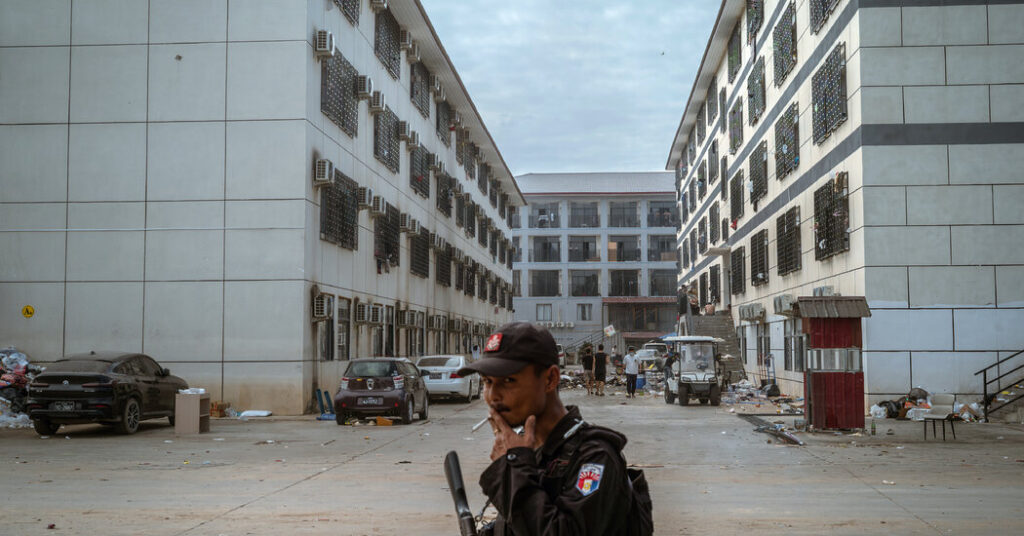
In a Southeast Asian war zone, cloaked in dense rainforest, the Chinese settlement dedicated to scamming people from Kentucky to Kazakhstan grew fast on fertile ground.
Over just a few months, a sprawling office park materialized and metastasized in the chaotic borderlands of Myanmar, with cavernous rooms holding rows of computer monitors and walls decorated with inspirational work slogans: “Dream chaser,” “Keep going,” “Making money matters the most.” In video conference suites, bookshelves stocked with fake business tomes and ersatz modern art simulated the kind of boardroom a successful crypto investor might inhabit.
The scam center, Shunda Park, opened for business in 2024 with more than 3,500 workers from nearly 30 nations, including Namibia, Russia, Zimbabwe and France. Some had been kidnapped and enslaved, but all had become skilled in the art of the online grift. When the scammers bilked $5,000 out of someone, they struck a Chinese gong. A $50,000 shakedown earned a celebratory pounding of a giant drum, then an offering to a Chinese deity resplendent in his golden altar.
While each nationality required a different approach — for Americans, one scammer told me, the preferred mark was “white old men” — the general approach was the same: an online foray by a sympathetic and attractive person, followed by an invitation to participate in a select investment opportunity.
Victims were not just lonely hearts or technologically timid retirees. Using generative intelligence and deepfake videos, as well as fraudulent businesses, websites and financial apps, the scammers at Shunda embraced the long con and reeled in people from almost every demographic.
But in late November, Shunda Park was unexpectedly captured by a rebel force long at odds with the Myanmar military, whose coup nearly five years ago catapulted this Southeast Asian nation into civil war and created a chaotic space for criminality to thrive. The photographer Jes Aznar and I were granted rare access to the scam compound to document the inner sanctum of this secretive, highly fortified industry. Shunda Park had been closed for business by the rebel militia, but we were able to meet some of its scammers, both those who were trying to return home and others who wanted to find another job in the fraud business.
With millions of people falling victim to online shakedowns every year, the cyberscamming industry has quickly grown into one of the planet’s most lucrative criminal enterprises, according to the United Nations Office on Drugs and Crime.
In the United States alone, in 2024, at least $10 billion was stolen through cyberscams run out of Southeast Asia, the U.S. Treasury Department said. That figure is likely only a fraction of the true toll because victims are often too embarrassed to admit they have been fooled. Late last year, the United States formed its first ever federal task force to combat scam centers and the Chinese transnational crime networks that American investigators say run them.
The Myanmar junta, which has imprisoned members of an elected government and killed thousands of civilians, recently vowed to tackle the scam networks. But its current crackdown feels like a Potemkin exercise. The global profits from online cons rival the gross domestic products of the countries where the fraud factories have proliferated, including Myanmar, Cambodia and Laos.
These illicit proceeds do not just line the pockets of the gangs, most of which are originally from China; dirty money also flows to powerful elites across the region — most of all, crime-watchers say, to powerful people in the conflict-ridden, failed state of Myanmar.
Our journey to Shunda Park occurred during what was supposed to be a lull in the fighting between the Myanmar military and the opposition militia, known as the Karen National Liberation Army. (The Karen, pronounced Kuh-REN, are one of Myanmar’s many ethnic groups that have been persecuted by the military for generations.)
By the time we arrived in the village of Min Lat Pan, where Shunda Park is, the lull had ended. Our visit was punctuated by the thud of mortar rounds and the crackle of small-arms fire. At least three shells flew over our heads and landed across the river in neighboring Thailand. The next day, a 60-millimeter mortar hit a building where we had been sheltering the day before, wounding three people, including our guide.
What we discovered inside Shunda Park’s thick walls ringed by razor wire resembled a set for an apocalyptic film. Amid white office blocks, Chinese restaurants and luxury villas reserved for the compound’s Chinese bosses, bonfires burned, consuming the tools of the illicit economy. Piles of electronic equipment — keyboards, tangles of cables and thousands of cellphones — littered the site. In some buildings, with nearly every step I took, I crunched on SIM cards, scattered like snow in the tropical heat.
While members of the Karen militia handed over armfuls of evidence to the police in Thailand, along with a man identified as the compound’s Chinese boss, no representatives of foreign governments or intelligence agencies have come to Shunda Park to investigate. Now, the fighting has intensified, and all of Shunda Park’s workers have scattered. Other proof of scamming has gone up in flames.
“We are trying our best, but we are not scam experts,” said Padoh Saw Taw Nee, the spokesman for the K.N.L.A.’s political wing, as he leafed through a notebook with instructions on how to cheat middle-aged women in Taiwan. “We do not like that our land is known as the place where criminals cheat people.”
The layers of victimhood at a place like Shunda Park are complex. Many of the scammers who worked here say they were duped, too. They arrived in neighboring Thailand, thinking they had been hired for well-paying tech or marketing jobs. Others thought they were checking out merchandise for online sales businesses. Instead, they were hustled at gunpoint across the river that demarcates the border with Myanmar.
I spoke with several scammers whose bodies bore scars from beatings or tight shackles. They never received payment for their 12-hour shifts, they said. Life was a Sisyphean loop: sleep, eat, scam, eat, sleep, scam.
Kason, a 22-year-old from Malaysia who is being identified only by his first name, said he suffered only two “hard” beatings. But his legs and torso were crisscrossed with traces of lacerations from what he called “many, many” smaller beatings.
His job for more than a year was to send endless “hellos” into the social media ether. If he did not receive responses from at least 5 percent of the greetings, then he would be punished physically, he said.
Ivan, a Malaysian who once worked as a member of the ground staff at the Singapore airport, said he was chained in a crucifixion position and denied food for days.
“You think you know hell,” he said, “and it’s actually even worse.”
In one of the Shunda Park workrooms, bobblehead dolls and fake gold bars enlivened the space. At the front, near a statue of a Chinese god worshiped by the gangsters, were three port-a-potty style boxes that scammers said were used as punishment chambers, in clear sight of the rest of the room. Elsewhere in the compound, behind a barbecue restaurant, a row of cement torture cells was outfitted with bars and shackles.
Not all the workers at Shunda landed there unwillingly. Many of the Chinese employees at Shunda Park received salaries, a review of records in one finance office shows. A company called Huisheng International, for instance, had stacks of wage receipts, sick-leave forms and medical tests for H.I.V. and syphilis, among other diseases, all written in Chinese. Employees were identified by nicknames like “Eastern Dragon” or “Little Li.” Contracts in the office specified that workers would be bound by Myanmar labor law.
While most of the workers at Shunda Park were transported to safety via Thailand, about 900 Chinese workers refused to leave for more than two weeks, despite the compound being in the middle of an active conflict zone. The Chinese government has periodically cracked down on the scamming industry, arresting Chinese workers who are repatriated. So tense was the situation that days before our visit, some Chinese workers had tried unsuccessfully to wrestle weapons away from the Karen soldiers, according to members of the militia and other scammers who witnessed the melee.
All but one Chinese man at the compound refused to speak with me. The scammers shielded their faces with their hands or with masks. The one worker who agreed to talk said he had been promised a salary of 30,000 yuan a month, or $4,250. But upon arriving, he said, he only received 30,000 Thai baht a month, or $940. Records in the finance office showed base salaries of that amount.
“They tricked me,” he said of his employers. The boom of shelling punctuated our conversation.
Around him, rotten food festered. On the basketball court and by a nightclub, fires smoldered. A French bulldog that used to be cared for by one of the compound’s Chinese managers padded by, before collapsing in the shade provided by a luxury sedan. The cars on site came from all over Myanmar, including a fire department vehicle from halfway across the country. There was also an oil tanker truck with Chinese license plates.
The Myanmar military appears determined to reclaim Shunda Park, even as it dynamites buildings in other scam centers to show it is tough on crime. Workers at those raided sites, also run by Chinese criminal networks, however, say the crackdowns are just for show. In fact, some of the workers at Shunda said they had just arrived from these cleared out compounds. With international sanctions biting, Myanmar’s generals, supported by business allies and sympathetic militias, have embraced various illicit economies, making the country a global crime capital.
Outside the scam compounds, life is impoverished and insecure. The Myanmar military regularly launches airstrikes around Shunda Park, and across the rest of the country, targeting civilians. More than 3.5 million people nationwide are now displaced.
As the shelling intensified, we climbed into pickup trucks and sped away. Our driver, the commander of the K.N.L.A.’s special forces, varied his speed to ward off the suicide drones that terrorize the area’s roads. A few days before, an armed drone detonated a bus length away from one of the trucks.
In the next village, in an area where an ethnic armed group aligned with the junta had held sway, I spotted more neat rows of scam centers being built, Chinese red lanterns hanging from the eaves. Chinese workers wandered through the construction site, shirts off in the heat.
A few days later, the 900 or so Chinese workers left Shunda. Some went over the border to Thailand. But most headed to other Chinese compounds in the wilds of Myanmar, where scammers are busy finding their next victims.
Berry Wang contributed research.
Hannah Beech is a Times reporter based in Bangkok who has been covering Asia for more than 25 years. She focuses on in-depth and investigative stories.
The post At This Office Park, Scamming the World Was the Business appeared first on New York Times.