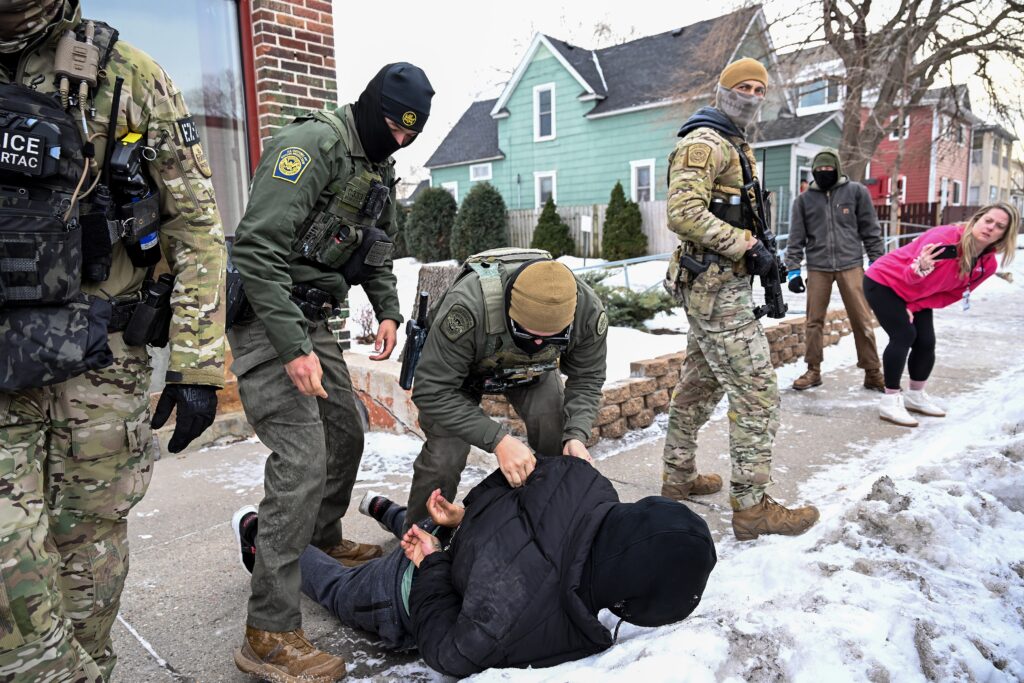
The Jan. 12 front-page article “Monitoring of ICE in spotlight after killing” reported that Americans documenting immigration arrests are being accused of obstructing justice. And last week, Vice President JD Vance declared that the Immigration and Customs Enforcement officer who fatally shot Renée Good has “absolute immunity.” Why would we in the United States of America have a federal police force that is immune to any oversight? ICE agents show no ID, cover their faces, use unmarked vehicles, act despite the protests of local authorities, detain individuals without due process, and have killed and wounded civilians without local oversight. Are we living in a police state and just haven’t publicly declared it?
William A. Madden, Tucson
I proudly worked in a Minneapolis factory that supports the military. I didn’t see any behavior by immigrants that would require a response from masked assailants.
I used to be an active Republican due to the simple concept that government shouldn’t be dictating to its citizens what’s good for them. Today’s Republican Party is a mirror image of that concept. I’m worried that our sense of freedom is decaying to the point where even peaceable protest isn’t allowed anymore. I appeal to Congress to withhold funds from Immigration and Customs Enforcement.
Gilles Burger, Micanopy, Florida
The writer is former chairman of the Maryland State Board of Elections.
Governors are not spectators in moments like this. They have both the authority and the responsibility to protect the people in their states. Deploying the National Guard to stabilize situations and safeguard civilians is not defiance of federal law; it is the exercise of constitutional federalism.
As a military veteran, I swore an oath to the Constitution — not to a party, president or agency. That oath was to defend the rights and lives of people, and to ensure that force is used lawfully, proportionally and as a last resort. When enforcement actions begin to resemble military operations, something has gone dangerously wrong. No agency should operate beyond meaningful oversight. Accountability is not anti-law-enforcement. It is the foundation of a free society.
Jeff Lind, Lindenhurst, Illinois
Where are you, Senate Democrats?
The Jan. 7 editorial “Greenland isn’t worth destroying NATO over” was on point regarding the damage a U.S. seizure of that island would do to NATO — and by extension American national security. Which makes the lack of a coordinated response by Senate Democrats hard to understand. In a YouGov poll last week, 73 percent of respondents said they’re against using force to take over Greenland, including a majority of both Republicans and Democrats. Only 8 percent said they were in favor of the idea. As David Ignatius noted in his Jan. 9 op-ed, “Trump’s Greenland fixation curdles into a crisis,” White House Deputy Chief of Staff Stephen Miller enthusiastically endorsed a military incursion, telling CNN’s Jake Tapper, “We live in a world, in the real world, Jake, that is governed by strength, that is governed by force, that is governed by power.”
Senate Democrats’ power is limited, but they should gather in front of the White House to make a promise: A U.S. invasion and occupation of Greenland will be reversed on Day 1 of the next Democratic administration, with reparations paid to Denmark and Greenland for damage done and official apologies extended to both, plus the European Union.
Edward Grimes, Lexington, Virginia
A man of the past
President Donald Trump’s actions and threats regarding Venezuela, Colombia, Cuba, Panama, Greenland and even Canada smack of imperialism. His moves portend a return to the 19th-century spheres of influence, client states and colonialism. He’s not alone. China already has its hooks in Africa, especially the Democratic Republic of Congo, with its Belt and Road Initiative. India has moved closer to Russia. The world will regret this overreach.
George Magakis Jr., Norristown, Pennsylvania
A man of the future
President Donald Trump’s military incursion into Venezuela holds a lesson. Physical borders are less important than ever. The digital age has turned them into a dotted line, and artificial intelligence may erase them altogether. Sovereignty increasingly is personal, not national, and the future will not be stuffed back into a 17th-century box. Criticizing Trump for violating the old rules is pointless.
Instead, it might be better to understand his autocratic behavior as a preview, as ungainly steps toward a new order. Trump himself probably misses the bigger picture. Avarice is his blind spot, and he seems content developing spheres of influence. He is an opportunist, not a statesman. Still, it would be a mistake after he is out of the White House to focus on cleaning up his mess, apologizing to an aggrieved world and rebuilding what has been torn down. Trump is climate change, not bad weather. It is a bad idea to invest in the same flood zone as the United States did after the Berlin Wall fell.
Most of us can see Trump’s shortcomings, but it is worth remembering he did not get into the Oval Office by accident, and though his behavior there has been reliably bad, his intuition has been unreliably good. He is not right on most issues, but he is not simply wrong on most, either. His successor’s job will be to build, not excavate, and to behave like an adult while doing it.
David Robinson, Bethlehem, New Hampshire
Following Sarah Fletcher’s Jan. 4 Sunday Opinion essay, “The magic has gone out of flirting. Maybe this infamous book had a point.,” Post Opinions wants to know: What should flirting look like in 2026? Send us your response, and it might be published as a letter to the editor. wapo.st/flirting
The post Are Americans living in a police state? appeared first on Washington Post.