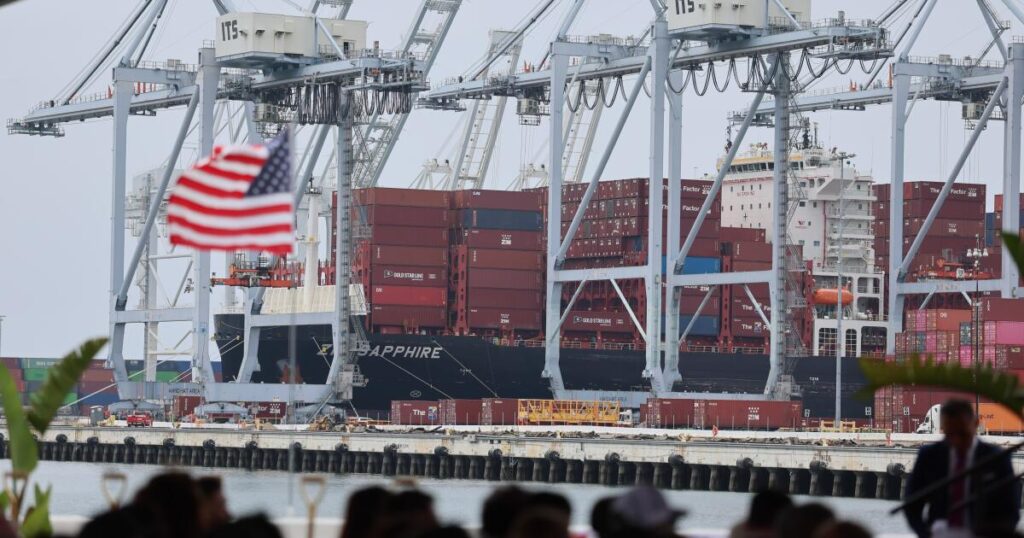
Despite a year of trade volatility and unprecedented tariffs, the Port of Long Beach handled a record amount of cargo in 2025 and expects growth to accelerate.
Under the leadership of a new chief executive, Noel Hacegaba, the second-busiest port in the U.S. plans to invest to be ready to double the cargo it processes by 2050. That’s also the year the port is hoping to achieve zero carbon emissions.
“We have 24 years to figure this out and ensure we can handle double our capacity,” Hacegaba said.
The forecast predicted the Port of Long Beach will handle the equivalent of 20 million containers in 2050, up from 9.8 million containers last year.
Hacegaba, who joined the Port of Long Beach in 2010 and previously served as chief commercial officer before beginning his CEO role Jan. 1, said he is focused on upgrading the port’s operations. The future of the port depends on investments in infrastructure and efficiency, he said.
“A lot of what I’m going to do as chief executive resembles what a head coach of a football team would do,” Hacegaba said. “I want us to move to a hurry-up offense,” he said.
Managed by the city’s Harbor Department, the port currently handles about $300 billion in cargo annually and supports 2.7 million jobs in the U.S. The port accounts for 534,000 jobs in Los Angeles and Orange counties and 1.14 million jobs in California. Hacegaba is looking forward to increasing those numbers.
“If we double our throughput, there’s no question we’re going to need a bigger workforce to handle that,” he said.
After a year under the Trump administration, some things have changed for the port.
Trade with China used to account for 70% of the port’s cargo handling, but after President Trump’s tariffs on Chinese exports, that amount has fallen to 60%. Much of the movement has shifted to Vietnam, which takes longer to travel to and from, Hacegaba said.
Breaking cargo records in 2025 “is remarkable when you consider everything that we’ve gone through as an industry and as an economy,” he said.
At one point, Trump imposed a nearly 150% tariff on Chinese goods, but as of November, the tax on many goods from the country was 47%. Trump also imposed steep taxes on imports from other key trade partners, including Mexico and Canada.
As a result, cargo volumes varied drastically by month at the Port of Long Beach and the Port of Los Angeles.
“Every time there was an announcement of a new tariff, the reaction from the shippers was to advance shipments to get ahead,” Hacegaba said. “We did notice ups and downs.”
From April to May last year, the number of containers processed at the port fell from 867,493 to 639,160. By July, the number jumped up to 944,232.
International shippers who front-loaded goods to get ahead of new taxes accounted for much of the port’s cargo during its record year.
“Despite some of the doom and gloom that a lot of people were suggesting, we ended in record territory,” Hacegaba said. “The single biggest factor was all the front-loading.”
The port handled last year’s cargo without congestion or backlogs, according to Hacegaba. Over the next 10 years, the port plans to invest $3.2 billion in inland railroad connectivity to move goods faster and more efficiently.
The intricate cargo-hauling system still will rely on truck drivers, who represent a significant portion of California’s working class, but is looking to lean more towards using railways, which can be faster and greener, Hacegaba said.
“In order for us to accommodate that growth, we’re going to have to leverage every mode of transportation to get those containers out as quickly as possible,” he said.
To “grow green” and eliminate carbon emissions by 2050, the port agreed to a deal with Brookfield Properties to build a zero-emission container terminal at Pier S, located in the port complex along the Cerritos Channel.
The port has also spent the last decade preparing its infrastructure for bigger and more energy-efficient ships.
In November, the California State Transportation Agency rejected a proposal from the Port of Los Angeles to raise the height of the Vincent Thomas Bridge, which connects San Pedro to Terminal Island and Long Beach.
Hacegaba said that the Port of Long Beach is already “big ship ready.” The Long Beach International Gateway Bridge, a key artery in the port complex, is 515 feet tall, high enough for the next generation of cargo ships to pass under.
The Vincent Thomas Bridge is 185 feet tall.
The ports of Los Angeles and Long Beach share a space and compete against other global gateways, Hacegaba said. But he wants Long Beach to be the best choice for shippers and marine terminal operators.
“To the rest of the world, we are one port complex,” Hacegaba said. “However, the ocean carriers, the shippers, they keep score on customer service.”
Hacegaba stepped into his new role this month, eager to usher in the next era at the Port of Long Beach. He said his 15 years working for the port have prepared him for what’s next.
“We’re going to simplify our mission and we’re going to amplify our impact,” Hacegaba said. “I know what’s working and I know what can work better.”
The post After a record year, the Port of Long Beach prepares for growth appeared first on Los Angeles Times.