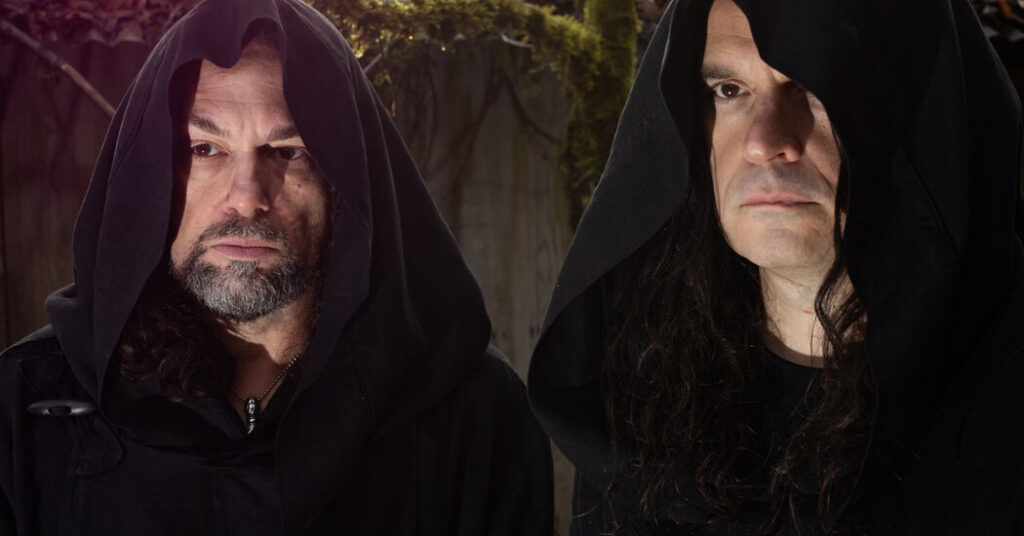
A few years ago, the underground-metal lifer Greg Anderson placed a call to another indie-music luminary — Jonathan Poneman, co-founder of Sub Pop — with a proposition: a collaboration between the foundational Seattle rock label and Sunn O))), Anderson’s long-running, ultraheavy duo with fellow guitarist Stephen O’Malley.
In a joint phone interview with O’Malley last month, Anderson recalled that Poneman quickly agreed, saying he’d been hoping to see the label that helped propel Nirvana and Soundgarden return to a more guitar-oriented direction.
Anderson said he laughed and replied, simply, “Well, we have guitars.”
That they do: Perhaps no other 21st-century act has reveled more fully in the power and mythology of the electric six-string. Taking its name and logo from a line of high-powered amps, the duo distills the heavy-metal power chord into a kind of primordial om, removing drums and favoring a symphonic scale over any conventional rock form. Sunn O)))’s albums and deafening concerts, at which Anderson and O’Malley sport hooded cloaks, unfold like infernal sound baths.
As the Soundgarden guitarist and sometime Sunn O))) collaborator Kim Thayil put it in a phone interview, the effect is “like a metallic version of new age.”
Jim Jarmusch, who incorporated its music into the soundtrack of his 2009 film “The Limits of Control,” praised the way the Sunn O))) eludes categorization. “Are they drone, or are they doom or are they dark ambient?” he asked rhetorically in a phone interview. “I consider them to be almost — well, at times, most certainly — ecstatic music, in that they transport you to another realm that is verging on a kind of spiritual thing for me.”
Since forming in 1998, Sunn O))) have enlisted a slew of collaborators, including artists versed in jazz, film soundtracks and experimental soundscapes, as well as various wings of heavy music. Attila Csihar, vocalist for the Norwegian black-metal pioneers Mayhem, has added croaks and growls to various albums and shows, while 2019’s “Life Metal” featured incantatory vocals from the Icelandic cellist Hildur Gudnadottir, and 2009’s “Monoliths & Dimensions” wove in strings and choirs, and concluded with a searching solo by the veteran jazz trombonist Julian Priester.
But “Sunn O))),” the band’s 10th album out March 20, strips all of that away. Its debut full-length for Sub Pop following an earlier single and EP is the first Sunn O))) album on which only Anderson and O’Malley appear, each playing bass and synthesizers as well as guitar (and during one memorable passage, spare and haunting piano, performing simultaneously on a single instrument).
The result — captured with exceptional vividness by Brad Wood (Liz Phair, Veruca Salt, Sunny Day Real Estate) — is a hyperdistilled version of its core aesthetic, in which snarling distortion and glinting feedback ooze from the speakers like the dense fog that fills the air at the band’s shows. (Wood, who co-produced with the band, “lent his expertise to making the heaviness even heavier,” Poneman said in a video interview.)
Other textures seeped in from the natural world: field sounds sourced from the environment around Bear Creek Studio in Woodinville, Wa., around 25 miles northeast of Seattle, where the album was recorded in a converted barn looking out onto a coniferous forest. Along with various ambient sounds, including the gurgle of a creek and a stump grinder whining in the distance, the album features the signature Sunn O))) drone actually mingling with the outdoors.
On a video call, Wood explained how he and the band made extensive use of re-amping: playing back their base performances through different gear or capturing it in new ways — including with microphones situated in the landscape — and layering it back into the mix.
“We opened up these giant doors and the doors to the kitchen leading out into the outside on the left and right side of the studio and just blasted their music out,” Wood said, “and then set up microphones a couple hundred yards away from each other — like the world’s largest stereo array of room mics.” The results, he said, “sounded like a thunderstorm rumbling off in the distance.”
The album’s Seattle-area terroir points back to the beginnings of Anderson and O’Malley’s partnership. Both grew up in the city and attended the same high school, though they didn’t overlap there. They met in the early ’90s through the younger brother of Anderson’s first girlfriend, and quickly bonded over niche metal and punk. They appreciated the so-called grunge bands that made their hometown an international sensation, but their deepest regional fascinations were more esoteric, including Melvins, the severe yet irreverent Montesano, Wa., trio that was also a key influence on Nirvana and Soundgarden.
“Their expression of being extreme a lot of times was to go extremely slow, which I thought was amazing,” Anderson, 55, recalled. In a scene where speed was prized, he realized, “They’re doing the opposite. This is kind of their punk rock, and a middle finger to a lot of the hardcore audience because they wanted it faster and faster.”
Their other local lodestar was Earth, the brainchild of Dylan Carlson, a guitarist equally enamored of metal and avant-garde minimalism. The band’s debut LP, “Earth 2: Special Low Frequency Version,” released on Sub Pop in 1993, is a hulking, drumless riffscape — drone metal’s universally acknowledged Big Bang.
O’Malley, 51, recalled that a friend who worked at Sub Pop recommended the album to him on the basis of its back cover photo, in which Carlson wore a long-sleeve shirt featuring the logo of Morbid Angel, an extreme-metal act O’Malley revered. “If Melvins were kind of the slowed-down Sabbath, they were kind of the slowed-down Slayer,” O’Malley said of Earth, eliciting a hearty, knowing laugh from Anderson.
Anderson and O’Malley’s early joint bands, Thorr’s Hammer and Burning Witch, conveyed bestial intensity via the traditional metal instrumentation of guitars, bass, drums and vocals. But Earth’s approach had planted a seed. “Even from the first practice we had of our first band, it was just me and him playing riffs in the basement,” O’Malley said.
Sunn O))) initially hewed close to its influences but quickly began branching out. The albums “White1” and “White2,” for example — 2003 and 2004 releases that included contributions from Joe Preston, a former member of both Earth and Melvins — each explored bizarre sonic assemblages that often departed from metal entirely. After the pandemic, though, partly inspired by Covid precautions, the duo gravitated back toward its original form, playing shows as a duo.
“I thought right away, ‘This is really interesting,’” O’Malley said. “All the music, the variations and stuff,” he added, “it’s all there in the guitars.”
Building on that idea, Wood took an uncommonly meticulous approach to capturing the duo’s massive sound at Bear Creek. Typically, when recording guitars, one microphone will be used on each four-speaker cabinet, but for the “Sunn O)))” sessions, he used one for each speaker on every one of both guitarists’ three cabinets. (The inspiration came from an earlier session for an Anderson solo project when Wood pointed out Anderson’s cabinet and asked him which speaker he preferred to have miked. Anderson’s reply: “I kind of like all of them.”)
Wood miked the cabinets, captured the sound of the space with separate mics and also recorded direct signals for use in later reamping, including some in a room with a grand piano so its strings would resonate in response to the guitar sound. Doing the math in his head, Wood said, “I don’t think any song had less than 130 tracks of guitar.”
As Anderson and O’Malley pointed out, some had well over that number. “I can’t remember what the record was that we ended up getting to,” Anderson said, “but we’re talking, like, I don’t know, 180 tracks of guitar that you need to —”
“Of just guitar!” O’Malley interjected, gleefully underscoring his bandmate’s point. Anderson howled with laughter as O’Malley concluded: “I love it.”
The post 130 Tracks of Guitar Per Song? Sunn O))) Is Back, and Going Big. appeared first on New York Times.