For the first time in history, the chair of the Federal Reserve is now the subject of a criminal investigation by the Justice Department.
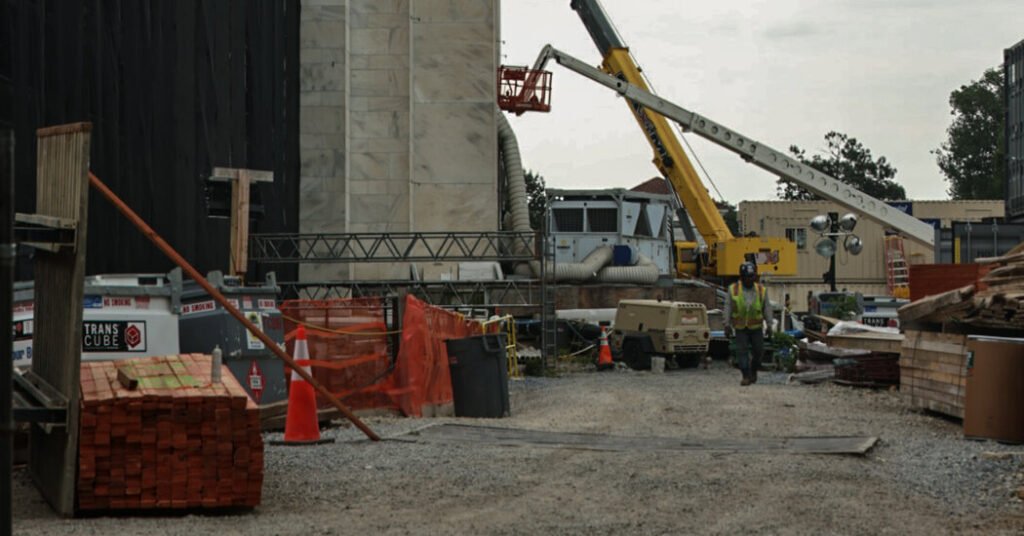
The probe revolves around Jerome H. Powell, who has led the central bank since 2018, and his oversight of a $2.5 billion renovation of the Fed’s headquarters in Washington.
Mr. Powell responded forcefully in a rare two-minute video message Sunday evening, accusing the administration of using legal threats as “pretexts” to coerce the central bank into ceding to the president’s demand for lower borrowing costs.
The president has long treated Mr. Powell as an adversary. But the investigation represents a sharp escalation in his pressure campaign against the central bank, one that has raised questions about whether the Fed can continue to operate independently. That independence has allowed the Fed to make policy decisions that are in the best interest of the economy, rather than what’s politically popular.
What’s behind the investigation?
The inquiry into Mr. Powell’s actions was approved in November by Jeanine Pirro, the U.S. attorney for the District of Columbia and a longtime ally of President Trump, officials said.
It is not the first time the administration has leaned on the weight of the Justice Department to go after political foes. Two of Mr. Trump’s top targets, the former F.B.I. director James B. Comey and Letitia James, the New York attorney general, have faced similar investigations by the Justice Department.
The inquiry involving Mr. Powell rests on public statements he made regarding an extensive refurbishment of the Fed’s headquarters in Washington. The project is running roughly $700 million over budget and is expected to cost $2.5 billion.
Prosecutors in Ms. Pirro’s office, who served the central bank with grand jury subpoenas on Friday, are looking into whether the Fed chair misled Congress when he was questioned at a hearing in June about the project. They are also looking into spending records and have reached out multiple times to Mr. Powell’s staff.
The renovations emerged as a focal point in the Trump administration’s attacks on the central bank last year. As the president’s anger grew over the Fed’s reluctance to cut interest rates, Mr. Trump seized on the cost overruns, going as far as to show up at the construction site for a tour, where he openly sparred with Mr. Powell about the total cost. After his tour, the president said of the Fed, “they have to get it done.”
Around the same time, Mr. Trump had revisited the idea of ousting Mr. Powell, something he could only lawfully do if he had sufficient cause. That has typically meant gross malfeasance or a dereliction of duty while on the job.
The renovations, which had started in 2022 and are set to be completed in 2027, became useful fodder for the administration. Russell T. Vought, the director of the Office of Management and Budget, compared the project to the Palace of Versailles in France, while another administration official, James Blair, dubbed it the “Taj Mahal on the National Mall.”
Until Sunday, Mr. Powell had refused to publicly link questions about the renovations to the president’s pressure campaign against the Fed. Rather, the central bank sought to address the controversy by providing exhaustive details about the project, including publishing a virtual tour of the construction site alongside photos and a list of frequently asked questions.
Why have the renovations been so costly?
The refurbishment involves expanding and modernizing the Marriner S. Eccles Building, which was built in 1935, and another building on Constitution Avenue, which was built in 1932.
The Fed has said that neither of those buildings has been “comprehensively renovated” since their construction nearly 100 years ago. Part of the project includes removing asbestos and lead contamination as well as making the facilities compliant with laws related to accessibility for people with disabilities.
The plans for the complex, which was designed by the French architects Paul Philippe Cret and Jules Henri de Sibour, seek to preserve much of the classical features of the original buildings. But it also includes more modern additions like a new parking garage, atriums and skylights.
An initial proposal submitted in 2021 to the National Capital Planning Commission, a little-known board that became a cudgel to pressure Mr. Powell, described the inclusion of private elevators and dining rooms for top policymakers, additional water fountains and new marble features.
Certain amenities were later scrapped, including the addition of seating on a walkable green roof, fountains and planter boxes that were proposed to sit outside one of the buildings.
In explaining the cost overruns, the central bank on its website cited expenses tied to materials, equipment and labor as well as unforeseen circumstances, such as more asbestos than anticipated and soil contamination. On a tour attended by The New York Times in July, Fed staff added that tariffs, which Mr. Trump has ratcheted up this year, led to the price tag being higher than what was estimated in 2018 and 2019.
What did Powell tell Congress?
Mr. Powell last testified before Congress in June, and the renovations received little attention.
Responding to Senator Tim Scott, Republican of South Carolina, Mr. Powell justified the project by saying the building “was not really safe and it was not waterproof.” He also denied that many of the luxury features flagged by earlier media reports, calling them “misleading and inaccurate.”
“There’s no V.I.P. dining room; there’s no new marble,” he said. “We took down the old marble, we’re putting it back up. We’ll have to use new marble where some of the old marble broke. But there’s no special elevators. There’s just old elevators that have been there.”
Mr. Powell added that the project’s plans had “continued to evolve” and that some features that had been initially incorporated were scrapped.
But the fact that the building’s plans had changed gave Republicans an opening to criticize Mr. Powell, with some lawmakers accusing him of lying to Congress.
Mr. Scott, who leads the powerful Senate Banking Committee, later followed up with more extensive questions that scrutinized the Fed chair’s responses and called out “distinct differences” from publicly available plans.
To address his critics, Mr. Powell also called on the central bank’s internal watchdog to look into the renovations.
Who’s backing Powell?
Mr. Powell has received an outpouring of support since Sunday. Every living former Fed chair and several former Treasury secretaries signed a statement on Monday in support of the Fed’s independence, describing the Justice Department’s move as an “unprecedented attempt to use prosecutorial attacks to undermine” it.
“This is how monetary policy is made in emerging markets with weak institutions, with highly negative consequences for inflation and the functioning of their economies more broadly,” the group of 13 signatories wrote. “It has no place in the United States, whose greatest strength is the rule of law, which is at the foundation of our economic success.”
Several Republican lawmakers, including three senators, also voiced support for Mr. Powell. Their votes will be critical if Mr. Trump is to successfully confirm a new chair to replace Mr. Powell when his term as chair ends in May. All members of the Fed’s board of governors are chosen by the president and eventually need to be confirmed by the Senate. The Senate Banking Committee, which oversees the Fed, leads the vetting process.
Senator Thom Tillis, Republican of North Carolina and a member of the Banking Committee, vowed to oppose the confirmation of any nominee for the Fed, including any coming chair vacancy, citing reports of subpoenas.
“If there were any remaining doubt whether advisers within the Trump administration are actively pushing to end the independence of the Federal Reserve, there should now be none,” he said in a statement. “It is now the independence and credibility of the Department of Justice that are in question.”
Senator Kevin Cramer of Nebraska, who also sits on the Banking Committee, similarly expressed support for Mr. Powell, though he stopped short of saying he would oppose any nominee. Senator Lisa Murkowski, Republican of Alaska, said Monday that after speaking with the Fed chair “it’s clear the administration’s investigation is nothing more than an attempt at coercion.”
Representative French Hill, the Arkansas Republican who leads the House Financial Services Committee, on Monday said the probe “creates an unnecessary distraction” that “could undermine this and future administrations’ ability to make sound monetary policy decisions.”
How far could the administration push this?
The question is what comes next for Mr. Powell.
One concern is that the president will use this investigation as justification to try to remove Mr. Powell for cause, in similar fashion to what Mr. Trump is trying to do with Lisa D. Cook, a governor whom he tried to fire last year citing allegations of mortgage fraud.
Lawyers for Ms. Cook, who has been able to stay on the Fed as her lawsuit against the president is litigated, will present their case before the Supreme Court on Jan. 21.
Legal experts say that this broadside against Mr. Powell will help shore up Ms. Cook’s case because it is yet another example of the president going after individual officials in his pursuit of lower borrowing costs.
Mr. Trump denied having any knowledge of the Justice Department’s probe, saying the subpoenas had nothing to do with interest rates. “I wouldn’t even think of doing it that way,” he told NBC News on Sunday. “What should pressure him is the fact that rates are far too high. That’s the only pressure he’s got.”
Asked on Monday about the investigation, Karoline Leavitt, the White House press secretary, took the opportunity to criticize Mr. Powell.
“I do know one thing for sure, Jerome Powell is not very good at his job,” she said in an interview with Fox News. “As to whether he’s a criminal, that’s an answer the Department of Justice is going to have to find.”
Colby Smith covers the Federal Reserve and the U.S. economy for The Times.
The post What to Know About the Criminal Investigation of the Fed Chair appeared first on New York Times.