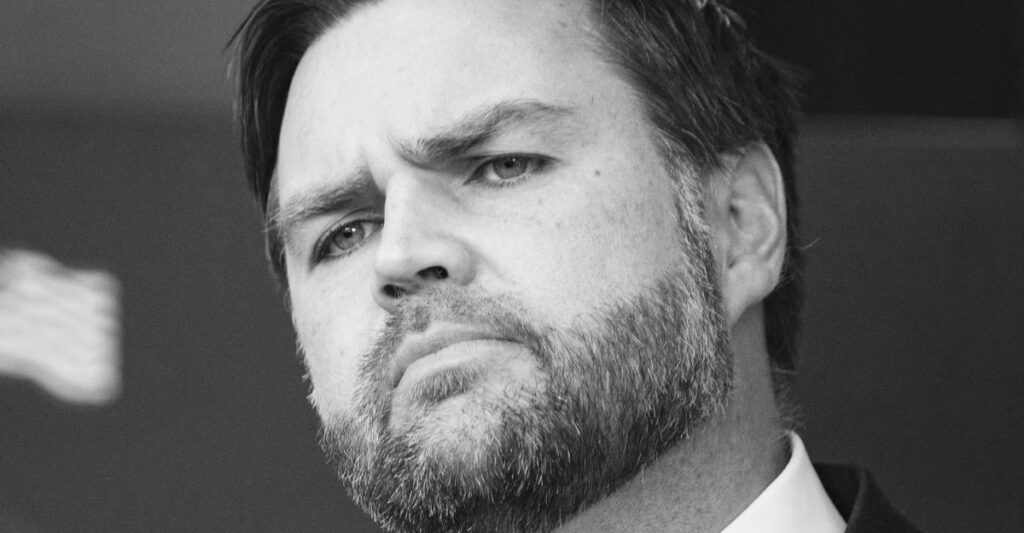
More than Donald Trump, more than Department of Homeland Security Secretary Kristi Noem, more than anyone in ICE’s leadership, J. D. Vance has made himself the lead defender of the killing in Minnesota. Why?
The day after the shooting, Vance announced a new administration effort to prosecute welfare fraud in Minnesota and elsewhere. Vance’s message started hot and got hotter. He blamed immigrants in general—and Somali immigrants in particular—for cheating taxpayers and raising the cost of child care for Americans. Then he launched into a denunciation of Renee Nicole Good, the woman shot dead in Minneapolis. He accused her of intentionally attacking a federal agent with her car. He alleged that she belonged to a broader network of activists who plotted “to attack, to dox, to assault” federal law enforcement. He blasted media outlets for covering her killer unsympathetically.
[Nick Miroff: From “I’m not mad at you” to deadly shots in seconds]
Vance’s words were not a spontaneous reaction to an unexpected question. They were planned, the message he arrived to drive. He did not wait for all of the facts. He did not bother with any notes of compassion for the dead woman and her grieving family.
The vice president next took to X, first to promote a video from the shooter’s point of view, then to mix it up with a journalist about that video (“He is allowed to discharge his weapon in self-defense”).
He did not have to do any of that. He could have expressed support for law enforcement more generally. He did not have to malign the victim. He did not have to champion the shooter. He did not have to insert himself as the main character in a story that was still only just coming into view.
That he did so may seem especially bold given the political context. According to a poll taken the same day as the shooting in Minneapolis, the public has turned against ICE’s often brutal methods. A majority of Americans condemn ICE as “too forceful.” Vance began his term as perhaps the least popular new vice president in the history of polling. Identifying himself with ICE at its deadliest might seem a hazardous move for such a disliked politician.
But there is a logic to Vance’s combative stance. Vance clearly understood what ICE means to Trump’s base.
For MAGA America, ICE is an instrument for cleansing violence. Visit ICE social-media accounts and you’ll see, again and again, videos of armed force against unarmed individuals, against a soundtrack of pumping music. There’s a montage of aggressive arrests in Minnesota of unarmed, non-white men, many of them thrown to the ground and cuffed, set to the 1977 hit “Cold as Ice”: “Someday you’ll pay the price.” A dozen heavily armed and armored agents round up a single unarmed woman in a T-shirt and two similarly defenseless men in California. In Indiana, armored agents throw handcuffs and ankle chains on a big haul of men and shove them in a cell, where they can be seen pacing, weeping, or with their heads plunged in their hands.
Rarely do these videos present a situation that couldn’t be managed with a couple of plainclothes officers bearing holstered sidearms. The point is to prove that the fearsome power of the American state is being wielded by righteous MAGA hands against despised MAGA targets.
On the afternoon of January 9, the DHS X account posted an image of a lone cowboy riding through some Western landscape while a stealth bomber flies overhead. Across the image are the words “We’ll have our home again.” You may not recognize the phrase. It’s a lyric of a song that’s popular on the nationalist far right:
In our own towns, we’re foreigners now, our names are spat and cursed The headlines smack of another attack, not the last, and not the worst Oh my fathers they look down on me, I wonder what they feel To see their noble sons driven down, beneath a coward’s heel
Oh by God we’ll have our home again, by God we’ll have our home By blood or sweat, we’ll get there yet, by God we’ll have our home
That is not an paean to law enforcement. MAGA Republicans do not reliably care about laws or the people who enforce them. One of Trump’s first actions upon entering office was to pardon more than 1,500 people charged in connection with the January 6, 2021, riots on the Capitol, including many convicted of violent offenses against the police. He has denigrated the FBI and transformed the agency into a tool of retribution, and he regularly disparages prosecutors and law-enforcement officials if they fail to comply with his will.
The only law-enforcement agency the administration consistently champions happens to have a particularly grim record of violent overreactions. According to The Trace, which tracks gun violence generally, Good was one of four people who have been killed by ICE since the crackdown began in June, and the organization has identified more than 30 incidents in which immigration agents have either opened fire or held someone at gunpoint. Border Patrol agents have also shot at least three people who were simply observing or documenting immigration raids, including a 30-year-old American woman in Chicago, at whom an agent shouted “Do something, bitch” before opening fire with an assault rifle. She was hit five times but somehow survived.
[Caitlin Dickerson: How ICE lost its guardrails]
This count doesn’t include the many reported incidents of physical assaults without guns, such as choking and body slams, including of elderly men and women. More and worse scenes have been recorded in Minnesota this past weekend.
ICE is violence-prone in part because the agency has lowered its training standards and ditched much of its background vetting to meet the president’s grandiose deportation targets. But more fundamentally, ICE is violence-prone because its main purpose has become theatrical. Under present leadership, ICE is less a law-enforcement agency than it is a content creator.
Americans want borders enforced. They want foreign criminals apprehended and deported. They want unfounded asylum claimants to be removed promptly. But most Americans don’t thrill to spectacular acts of six-on-one violence aimed at DoorDash delivery men. ICE’s approval ratings have duly plummeted.
Again and again, ICE agents are encountering membersof the public who reject their protection and sympathize with the supposed invaders. Yet ICE’s powers against U.S. citizens are limited. Americans can record ICE operations, follow ICE motorcades, and vex and annoy ICE personnel, and there’s not much that Border Patrol agents can legally do to stop them—hence the turn to unlawful force instead.
That’s the mentality the whole world saw in videos of the killing of Good in Minneapolis, including the one seemingly recorded by the shooter himself. The ICE agent will likely argue that he opened fire on Good—who was unarmed and driving away—to save his own life. But the videos also raise the possibility that he fired because he felt disrespected by a person who—in his opinion—owed him deference. ICE agents who use violence may be counting on superiors to back them up, because they feel disrespected too, and by the whole ungrateful country. Which returns us to Vance and his don’t bother me with the facts defense of the ICE shooter.
MAGA is many things, but above all it’s a movement about redistributing respect away from those who command too much (overeducated coastal elites) to those who don’t have enough (white Americans without advanced degrees who feel left behind). You see that redistribution at work in the Trump administration’s project to devalue medical experts and empower wellness gurus and vaccine skeptics, and in its dismissal of “deep state” national-security professionals in favor of TV pundits.
Nowhere does the demand to redistribute respect come into starker view than when guns start firing. In Trump’s first term, Kyle Rittenhouse—who shot and killed two men and injured a third during protests against police brutality in Wisconsin in August 2020—became a MAGA hero largely because he was enforcing the MAGA vision of respect due. Many Americans saw him as a trigger-happy 17-year-old vigilante, but to the MAGA faithful he was a brave soldier in the larger war against MAGA enemies, real and imagined.
The ICE agent who killed Good is Trump’s second-term Kyle Rittenhouse. Of course the agent could have walked away and left everyone unharmed. By law, he should have walked away: It’s generally illegal for a law-enforcement officer to kill a civilian seeking to escape, more so if the civilian is unarmed, and even more so if the civilian is not a criminal suspect of any kind. But letting Good drive off unscathed, without punishing her for her disrespect, would have let her “get away with it.” And that would have been an intolerable affront to the MAGA vision of who must submit to whom.
[Idrees Kahloon: The return of MAGA’s favorite forbidden book]
By coming so vociferously to the shooter’s defense, Vance full-throatedly committed himself to the MAGA mission of enforcing respect by any means necessary. Because there’s always such a strong whiff of cynical calculation and inauthenticity about Vance, he has to say more and go further than many natural MAGA personalities do. He has to pay moral cash where others might be trusted on moral credit. If the Minneapolis shooter is the next Kyle Rittenhouse, Vance dared not delay before thrusting himself at this new MAGA hero’s side.
This is how we arrive at a moment when the country’s highest-ranking officials are endorsing an extrajudicial execution on the basis of claims refuted by the evidence. What really happened was that a woman failed to heed the MAGA campaign to redistribute respect, and her insolence was punished by death.
The post Vance Knows What ICE Means to MAGA appeared first on The Atlantic.