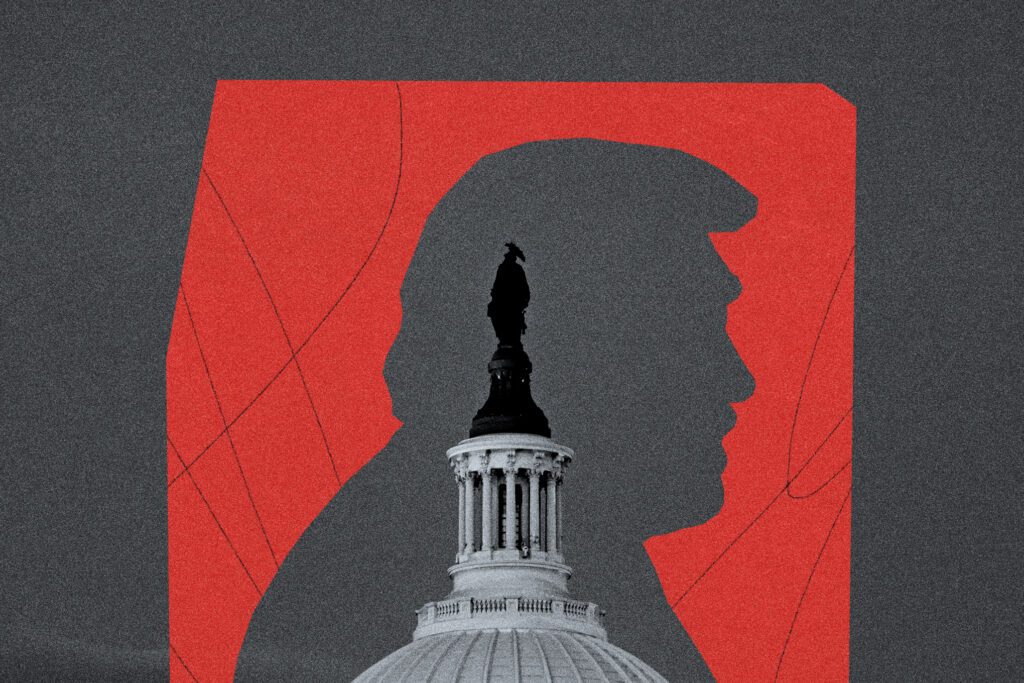
Five years ago, President Donald Trump pressured Republican county election officials, state lawmakers and members of Congress to find him votes after he lost his reelection bid. Now, he’s seeking to change the rules before ballots are cast.
Trump, openly fearful that a Congress controlled by Democrats could investigate him, impeach him and stymie his agenda, is using every tool he can find to try to influence the 2026 midterm elections and, if his party loses, sow doubt in their validity. Many of these endeavors go far beyond typical political persuasion, challenging long-established democratic norms.
They include unprecedented demands that Republican state lawmakers redraw congressional districts before the constitutionally required 10-year schedule, the prosecution of political opponents, a push to toughen voter registration rules and attempts to end the use of voting machines and mail ballots.
The administration has gutted the role of the nation’s cybersecurity agency in protecting elections; stocked the Justice Department, Homeland Security Department and FBI from top to bottom with officials who have denied the legitimacy of the 2020 election; given a White House audience to people who, like the president, promote the lie that he won the 2020 election; sued over state and local election policies that Trump opposes; and called for a new census that excludes noncitizens. The wide-ranging efforts seek to expand on some of the strategies he and his advisers and allies used to try to reverse the 2020 results that culminated in the attack on the U.S. Capitol on Jan. 6, 2021.
“I’m concerned about chaos and uncertainty in the administration of the 2026 election,” said Nathaniel Persily, a Stanford Law School professor who specializes in democracy and elections-related law. “There is a kind of avalanche of potential changes that are being proposed, and it’s at a time when people have lost trust in the election infrastructure and everybody’s on edge.”
In a statement, White House spokeswoman Abigail Jackson said the administration is focused on ensuring that only citizens vote and criticized Democratic-run states for how they maintain their voter rolls. “President Trump’s only motivation is doing what’s best for the American people and ensuring each of their votes count,” Jackson said.
Trump cast this year’s elections in existential terms in a speech to House Republicans this month, telling them that Democrats would impeach him if they win a majority. He teased the notion of canceling the elections but said he wouldn’t because he’d be accused of being a dictator if he did.
Trump can’t cancel elections and he lacks the authority to carry out some of his most far-reaching plans because local and state officials oversee elections, rather than the federal government. Trump has already ignored those constraints and signaled he will continue to do so, which means courts will likely have to determine what rules are in place for the midterm elections.
“All across the powers of the executive, he’s attempting to do things that maybe he doesn’t have the authority [to do] — or certainly have never been tried,” said Trey Grayson, a former Republican secretary of state in Kentucky.
Here’s a look — based on documents and interviews with more than three dozen election officials and experts over the past year — at how Trump and the administration are trying to reshape how the midterm elections will be conducted.
Pushing states to redraw House districts
What has Trump done? Trump pressed GOP leaders in several states to take the unusual step of redrawing their congressional maps for partisan gain in the middle of the decade. Ordinarily, states draw new maps once every 10 years, after the census is completed.
Where is it happening? Republicans made nine districts more favorable for themselves across Ohio, Missouri, North Carolina and Texas, and are considering redrawing districts in Florida.
What does this mean? If successful, Republicans could gain enough seats to protect their thin House majority, even if Democrats have a good year and pick up other seats. Republicans lead the chamber 218-213, and a handful of races could determine control after 2026.
What could stop Trump? The Supreme Court upheld the new map in Texas, but voting rights groups are pursuing lawsuits that could alter the maps in other states. Democrats are trying to schedule a referendum in Missouri to block the new map there. Republican state lawmakers in Indiana rejected Trump’s entreaty to redistrict their state, and GOP leaders in Kansas and New Hampshire have also resisted his efforts. Meanwhile, voters in California approved a plan in November to give Democrats as many as five more seats, and Democrats in Virginia and other states are trying to redraw their lines to offset the GOP gains.
The wild card. The Supreme Court is expected to rule by summer on a case that could reinterpret the Voting Rights Act and allow Republicans to redraw districts in Black and Latino communities in their favor. That decision may come too late to affect the maps for 2026 but could play a major role in determining district lines for 2028 and beyond.
Demanding to end mail voting
What has Trump done? Trump for years has railed against mail voting, leading many of his supporters to question electoral outcomes even though academic studies and courts have found widespread ballot fraud is rare. In August, he pledged to “lead a movement” to end mail voting and suggested that he would issue an executive order to do so.
What does this mean? Trump’s plans would disrupt voting in all states and upend how elections are conducted in Washington, D.C., and eight states that conduct virtually all voting by mail.
What could stop Trump? The Constitution puts states in charge of elections but says Congress can set parameters for them. It does not give the president the ability to dictate voting rules. Any attempt to eliminate mail ballots would almost certainly end up in court.
The wild card. While the president and many of his allies want to end mail voting, the practice remains popular with many Republican voters — especially older, reliable voters in critical swing states like Arizona. Some GOP operatives worry that Trump’s attacks on mail voting could decrease Republican turnout.
A wrinkle. Trump issued an executive order in March that sought to prevent election officials from accepting mail ballots they received after Election Day, even if voters sent them before then. A court has blocked the provision, but the Supreme Court in November agreed to hear a Mississippi case addressing the same issue. Its ruling is expected to govern whether the late-arriving ballots can be counted in all states. Complicating the issue is a new U.S. Postal Service guideline that says some mail won’t be postmarked until days after it is placed in a mailbox.
Attacking voting machines
What has Trump done? Trump’s March executive order sought to establish new standards for voting equipment, but no machines meeting those qualifications are commercially available. Trump, who for years has condemned voting machines and baselessly claimed they are rigged, in August said on social media that he would attempt to end the use of voting machines, calling them a “COMPLETE AND TOTAL DISASTER.”
What does this mean? Every state tallies ballots using voting machines, which are far faster and far more accurate than humans. Ending their use would require states to recruit hundreds of thousands of additional poll workers. Results would take days, weeks or even months to compute, and recounts and court challenges would likely spike because the tallies would be less reliable.
What could stop Trump? The bipartisan Election Assistance Commission has not adopted the new standards for voting machines that Trump called for in his executive order, but it may soon. Litigation is almost certain if the commission tries to revoke the certification of existing voting machines. Trump would face roadblocks if he sought to more broadly curb the use of voting machines because the Constitution authorizes states and Congress, not the president, to set election rules.
The impact. While Trump can’t unilaterally stop the use of voting machines, he can continue to vilify them, giving him an avenue for sowing doubts in results he doesn’t like.
Seeking millions of voters’ private information
What has the DOJ done? The Justice Department is seeking the list of registered voters from at least 40 states, and in many cases has taken the rare step of asking that the rolls include personal information such as voters’ dates of birth and partial Social Security numbers. Ten states have provided their complete voter files or told the Justice Department that they intend to, according to the administration. The Justice Department has sued for records in 23 states and Washington, D.C.
What does this mean? The Justice Department has said it wants the lists to ensure that states are following federal laws for maintaining their rolls, and it has been sharing information with the Department of Homeland Security. Critics have warned that inaccurate data matches could disenfranchise legitimate voters and allow the administration to inflate its findings to undermine election results.
What could stop Trump? Many states have refused the requests, and officials in states that have been sued have said they will vigorously fight the administration in court. During Trump’s first term, a presidential commission requested similar information, but states refused to comply and Trump disbanded the commission.
Worth watching. States led by Republicans could face heightened pressure to turn over their voter rolls as others do so or as the administration ratchets up its threats.
Staffing the administration with election skeptics and deniers
What has Trump done? The president has appointed people who promote the lie that he won the 2020 election to some of the nation’s most powerful federal law enforcement positions, and his administration includes people who continue to echo Trump’s false claim that Democrats stole the 2020 election from him. They include:
Pam Bondi, attorney general. As a lawyer for Trump in 2020, Bondi claimed Trump had won Pennsylvania before about 1 million absentee ballots had been counted. During her confirmation hearings as attorney general, she sidestepped answering whether Biden won in 2020.
Kash Patel, FBI director. Patel, who has used his power to pursue Trump’s opponents, has leaned into the president’s false election claims, saying in 2023 that if Trump won the election, he would go after journalists who “helped Joe Biden rig presidential elections.”
Harmeet K. Dhillon, assistant attorney general. As a lawyer, Dhillon challenged state voting policies and baselessly claimed before the 2024 election that bureaucrats “change the outcomes of the election in a few counties and that changes the outcome of the national election — that’s what happened in 2020.” She now leads the Justice Department’s civil rights division, which oversees voting issues.
Ed Martin, pardon attorney. Martin has called the 2020 election rigged, falsely claiming Trump won that year. Martin, who also serves as the director of the “weaponization working group” that is reviewing past actions of the Justice Department, has promoted the pardons of dozens of people involved in efforts to overturn the 2020 results, including former Trump attorney Rudy Giuliani.
Andrew “Mac” Warner, senior counsel at the Justice Department. Warner is a former secretary of state of West Virginia who baselessly claimed the CIA stole the 2020 election from Trump. In 2025, he asked county election officials in Missouri if they would give him access to their voting equipment. They declined his highly unusual request.
Heather Honey, deputy assistant secretary at the Homeland Security Department. Honey worked on a Republican effort to reexamine Arizona’s 2020 election and has led a group challenging the eligibility of voters in Pennsylvania. She now helps oversee the nation’s election infrastructure.
Kurt Olsen, attorney. Olsen tried to help Trump overturn the 2020 election and has worked closely with MyPillow founder Mike Lindell and failed Arizona gubernatorial and Senate candidate Kari Lake, who have spread false election conspiracy theories.
Eric Neff, acting chief of the Justice Department’s voting rights section. As a prosecutor in Los Angeles County, Neff filed flawed charges against the head of an election software company that were quickly dropped. Neff was placed on administrative leave and the county reached a $5 million settlement with the man who had been criminally charged, according to Democracy Docket.
Gregg Phillips, head of response and recovery at the Federal Emergency Management Agency. Phillips has promoted election conspiracy theories, including those at the heart of the debunked film “2000 Mules” that alleged ballot drop boxes were used to commit fraud in 2020. FEMA can play a role in elections when it responds to disasters that affect voting, such as when Hurricane Helene struck North Carolina three weeks before early voting began in 2024.
What does this mean? These officials are pushing to overhaul election policies, suing election officials and launching investigations. Patel said the FBI found records detailing “alarming allegations” related to the 2020 election Dhillon sued to get copies of 2020 mail ballots from Fulton County, Georgia, and, in a highly unusual move, the administration and its allies sought access to voting equipment in Colorado and Missouri. Local officials rebuffed them, citing state laws that limit who can handle voting machines.
What does the administration say? A Department of Homeland Security spokesperson said it hires officials with diverse backgrounds, praised Honey and Phillips’s experience and said the agency is “committed to securing a free and fair election in 2026.” The Justice Department and White House did not provide any comment on staffing. The officials who hold keys posts did not respond to individual requests for comment.
What could stop Trump? Local and state officials have primary responsibility for running elections and can resist administration officials, and courts can throw out improper prosecutions or attempts by the federal government to claim power it doesn’t have. But there are few ways to stop the administration from conducting probes that subject targets to public ridicule and doxing and force them to pay costly legal bills and security expenses.
Worth watching. Election officials have said they distrust the administration and are reluctant to share information out of fear it could be used against them. That dynamic could make the midterm elections more vulnerable to cyberattacks, physical attacks on voting sites and efforts to undermine election results, according to experts.
Calling out the troops
What has Trump done? Trump has stepped up ICE patrols across the country and deployed or attempted to deploy National Guard troops in several cities run by Democrats. After the Civil War, paramilitary groups and mobs used violence in the South to prevent Black voters from casting ballots, and a century later law enforcement attacked civil rights protesters as they fought segregation. Now, the president’s critics fear he could try to ramp up deployments and law enforcement operations in Democratic areas in the lead-up to the 2026 election.
What does this mean? Even the mention of a large police or military presence in cities at election time could intimidate some voters and fire up the president’s base. After his 2020 loss, Trump considered authorizing the military to seize voting equipment and ballots.
What does the administration say? A White House official declined to say when the president might deploy the National Guard in the future but said in 2025 deployments were used to protect federal officers or assist law enforcement.
What could stop Trump? Federal law forbids military deployments at the polls and bars service members from intimidating voters or preventing them from casting ballots. States would likely sue over any deployments or attempts to seize voting equipment. The Supreme Court barred Trump from deploying the National Guard in Chicago in December, and Trump soon afterward said he was pulling troops from Chicago, Los Angeles and Portland, Oregon.
Of note. Local officials have welcomed assistance from the National Guard in the past, such as during the covid-19 pandemic, when National Guard members in civilian clothes served as poll workers in some states. A spokesperson for the National Guard said it was too early to know whether deployments would be sought this year.
Seeking a new census that excludes undocumented immigrants
What has Trump done? Trump suggested in August that he plans to conduct a census years ahead of schedule that would exclude people present in the country illegally. Since his 2020 defeat, Trump has falsely said that vast numbers of undocumented immigrants cast ballots for Biden, even though voting by noncitizens is exceedingly rare, according to studies and election experts. Trump wrote on his Truth Social platform that he had “instructed our Department of Commerce to immediately begin work on a new and highly accurate CENSUS based on modern day facts and figures.”
What does this mean? Population counts take place every 10 years, and Trump’s directive, if carried out, would have significant consequences for elections. The census is used to determine how many electoral votes each state gets for presidential elections, how many House seats each state gets, and how states draw their congressional districts. Changing the census count could shrink the representation of some blue states. But some red states, including Florida, could also be hurt.
What could stop Trump? An early census almost certainly would face legal challenges by voting rights groups and others who argue that excluding any residents would violate the Constitution because it says “the whole number of persons in each State” must be counted. The government has counted all residents in the past so that it can be confident it has accurate figures and can distribute the right amount of federal aid to states and cities.
Worth watching. The administration has told state officials they would not receive hundreds of millions of federal dollars for emergency preparedness unless they show updated population counts that reflect removals of unauthorized immigrants since Trump returned to power. Such a move could test how far states are willing to go to access the money and could give the administration data it could try to use to reshape Congress ahead of 2030.
The wild card. The clock is running out for a new census before the 2026 elections because a national count takes months to conduct and many states will hold their primaries in the spring. But Trump could keep pushing to conduct one before the 2028 presidential election.
What else is Trump trying? In his March executive order, Trump sought to require people to provide proof of citizenship when they register to vote. Courts have blocked that part of his order.
The post Trump is trying to change how the midterm elections are conducted appeared first on Washington Post.