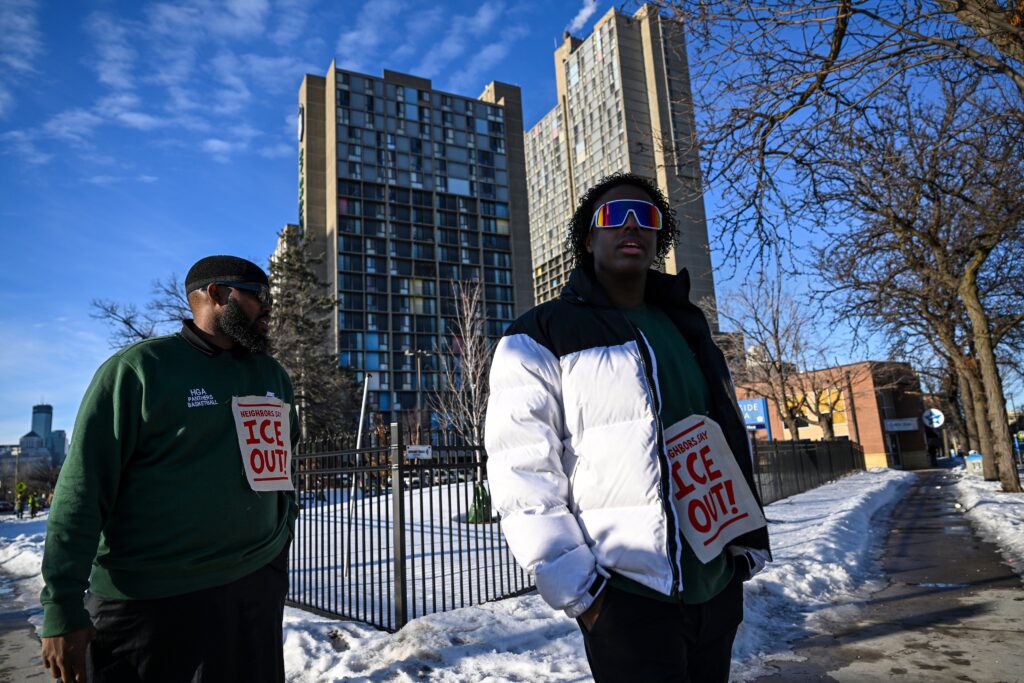
MINNEAPOLIS — While patrolling for Immigration and Customs Enforcement with other volunteers, two days after an officer from the federal agency fatally shot a woman in her car in this city, Sagal Ali repeated a mantra: “We will not obstruct their path. We are not escalating.”
A text chat alerted her group while driving on Friday that ICE was near Soma Grill and Deli. They drove over to find officers circling the restaurant, masked, in an unmarked SUV. Blowing whistles from open car windows to notify the neighborhood, the group made eye contact with the officers in their vehicle, then tailed them until they left.
As the Trump administration deploys thousands of federal immigration officers and agents around the nation, a loose-knit but increasingly organized network of activists is tracking their whereabouts and documenting arrests.
The fatal shooting of Renée Good last week, as ICE officers and residents faced off on a residential street here, has brought new attention to these activities. Good’s wife has said the couple came out with whistles that morning to support their neighbors; video shows both women exchanging words with ICE officers before Renée Good starts to move her car and one officer fires.
Federal court rulings say citizens can observe and record police activity in public areas as part of their First Amendment rights, and many of the observers are doing nothing more than that. They say that they believe authorities are less likely to use force if someone is recording and that they are providing a public service by letting their communities know when federal immigration officers are nearby.
But as officers and agents employ aggressive tactics, some activists have blown whistles to warn community members of approaching law enforcement, tried to follow immigration enforcement vehicles or used their own cars to block the roadways — entering murkier legal territory. Some legal experts said such behavior could in theory justify obstruction-of-justice charges, but they added that any such prosecution would be unusual.
“Could a prosecutor make a credible case that a person is interfering if they’re blocking an agent’s car or slowing them down? Yes, but whether that’s a crime that deserves seven to eight years in prison is a different conversation,” said Paul Butler, a former federal prosecutor who teaches at Georgetown University Law Center.
“You’re not going to find absolute rules on these issues. If the whistling is just annoying, that’s legal. If law enforcement can make a claim that it’s impeding enforcement, they can make a case,” he said. “But because it’s a form of protest — protected speech — courts give latitude to that.”
The Department of Homeland Security did not respond to repeated requests for comment, but officials there and throughout the administration have vowed to prosecute anyone who interferes with an operation or endangers an officer. Agency spokeswoman Tricia McLaughlin has said Good was “stalking” ICE officers before she was killed, and McLaughlin has told reporters that recording and posting images of officers online amounts to “doxing” at a time when they face a growing number of threats.
In Charlotte, where citizen activism has surged since an immigration crackdown began in November, at least three people protesting or monitoring officers have been charged with impeding law enforcement operations. A high-profile Chicago case, in which a woman was shot by an officer and then charged with drivingher car into a government vehicle, fell apart in court.
Good appears to be the first person killed by immigration officers while monitoring or protesting their presence since President Donald Trump’s mass deportation campaign began, although others have been tear-gassed or injured. Administration officials say the officer who shot her was acting in self-defense. But many law enforcement experts have questioned the officer’s decision to position himself in front of Good’s running vehicle and open fire.
Ali, who was trained as a legal observer last month, said that as a Somali American who wears a headscarf, she had concerns about her rights and safety even before the shooting of Good, a White woman. Now, she said, she believes “no one is safe.”
She and her group said that they will continue observing ICE officers and that they have been recruiting more volunteers since the shooting. One volunteer — a Minnesota Army National Guard veteran who spoke on the condition that he be identified only by his first name for safety reasons — said he saw patrolling as another way of serving his country.
“It’s the most American thing to do: not to be scared of people trying to scare you,” Fahad, 26, said as he walked Cedar Avenue on foot Friday. “This is a pivotal moment that we’ll be asked about by our kids, ‘Where were you?’ I don’t want to be in my house.”
Exercising their rights
Some who have documented federal immigration enforcement activity across the country are first-time activists who joined the action without clear objectives, moved to act with a smartphone and a car.
Others among the self-dubbed “verifiers” or “rapid response” have gone through hours of training by advocacy groups on how to interact with law enforcement and confirm sightings of federal immigration agents reported through phone hotlines. Verifiers are often dispatched to spot arrests, record interactions and, where possible, get contact information for family members of those arrested.
At a November training inside a church in Charlotte, a pastor laid out guidelines to hundreds of people crammed into the pews. Stand a few feet back, he told them. Carry whistles. If an agent tells you to move back, comply.
“There’s obviously risk involved in any organizing, and obviously thousands of people in Charlotte are willing to take that risk,” said Andreina Malki, an organizer with Siembra NC.
Stefanía Arteaga, executive director of the Carolina Migrant Network, said an incident like Good’s killing could have just as easily occurred in Charlotte, where the Trump administration says its crackdown has resulted in hundreds of arrests of undocumented immigrants. During the president’s first term, she said, agents would typically ignore citizen monitors or walk away. In the past year, in contrast, her organization often hears of agents reprimanding bystanders for following and filming, she said.
Social media is replete with videos of agents threatening to arrest monitors.
But David J. Bier, director of immigration studies at the Cato Institute, says those threats have rarely become prosecutions. He is tracking such incidentsand said he knows of fewer than a dozen cases in which people were charged with following or recording immigration officers or warning others of their presence. Most of those cases seem unlikely to go to trial, he added.
“Nothing in the law has changed,” Bier said. “They’ve just invented this concept that you’re not allowed to record them.”
To prove a charge of impeding federal officers, prosecutors generally must show the offender intended to cause some kind of harm or injury, said Tobin Raju, an attorney with Yale Law School’s media freedom clinic. “As long as there’s no real interference with the law enforcement operation, the right to record and document police activity is protected by the First Amendment,” he said.
David Loy, legal director of the nonprofit First Amendment Coalition, said that members of the public have the right to blow whistles or follow ICE vehicles at a sufficient distance and alert members of their community, but that protesters cannot physically stop an officer from doing his or her job.
“It doesn’t create a right to commit traffic violations or physically attempt to block a law enforcement vehicle,” he said. “But there is a right to follow and document what they’re doing.”
Tracking immigration officers
The day after one of Siembra’s packed trainings in Charlotte, the group’s staff members worked their laptops inside a local church, seeking updates from volunteers on the encrypted messaging app Signal.
Border Patrol agents had arrived at a gas station in south Charlotte, one message came in saying. They had a man in handcuffs. Then came video of officers marching the man to a car as a volunteer shouted: “Cómo te llamas? Teléfono?” What is your name? And phone number?
“I can’t watch this right now,” Tapia Torres said, closing the tab on her iPad. She asked another volunteer to send backup to the gas station.
Within minutes, footage of the arrest was posted on Siembra’s social media pages, reshared by more than 250 people on Facebook. Among those who viewed it was the man’s wife, who found out via the footage that her husband had been detained.
Other monitoring efforts have ended differently. On Nov. 18, also in Charlotte, 29-year-old Josh Long tailed a black SUV, trying to see whether it was carrying Border Patrol agents, when he realized a similar vehicle was following him.
“They’re right on my butt,” Long, a U.S. citizen, told 911 in a panic, calling from behind the wheel of his Subaru. “They keep trying to block my path.”
He heard sirens and stopped in a parking lot, he later recounted in an interview. Border Patrol agents in green uniforms exited the Jeep that had been following him. They pointed their guns at him through his car window, he said, opened the door and pulled him out. Video shows them tackling Long to the ground and putting him in handcuffs.
He was cited for impeding a federal investigation, a misdemeanor charge that carries up to one year in prison, a fine of up to $100,000, or both, and he is scheduled to appear in federal court in May.
Parts of the encounter were recorded by Miriam Guzzardi, 24, another ICE watcher who ended up in the same parking lot while following a different black SUV.
“He’s a citizen!” she shouted in reference to Long as she and her housemate ran over and filmed.
The next day, Guzzardi and her housemate again drew the attention of Border Patrol agents by honking their car horn while the agents faced off with protesters. Two agents walked over.
“We don’t have to play games. I understand what you’re doing and that’s fine,” one of them said, as Guzzardi recorded him. “But you understand what the honking is for. It’s to alert people. You understand that when people try to interfere or cut us off or whatever, that’s impeding.”
It would be the same, the agent said, “if someone is honking and screaming, ‘La Migra! La Migra! ICE! Border Patrol!’”
After the agent walked away, Guzzardi continued patrolling. Letting people know about arrests and enforcement efforts, she said, was the point.
“It’s to be there — to have a presence where they are,” Guzzardi said.
In Minneapolis, scores of ICE monitoring groups have formed, some with more than 1,000 members, volunteers said. They communicate in encrypted apps, using pseudonyms like Egg Salad or Prince, speak in code, and carry and distribute whistles. They assume authorities may monitor their license plates; if they have more than one car, they may keep the other one “clean” — not using it for ICE monitoring but instead to provide food and other aid to immigrants affected by the crackdown.
On Friday, members of the month-old Cedar Riverside Protection Alliance patrolled near a mosque on foot. Drivers stopped to alert them to nearby ICE sightings.
A mother of four said she confronted ICE that morning with her orange whistle as officers stopped two young men she recognized as U.S. citizens outside an apartment building. Halima Elmi said she confronted the officers, who checked her passport. “I’m a citizen of the United States,” she told them, “Leave them alone.” Instead, they detained the young men.
“How can I be scared when they’re coming for the kids? I’m a mother,” Elmi, 47, said through her car window.
Good’s shooting hurt her “like a family member died,” she added. Afterward, she contacted a group to get trained as an ICE legal observer.
Yeng Her, organizing director for the nonprofit Immigrant Defense Network, said the Twin Cities-based group has trained 2,000 observers so far, including 354 people the day after Good was killed.
“They are trained to just be there to observe, take notes and record, not to obstruct,” Her said. “That way, we have evidence.”
He said he was grateful citizens recorded Good’s shooting on their cellphones, capturing video that has become a central element in the heated national debate over what happened.
“We tell people: You have a right to record. If ICE tells you not to, just back up — but keep recording,” Her said. “And say you’re exercising your rights.”
Armus and O’Connor reported from Charlotte. Klemko reported from Washington. Marianne LeVine in Washington contributed to this report.
The post They say they’re monitoring ICE arrests. Feds say they’re breaking the law. appeared first on Washington Post.