As competing narratives and interpretations of viral videos muddy the investigations of the fatal shooting of Renee Nicole Good by an Immigration and Customs Enforcement officer in Minneapolis last week, there’s at least one thing that can’t be denied: the Department of Homeland Security’s operations in American cities are a sharp departure from how its agencies operated anytime before the second Trump administration.
ICE, specifically, is operating in a completely different way to how it has historically worked — with big shows of force in neighborhoods, seemingly indiscriminate arrests of immigrants (and citizens), and its careless treatment of bystanders and protesters.
But how did this shift develop? And what specifically changed in the way ICE operates domestically? I put these questions to David Hausman, a UC Berkeley law professor and the faculty director of the Deportation Data Project, a database of individual-level immigration enforcement cases. He assured me that none of what we’re seeing in Minneapolis is normal — and that these kinds of operations are about more than just immigration.
Our conversation has been edited for length and clarity.
How does domestic immigration enforcement now compare to how it used to work before Trump?
Before this current administration and going back to at least the first Obama administration, ICE was really an agency that didn’t conduct many arrests. The vast majority of arrests that ICE used to conduct were really transfers of custody from a state or local authority to the federal government. And as a result, ICE arrests out in the community were very, very rare. I think it’s fair to say that ICE didn’t have that much arrest capacity, and that’s part of the reason that, now that it’s under so much pressure to create arrests, it’s going about it so indiscriminately.
How did it evolve in the Trump administration?
I think the difference between the first and second Trump administrations in ICE arrests is the sense that this administration is just not acting subject to constraints. An additional difference is that Congress recently allocated a huge amount of money for building additional detention centers, which gives ICE more capacity to imprison people after arrests now. And then one last difference is that arrests at the border are very low now, whereas they were relatively high, especially towards the end of the first Trump administration. And that also means there’s more detention capacity for people who’ve been arrested inside the United States.
I think the easiest way to see the lack of constraint is the obvious one: We just see ICE and CBP randomly arresting people, often openly, or almost openly, on the basis of race. The scale of that phenomenon is new with this administration.
It’s to fulfill the Trump administration’s mass deportation promises, right?
That’s right. ICE is under tremendous pressure from the administration to increase arrest numbers. And there just aren’t enough people who are non-citizens in jails and prisons for them to meet those numbers, which is related to the more general point that there just aren’t that many non-citizens who’ve been convicted of crimes. And that’s why, under the new administration, such a small proportion of people they’re arresting have any criminal convictions.
What effect does that have on neighborhoods, on people’s perceptions of ICE and their communities? What is this doing to our understanding of public spaces if ICE is suddenly monitoring those spaces?
Anecdotally, we’re hearing about people being afraid to go out, afraid to do normal things. There’s research from the Obama era actually showing that the intensity of immigration enforcement back then had all sorts of bad effects in communities, including unemployment and health outcomes. So there’s every reason to think that those effects would be even larger now.
It’s important to recognize that a lot of what’s happening is not about immigration. We can see that most directly in the many arrests of citizens or people with lawful immigration status in these raids. But having masked men roving the street, seemingly randomly arresting people, obviously has implications well beyond immigration.
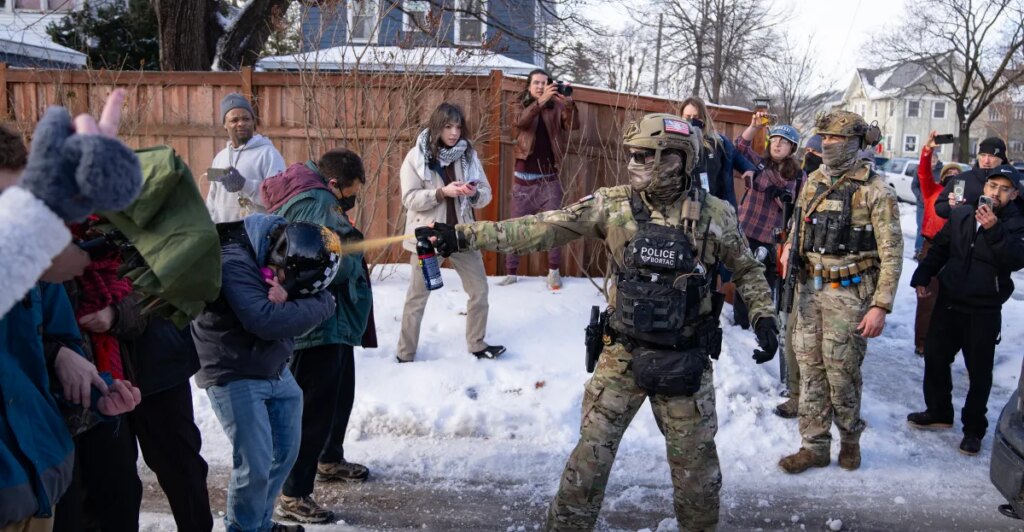
Some of these viral videos that we’ve been seeing over the last few months depict not just protesters, but bystanders or observers being treated much more harshly. In many cases, these are citizens who are being manhandled and pepper-sprayed — all of these ways that ICE agents have moved beyond immigration enforcement to use of violence against citizens.
What I’d say is that there’s a way in which interior or domestic ICE enforcement hasn’t been that much about immigration before Trump either.
And what I mean by that is that because almost all arrests were in jails or prisons, interior immigration enforcement was really much more about assigning an additional penalty for criminal convictions for non-citizens than about controlling immigration. And these new arrests in their randomness just reach much farther into communities.
I think that the decrease in enforcement at the border as a result of fewer border crossings, which is a trend that started under the previous administration, is part of what has made this domestic campaign possible.
Border arrests going down and interior arrests going up are both evidence of more enforcement because fewer border arrests are evidence of fewer border crossings, and more ICE arrests in the United States are evidence of more ICE activity.
The post The violent “randomness” of ICE’s deportation campaign appeared first on Vox.