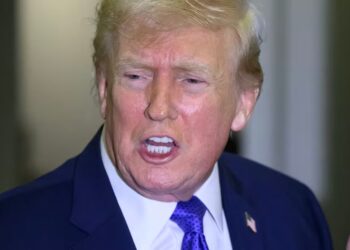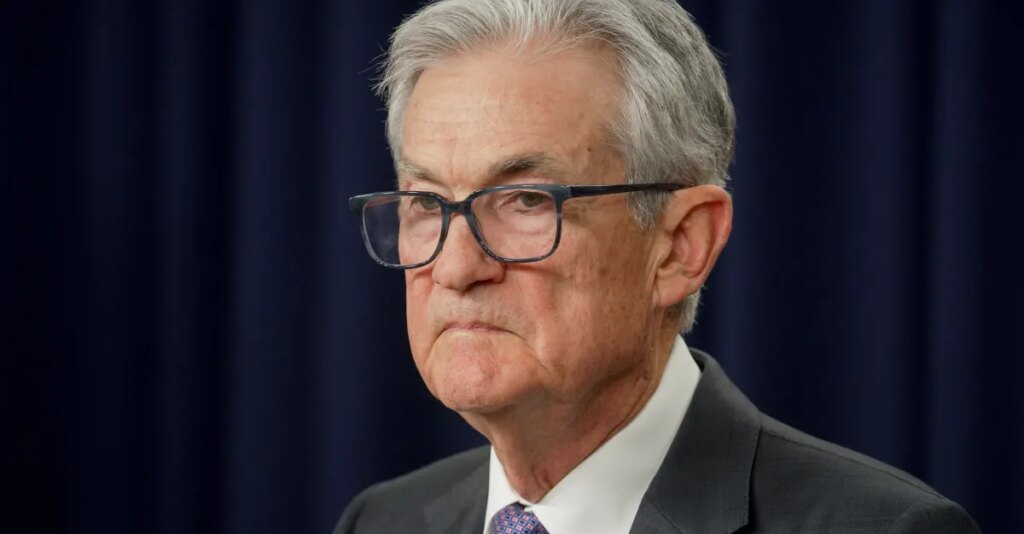
On Sunday evening, Federal Reserve Chair Jerome Powell revealed that the Trump administration has opened a criminal investigation into him, nominally because of a dispute over a renovation of the Fed’s headquarters. The real reason for the investigation is almost certainly that President Donald Trump wants to push Powell out of office and make room for someone more aligned with Trump’s agenda.
Trump initially appointed Powell to lead the Fed in 2018, but the president later soured on Powell, because Trump wants the Fed to lower interest rates more quickly than it has.
By law, the Federal Reserve is insulated from presidential control, and members of the Fed’s Board of Governors may only be removed by the president “for cause.” This is because the Fed has the power to temporarily stimulate the economy, potentially boosting a president’s approval rating during an election year, but at the cost of much greater economic turmoil down the road.
In advance of the 1972 election, for example, President Richard Nixon successfully pressured Fed Chair Arthur Burns to lower interest rates in order to juice up the economy. It worked, at least in the short term, and Nixon won that election in an historic landslide. But Burns’s decision to play along with Nixon is often blamed for the years of “stagflation,” slow economic growth and high inflation, which followed.
As University of Michigan economist Justin Wolfers told the BBC Sunday night, pressuring a central bank to lower interest rates without justification is “a thing that tin pot dictators do right before starting a hyperinflation and destroying their own economies.” Wolfers listed several other countries where political leaders applied similar pressure to central bank leaders, including Venezuela, Russia, and Zimbabwe.
And, for what it is worth, the Supreme Court has signalled pretty clearly that it does not want a repeat of 1972. While the Court’s Republican majority normally believes that Trump should be allowed to fire any leader of a federal agency for any reason, they wrote last May that the Fed has a “distinct historical tradition” that should protect it from presidential control.
But, if the Court’s Republicans are troubled by Trump’s attacks on Jerome Powell, they have no one to blame but themselves. In Trump v. United States (2024), the infamous Trump immunity decision, the Republican justices did not merely conclude that Trump is allowed to use the powers of the presidency to commit crimes. They also said that Trump may order the Justice Department to target someone “for an improper purpose.”
Trump’s dubious investigation into Powell, in other words, was explicitly licensed by the Supreme Court of the United States. All six of the Court’s Republicans said outright that Trump may order the Justice Department to bring spurious investigations against his political enemies, and that nothing can be done to Trump as a result.
The legal theory that made Trump’s attacks on the Fed possible
Both the fight over the Federal Reserve’s independence and the fight over whether Trump is immune from the law flow from the same legal theory.
The “unitary executive” is the idea that the Constitution vests certain powers in the president that cannot be diminished by either Congress or the judiciary. Until Trump was indicted for his failed attempt to overturn former President Joe Biden’s victory in the 2020 election, Supreme Court cases invoking this theory typically focused on whether the president may fire a particular federal official.
Proponents of the unitary executive theory believe that leaders of federal agencies typically must be subordinate to the president, and thus, the president must have the power to fire them at will. This theory raises obvious problems for the federal law providing that the Fed’s leaders may only be removed for cause. Yet, while all six of the Supreme Court’s Republicans are enthusiastic supporters of a unitary executive, they indicated in Trump v. Wilcox (2025) that the Fed is special, and its leaders should not be subject to presidential pressure.
Admittedly, their explanation for why the Fed is special is only one sentence long — “The Federal Reserve is a uniquely structured, quasi-private entity that follows in the distinct historical tradition of the First and Second Banks of the United States” — and that sentence is gibberish. But Wilcox should prevent Trump from firing Powell for the simple reason that it is a decision of the Supreme Court. And Supreme Court decisions are binding even if their reasoning is about as coherent as a teenager yelling “six-seven.”
Rather than accept the Wilcox decision, however, Trump appears to have responded to it by bringing fake allegations against members of the Fed that he wants to remove. Next week, in fact, the Supreme Court plans to hear Trump v. Cook, a case about Trump’s attempt to fire Fed governor Lisa Cook after accusing her of committing mortgage fraud. According to Reuters, Cook’s mortgage documents appear to debunk Trump’s allegations against her.
The criminal investigation into Powell seems to be a similar effort to gin up dubious charges against a Federal Reserve leader, which then can be used to justify removing Powell “for cause.”
This wouldn’t be happening without SCOTUS
Trump can bring these shady investigations against his perceived political enemies because the Republican justices explicitly gave him the power to do so in its Trump immunity decision. Recall that the unitary executive theory holds that the president has certain powers that cannot be touched by Congress or the courts. According to Chief Justice John Roberts’s majority opinion in Trump, “investigation and prosecution of crimes is a quintessentially executive function.” And thus, the president has full control over everything done by a federal prosecutor.
But that’s not all. In Trump, the Republican justices went so far as to conclude that the president may even use this power to bring investigations that are “shams.” When the president orders the Justice Department to act, Roberts wrote, even if he does so “for an improper purpose” that purpose does “not divest the President of exclusive authority over the investigative and prosecutorial functions of the Justice Department and its officials.” According to the Republican justices, Trump must have full control over the Justice Department even when he uses it as a weapon to settle political scores.
For this reason, the Republican justices held that Trump is “absolutely immune from prosecution” for conduct “involving his discussions with Justice Department officials.“
Six months before Trump returned to power, in other words, the Court’s Republican majority did not simply hold that Trump may use the powers of the presidency to commit crimes; they also explicitly authorized Trump to bring sham investigations, and potentially even sham prosecutions, against anyone he wants — even if he does so “for an improper purpose.”
So, Roberts and his fellow Republican justices should not be the least bit surprised that Trump has now turned this power against Powell. They told Trump he can do this. The Powell investigation is entirely the Republican justices’ fault.
The only good thing that can be said about Trump, and the political prosecutions that it explicitly permits, is that the Court has the power to overrule it. Next week, in fact, the Court will hear Trump v. Cook, a case about Trump’s sham allegations against another member of the Fed’s board. If the justices want to end these political investigations and prosecutions, it should use the Cook case as a vehicle to overrule its Trump immunity decision.
And if the Court’s Republicans refuse to do so, they shouldn’t be surprised if they are the next people that Trump decides to target, using his Supreme Court-given power to prosecute his political foes — both real and imaginary.
The post The Supreme Court made Trump’s attack on Jerome Powell possible appeared first on Vox.