For months, President Trump has been trying to pressure the Federal Reserve, the U.S. central bank, into cutting interest rates. Yesterday, my colleagues revealed that he has made his most aggressive move yet: Prosecutors have opened a criminal investigation against the chairman of the Fed.
Insulating central banks from politicians has long been considered sound economic policy. That conventional wisdom has been challenged since the financial crisis. But one thing is clear: If Trump succeeds in gaining control over the Fed, it won’t just affect Americans.
Futzing with the Fed
Trump has called the Federal Reserve chair Jerome Powell a “clown,” a “dummy,” a “major loser” and a “bad head of the Fed.” He has gone after him on social media, saying Powell and his colleagues “should be ashamed.” He sent him a handwritten note accusing him of costing the United States “a fortune” and demanding that he cut interest rates “by a lot.”
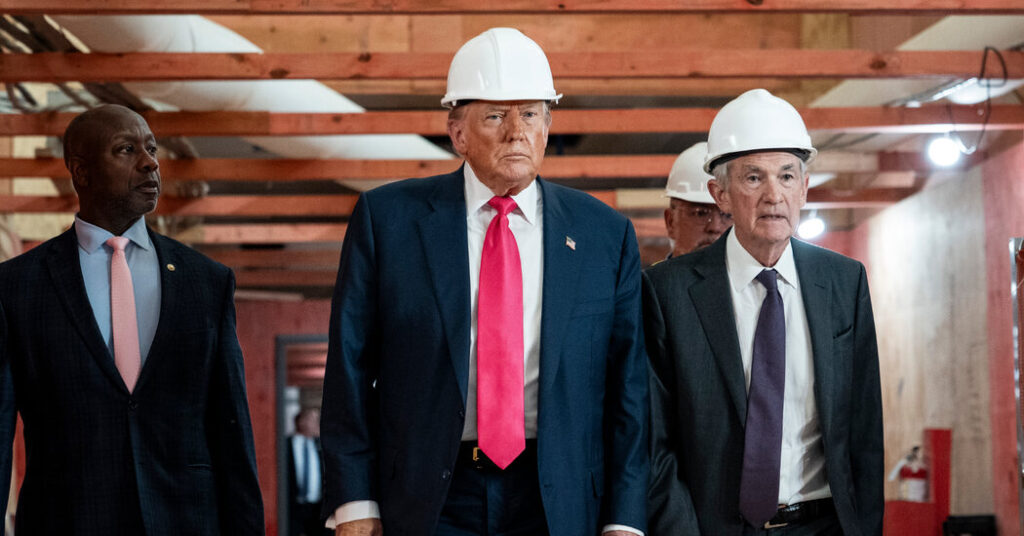
This week, we learned that Trump’s campaign against Powell has escalated further: Federal prosecutors have begun investigating Powell for his role in overseeing the renovation work being done on the Fed’s headquarters. The criminal investigation is being overseen by a longtime Trump ally.
Trump told NBC News that the investigation didn’t have anything to do with interest rates. Powell sees it differently. The investigation, he said in a rare video statement (below), is about whether “monetary policy will be directed by political pressure or intimidation.”
At the heart of the dispute is the question of whether the Fed, which sets interest rates, should be governed by technocrats whose main objective is to maximize employment and keep inflation under control; or whether it should, as Trump has argued, be controlled by politicians with a mix of objectives — among them winning elections.
Who wins that fight matters not just for Americans but for everyone else, too. As my colleague Eshe Nelson wrote last year, the Fed is “the most important and influential central bank in the world.”
Top dollar
The U.S. dollar has a special role in the global economy. So when the Fed changes interest rates, the ripple effects are felt far beyond U.S. borders.
Some countries like Panama and El Salvador have replaced their own currency with the dollar. Others, like Saudi Arabia, have pegged the value of their currencies to it. And most global commodities, like oil and gold, are denominated in dollars. So are U.S. stocks and Treasuries, which feature prominently in the portfolios of governments and private investors.
What makes this all possible? Stability. Investors and governments trust that the value of the dollar won’t be too volatile, rising or falling solely on the whims of politicians seeking to win over voters at election time.
But the Fed’s importance goes beyond that.
I spoke to Leah Downey, a lecturer at King’s College London and author of “Our Money,” a book about monetary policy, who explained that the Fed had effectively become “the lender of last resort to the world.” During times of turmoil, like the subprime mortgage crisis and the Covid-19 pandemic, the Fed stepped in to supply dollars to other central banks to make sure that global markets don’t break down.
Losing faith
That’s why markets have reacted badly every time Trump has threatened the Fed’s independence — not just in the United States but worldwide. Stocks, the dollar and U.S. government bonds wobbled on the morning after news broke of Powell’s criminal investigation. The price of gold, a haven when investors are anxious, set a fresh record.
The Fed also sets the standard for how central banks operate around the globe. A Federal Reserve controlled by the White House could undermine the idea of central bank independence elsewhere, too.
The concept of central bank independence has been sacrosanct for decades. The idea is that politicians can’t always be trusted with monetary policy, because the temptation of lowering interest rates right before an election is too great. That can cause long-term damage by increasing inflation down the road.
There are many instances when central banks have become subject to political meddling and the outcome wasn’t good, Eshe told me. Turkey is perhaps the clearest recent example. President Recep Tayyip Erdogan pressured the central bank for years to cut interest rates, even as the country’s currency plummeted; inflation now sits at a punishing 30 percent.
Recently, however, some academics, Downey included, have begun to wonder whether the structure of the Federal Reserve — and its connections to private financial institutions — make it overly focused on very low inflation at the expense of things that might be a higher priority for many Americans.
Even a softer version of bringing politics into monetary policy — say, a system of periodic reviews of the central bank, or adding to its objectives — may not be welcomed by the rest of the world because of the volatility it might introduce. It could threaten the special status of the dollar, which might create its own consequences: The U.S. may not be able to borrow and spend as freely. But some economists argue that the potential benefits might be worth it.
Trump has, in a way, touched on an important discussion. But not even the fiercest advocates for a more accountable central bank think it’s a good idea to threaten Powell with prison.
Trump Administration: Live Updates
Updated
- Minnesota and Illinois sue Trump administration over ICE deployments.
- Mark Kelly sues Pentagon over a move to punish him for a video warning about illegal orders.
- Here’s what to know about the criminal investigation of the Fed chair.
MORE TOP NEWS
Demolishing Gaza, building by building
More than two months ago, Israel and Hamas signed a cease-fire agreement that offered Palestinians in Gaza a hope of respite after a punishing two-year Israeli bombardment that left much of their enclave in ruins. Yet the destruction has continued.
Israel has demolished more than 2,500 buildings in Gaza since the cease-fire began, a New York Times analysis of satellite imagery has found. While most of these structures are in Israeli-controlled areas, dozens lie beyond the agreed-upon boundary for Israeli forces.
Israeli officials say the demolitions are part of efforts to “demilitarize” Gaza, destroying tunnels and booby-trapped homes. But Palestinians in Gaza argue that Israel has been flattening entire neighborhoods.
“This is absolute destruction,” said one former Israeli military commander who led forces in Gaza in the 1990s. “It’s not selective destruction. It’s everything.” Read more.
OTHER NEWS
-
Iran said it was prepared for war but also ready to negotiate, after Trump threatened military strikes.
-
Venezuela’s government released at least 24 more political prisoners, bringing the total to at least 41.
-
Britain began an investigation into the social media platform X, over its artificially generated sexual images of women and children.
-
The E.U. gave automakers a workaround for electric vehicles made in China, forgoing stiff tariffs if they limit imports and set minimum prices.
-
The Nigerian author Chimamanda Ngozi Adichie accused a Lagos hospital of negligence in the death of her 21-month-old son.
-
A Swiss court ordered an owner of a bar that caught fire on New Year’s Day to be placed in pretrial detention for at least three months.
SPORTS
Football: Xabi Alonso was sacked as head coach of Real Madrid, replaced by the club’s reserve team coach, Alvaro Arbeloa.
Basketball: The French phenom Victor Wembanyama can jump-kick a basketball out of the net.
MORNING READ
A growing number of U.S. citizens are joining the military in an attempt to protect their immigrant families from deportation.
A little-known government program called Parole in Place protects undocumented parents and spouses of service members from deportation, and gives them a streamlined pathway to a green card. That benefit has become a powerful incentive and recruiting tool amid ongoing immigration raids.
My colleague Greg Jaffe spent over a week shadowing Sgt. First Class Rosa Cortez, a top recruiter for the Oregon National Guard, who is herself the daughter of Mexican immigrants. “Emotions are everywhere for me,” she said of her work. Read more.
EAVESDROPPING PETS OF THE DAY
Dogs
— New research shows that dogs have advanced word-learning skills: They can learn the names of new toys by listening in on the conversations of their owners. Some dogs, especially Border collies, have memorized the names of hundreds of toys.
AROUND THE WORLD
The Man v Fat football league
At an adult football league in suburban Dallas, enrollment starts with a weigh-in. “Sorry, you’re not fat enough,” one coach told some newcomers.
The league was founded in Britain in 2014 as an answer to weight-loss programs that primarily attracted women. It has expanded to the U.S., with more than a dozen leagues in New York, Florida and Texas. Games are reserved for hefty players lured by competitive football and heavy doses of self-deprecating humor.
With its cheeky team names (Fat Man United, Totten-Ham and Cheese) and playful ethos, Man v Fat might be dismissed as a gag. But participants say they are serious about getting in shape. “You have no idea how much faster we are now,” one player said. Read more.
RECOMMENDATIONS
Boost: Try seven expert-backed tips to improve your gut health.
Listen: Virginia Evans discusses the success of her debut novel, “The Correspondent,” which became one of last year’s sleeper hits.
Watch: Check out these five new international movies that are streaming now.
RECIPE
Kelewele is a popular Ghanaian dish of ripe plantains, marinated in a blend of ginger, garlic, selim seeds and cayenne, and then fried and served as a side dish or a snack. This version is made in the oven, and the result is a parade of flavors and textures.
WHERE IS THIS?
Where are these ski slopes?
TIME TO PLAY
Here are today’s Spelling Bee, Mini Crossword, Wordle and Sudoku. Find all our games here.
You’re done for today. See you tomorrow! — Katrin
We welcome your feedback. Send us your suggestions at [email protected].
Katrin Bennhold is the host of The World, the flagship global newsletter of The New York Times.
The post The Global Cost of Futzing With the Fed appeared first on New York Times.