Across six years and three seasons, the Israeli series “Tehran” has played a game of tag with real events in the Middle East. The Israeli disabling of Iranian air defenses; the assassination of the leader of the Revolutionary Guards; the use of booby-trapped cellphones as killing machines; the targeting of Iranian nuclear facilities — all have been plot points in “Tehran.” It can be hard to recall where you saw it first, in the news or in the spy thriller.
Last year, Apple TV decided the show was a little too real. The third season, which focuses on Iran’s nuclear program and had been shown on Israeli TV in December 2024, was set for streaming in July but was pulled from the schedule. As it happened, the Israeli and American attacks on Iran in June had included the bombing of a facility central to the season’s story.
Apparently six months was considered a suitable cooling-off period, because Season 3 of “Tehran” made its streaming premiere Friday on Apple TV; the eight episodes will appear weekly through Feb. 27.
It arrives in America just as the Iranian government’s violent response to anti-regime protests has put Tehran back in the news. (There is no word yet on the fate of the domestic-terrorism drama “The Savant,” which Apple yanked in September after the shooting of Charlie Kirk.)
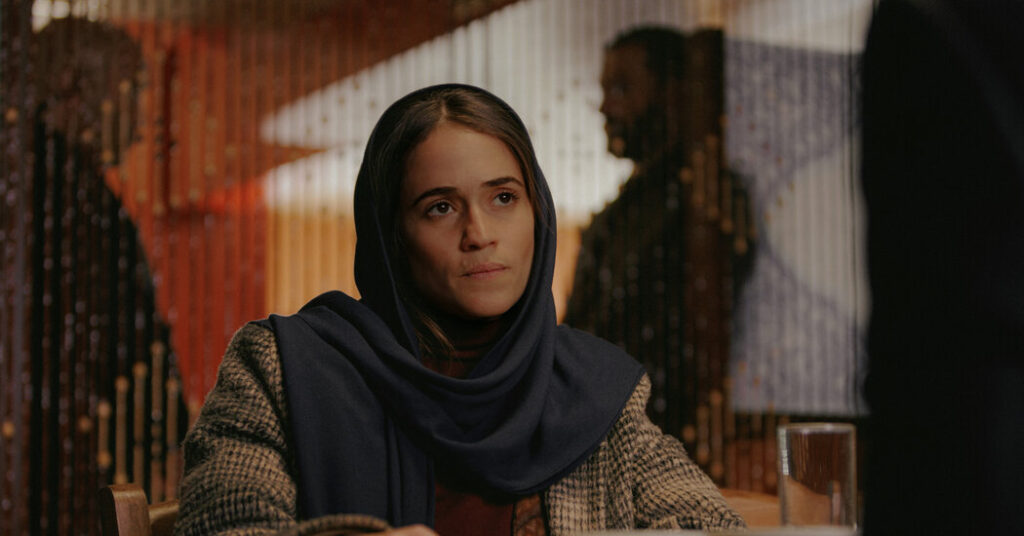
The heroine of “Tehran” is an Israeli woman, Tamar, who was born in Tehran. She is now embedded there as a Mossad agent, another aspect of the show that resonates with the June attacks. But the new season confirms the truth that the show is not of interest because of any documentary qualities.
Instead, “Tehran” is entertaining because of its pulp-fiction essence — it is a harebrained, perpetual-motion action fantasy, with Tamar running around Tehran from one crisis to another like a lethal Energizer bunny. In the real world, embedded spies spend years doing nothing so that eventually they can do one thing. In “Tehran,” Tamar barely slows down long enough to change clothes, and she no longer has a cover job or an address.
That the constant fights and shootouts and chases are as credible as they are is to the credit of Daniel Syrkin, who has directed all 24 of the show’s episodes. His choreography of the action, along with the overall restraint he elicits from the cast, keeps us attentive despite the extremities of the plotting and the occasional woodenness of the writing, at least in translation. The show is beginning to have an echo-chamber quality — we’ve been watching the same people in crisis in the same place for a while now — but it can still suck you in.
“Tehran” also benefits from the appeal of its central performers. Niv Sultan, who plays Tamar, and Shaun Toub, who plays Faraz, the Iranian agent who is her nemesis and sometimes her reluctant ally, both have a quiet expressiveness; Tamar is more soulful and Faraz more complicated than characters in this kind of show need to be. Their exploitations and betrayals of each other are as poignant as ever in the new season.
This time around, Sultan and Toub are joined by Hugh Laurie, as a South African nuclear inspector, and Sasson Gabai, as another embedded Mossad agent who has to endanger himself to help Tamar. The motives of the inspector are at the heart of the season’s mystery, and Laurie’s performance is off-key until those motives start to make sense a few episodes in, after which he’s fine. Gabai, a veteran Israeli actor (“The Band’s Visit”), is stuck playing a sentimental cliché — the tough, taciturn old guy who gradually warms to the headstrong young woman — but he avoids making him either too stony or too maudlin.
Each season of “Tehran” ends with Tamar on the run, not just figuratively but physically — the last thing we see is her disappearing into the distance. (Spoiler alert: This is true again in Season 3, something that could be guessed given that Season 4 is in production.) It’s a neat little joke (perhaps borrowed from “The Fugitive”) on the existential insecurity of the undercover agent, but it also hints at a peculiarity that informs the show’s tone: Tamar is frequently, almost habitually unsuccessful.
She will succeed in the end — it’s an Israeli series, after all — but in the meantime she will fail to hack a computer system, fail to kill an assassination target, fail to get a tracker onto the right car. She will get family members and loved ones executed or arrested, a trend that continues in the new season. Any sympathetic Iranians who help her in her missions need to start tidying up their affairs.
Tamar’s missteps and compromises give her a sympathetic vulnerability; they give the show an atmosphere of ambivalence and a constant sense of grinding, Sisyphean effort. The Israelis in the field are weary of their jobs and resentful of their Mossad handlers, who give the orders to kill from a bunker in Israel.
Tamar’s humanity — seen as a threat by Mossad, reflective of her “Iranian side” — leavens her brutality, encouraging the perhaps wishful notion that the two can be combined. That ambiguity is at the heart of “Tehran,” in which rooting for Tamar is not, at least in some very small degree, the same thing as rooting for Israel.
Mike Hale is a television critic for The Times. He also writes about online video, film and media.
The post ‘Tehran’ Review: Israel vs. Iran, Retold as a Spy Thriller appeared first on New York Times.