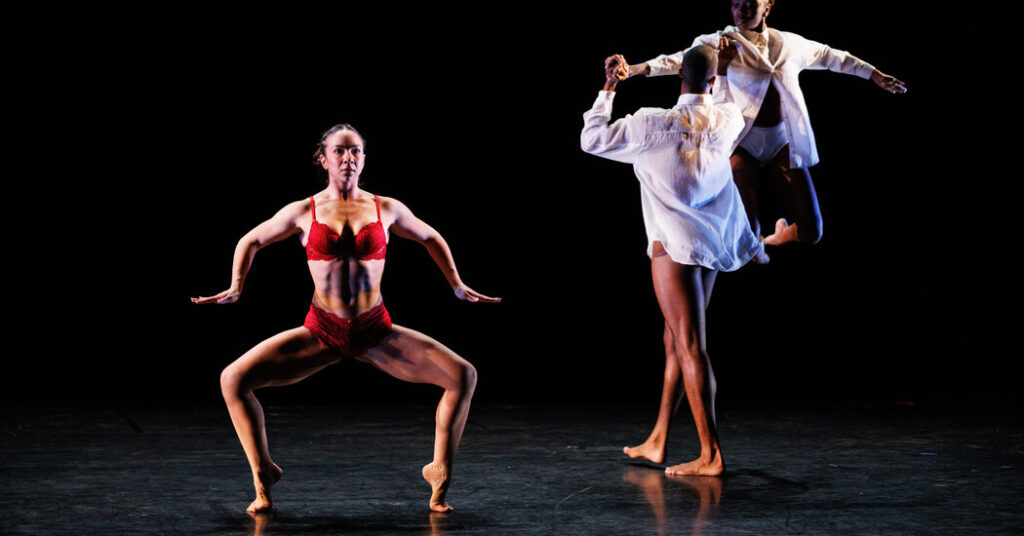
A defining event in the history of the Bill T. Jones/Arnie Zane Company is the death of Zane, of AIDS-related lymphoma, in 1988. Just two months before, Jones and Zane had debuted a work called “The History of Collage,” the final collaboration of these onstage and offstage partners.
Despite that distinction, it’s not a work that has figured much in the history of the company since then. It fell out of the repertory, and it isn’t one of the celebrated pieces, like “D-Man in the Waters” and “Still/Here,” that the group has revived in recent years. Now, though, it has been slightly revised in “Collage Revisited,” which the company performed for the first time at its home theater, New York Live Arts, on Saturday, as part of the Live Artery festival.
Like the original, “Collage Revisited” features a sound score by Charles R. Amirkhanian and Blue Gene Tyranny in which a narrator speaks of Freud’s dreams and lectures on the history of modern art, explaining how collage turns “nothing new” into the fresh sensations afforded by juxtaposition and the associative imagination.
The principal effect remains: Formal rumination, accompanying largely abstract choreography, is overwhelmed at the end of the sound score by recordings of the 1979 White Night riots, when gay citizens of San Francisco took to the streets to protest the lenient sentencing of the man who assassinated the openly gay politician Harvey Milk. The meaning of the whole work changes.
As in the original piece, the dancers in “Collage Revisited” choose their own costumes, changing them for what seems like every entrance. A transition from school uniforms to underwear and stilettos (or no underwear beneath up-flying skirts) reads as a liberation from conformity. To the sounds of the riots, the dancers run with windmilling arms and advance in a group from a corner, pushed back by invisible blows but then moving forward in defiance. They find community in lining up and tenderly embracing in relay motion.
The dancer Barrington Hinds, who wears a suit and tie throughout, even acquires a character. He’s a closeted type, who tosses around Rosa Allegra Wolff in a Twyla Tharp-style duet but also hooks up clandestinely with Jacoby Pruitt.
“Collage Revisited” demonstrates how emotionally and politically charged material can swamp formal play. Watching it, though, I thought of the absence not just of Zane but also of Janet Wong, Jones’s longtime associate artistic director, who resigned in August. The dancing on Saturday was a little sloppy, as it seldom was under her eye.
Where “Collage Revisited” shows how narrative can subvert a will to abstraction, the program’s other work, though called “Story/,” reveals a similar power in music. “Story/” (2013) derives from “Story/Time,” a 2012 piece in which Jones, inspired by the composer John Cage, recited a series of one-minute anecdotes while his company danced around him. The order of the tales was determined by chance, their relation to the dancing mostly serendipitous and left up to the viewer. The shorter “Story/” replaces that narration with Schubert’s String Quartet No. 14, in D minor (known as “Death and the Maiden” for its use of a musical theme taken from the song of that name), played live.
Performed on a grid taped on the floor, “Story/” is formally rigorous. The dancers repeat photograph-like poses and phrases of movement in slow motion and in reverse. But in place of distancing indeterminacy, Schubert’s music gives the dance a motor and a direction. It builds.
What’s more, the dancers respond to the music differently than they do to the monologues of “Story/Time” or the sound score of “Collage Revisited.” They dance better, with more freedom and elasticity, loosening up. They toss and catch green apples and do the same with their bodies. During the madness of the final section, a tarantella, they collapse in exhaustion, having earned applause.
The “Death and the Maiden” quartet is notable for being a wordless work that has a story buried in it, the one from Schubert’s mortality-haunted song. But its effect in “Story/” is liberating. This is not a dance of death. It’s a dance of joy.
Bill T. Jones/Arnie Zane Company
Through Jan. 12 at New York Live Arts; newyorklivearts.org.
The post Review: Bill T. Jones Goes Back to Collage appeared first on New York Times.