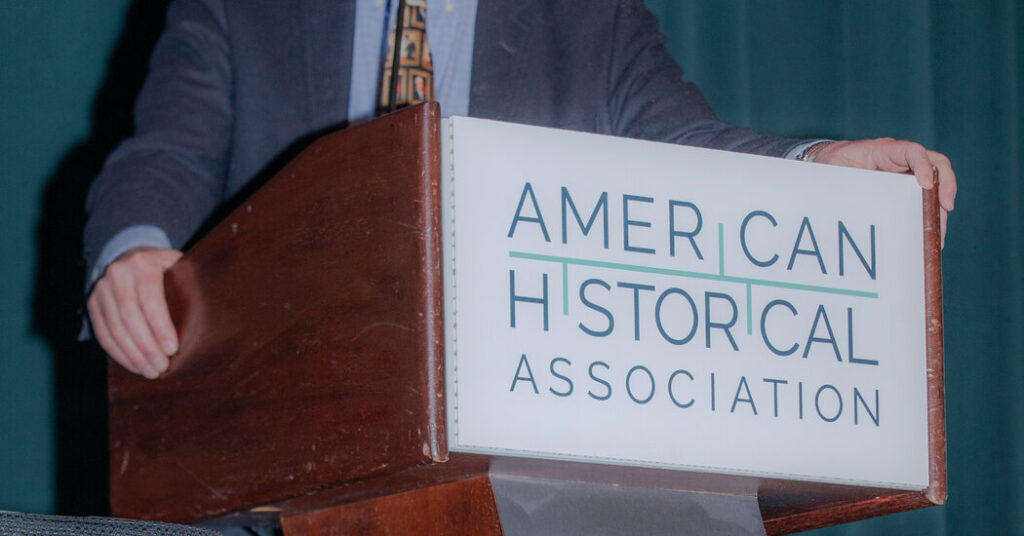
Leadership of the American Historical Association has vetoed two resolutions criticizing Israel’s actions in Gaza that were approved by a member vote over the weekend, saying they lay outside the group’s mission and would pose risks to the organization and the historical profession.
The first resolution criticized what it characterized as intentional “scholasticide” in Gaza, where most of the educational system, including all 12 universities, has been damaged or destroyed. The second condemned ongoing attacks on academic freedom at American universities, including the silencing of protest against “the U.S.-sponsored genocide perpetrated by Israel in Gaza.”
Both resolutions passed with nearly 80 percent support from the almost 500 members who attended the vote, held on Saturday during the group’s annual conference in Chicago. But on Sunday the 16 voting members of the executive council voted not to pass them on to the full membership of roughly 14,000 for final consideration.
“As worded the two resolutions fall outside the scope of the American Historical Association’s chartered mission,” the council said in a statement. “Approving them on behalf of the entire association would present institutional risk and have long-term implications for the discipline and the organization.”
The association, an independent nonprofit organization, is the largest group of professional historians in the country. It was chartered by Congress in 1889, with the mission of pursuing “the promotion of historical studies, the collection and preservation of historical manuscripts” and “kindred purposes in the interest of American history and of history in America.”
In recent years, the group has been a prominent critic of laws restricting teaching on race, gender and other controversial subjects. It has also strongly criticized President Trump’s efforts to promote what he calls “patriotic” history emphasizing a positive story of national greatness, including his continuing campaign against the Smithsonian.
But as with many universities and cultural organizations, the war in Gaza has opened up deep internal rifts. Those fissures have become only more complex as the Trump administration has cited pro-Palestinian activism and campus antisemitism as a central justification for its pressure campaign against higher education.
Last year, the council vetoed a similar “scholasticide” resolution after a member vote supporting it. In a statement at the time, the council said it “deplores any intentional destruction of Palestinian educational institutions, libraries, universities and archives in Gaza,” without taking a position on whether the damage had been intentional or who was responsible for it.
(The resolution’s charge of “scholasticide” rests on an April 2024 statement by United Nations experts, which said that the damage or destruction of 80 percent of Gaza’s schools, including all 12 of its universities, stemmed from “patterns of attacks” by Israel. The Israeli government has disputed that report, blaming destruction of Gaza’s schools on the “exploitation of civilian structures for terror purposes” by Hamas.)
In November, the council announced that it would not allow a revised version of the “scholasticide” resolution along with a new one on academic freedom, to be presented for a vote at all. This weekend’s vote came after the resolutions were reintroduced at the meeting itself, as allowed under procedural rules.
Supporters of the resolutions, which were sponsored by the group Historians for Peace and Diplomacy, were dismayed that the council vetoed a member-approved resolution for a second time.
Margaret Power, a retired professor at the Illinois Institute for Technology, said the executive council’s action reflected an “anti-Palestinian bias among leadership” and a lack of respect for members’ democratic wishes.
“If they had any hesitation of which way to go, they should have sent it to the full membership, so the entire membership could express its opinion,” she said. “That’s how a democratic organization operates.”
Proponents of the resolutions have also accused the organization of a double standard, noting that within days of the Russian invasion of Ukraine in 2022, the group’s leadership had issued a statement condemning it as “an unprovoked act of military aggression.”
Sarah Weicksel, the executive director of the historical association, said that the statement about Ukraine was broader, and focused on what it called the “distorted and tendentious misreading of history” that the Russian President Vladimir Putin invoked to justify it. The “scholasticide” resolution, by contrast, commits the group to unspecified actions to support the rebuilding of Gaza’s educational system.
As for the academic freedom resolution, Weicksel said the concern lay with the reference to “the U.S.-sponsored Israeli genocide in Gaza.”
The issue, she said, wasn’t the accuracy or inaccuracy of the genocide charge, which is a matter of intense debate among scholars, legal experts and human rights advocates, but that it is “a political statement.”
“The resolution includes phrasing that requires the A.H.A. to take a political stance, and that would be problematic in terms of mission and in terms of the fiduciary responsibility to the organization to ensure its continued nonprofit status,” she said.
Opponents of the resolutions have noted that many individual scholars have spoken out strongly against Israel’s actions in Gaza, including accusing it of genocide, and the group should defend their speech rights without itself endorsing any one point of view.
They have also argued that the resolutions would damage the group’s reputation at a moment when the profession is already facing attacks from the political right.
“History is under assault right now,” Natalia Mehlman Petrzela, a professor at the New School, said by phone Sunday after the vote. “Pushing the pre-eminent organization of historians to take an overtly political stance only serves to divide the organization and also to jeopardize its reputation as a place for nonpartisan historical inquiry.”
The tensions around the resolutions were present throughout the four-day conference, where nearly 3,000 scholars gathered for some 200 panels on both historical topics and current challenges to the profession, like the cratering academic job market.
The program included nearly a dozen sessions relating to Gaza and broader Palestinian history, where some panelists issued denunciations of the historical association, including charges that it was complicit in genocide.
Before the vote, the group’s outgoing president, Benjamin Vinson, a former president of Howard University, said the question before the council wasn’t whether the situation in Gaza “warrants moral concern.”
“It plainly does,” he said, noting that the association had begun forming a committee to advise on how to aid Palestinian historians. (Three invited members withdrew from the committee last month, after the council said it would not allow a vote on the resolutions.)
The issue, Vinson said, was whether the group should adopt “binding institutional positions on active geopolitical conflicts that would set enduring precedent,” particularly on matters where membership holds “deeply divergent views.”
The “scholasticide” measure was passed with 282 votes for, 76 against, and two abstentions. The academic freedom resolution passed 245 in favor, 62 against, with one abstention.
The academic freedom resolution was developed in coordination with members of the Modern Language Association, the country’s largest scholarly association in the humanities. Over the weekend, it was approved by that group’s delegate assembly, by a vote of 61 in favor, 52 against. That resolution will now pass to a vote by the group’s roughly 20,000 members, where it must receive a majority that also totals at least 10 percent of membership.
Jennifer Schuessler is a reporter for the Culture section of The Times who covers intellectual life and the world of ideas.
The post Leaders of Historians’ Group Veto Resolutions Critical of Israel appeared first on New York Times.