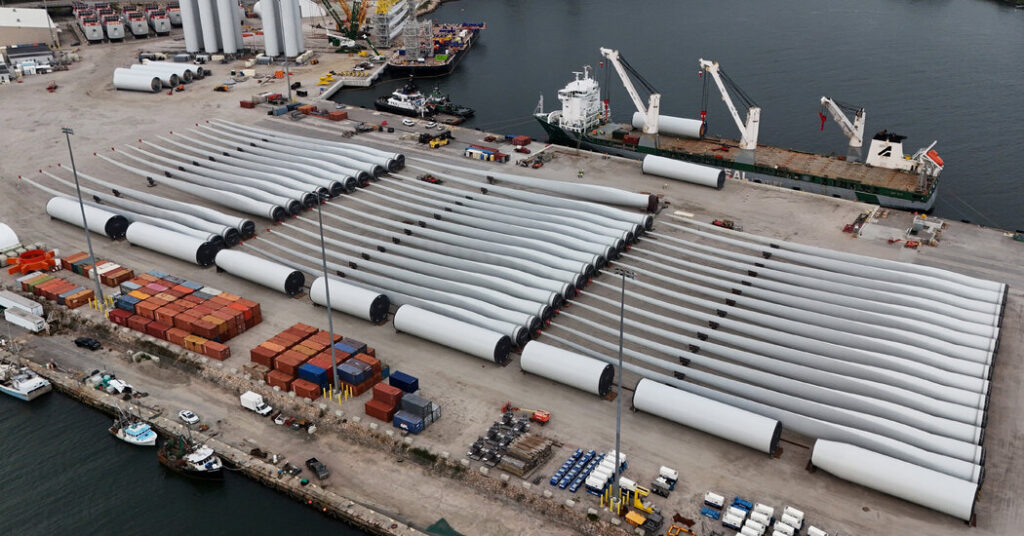
A federal judge on Monday ruled that construction could resume on a $6.2 billion wind farm off the coast of Rhode Island, striking down the Trump administration’s decision last month to halt work on the Revolution Wind project.
Judge Royce Lamberth of the U.S. District Court for the District of Columbia ruled that the Interior Department’s suspension order was “arbitrary and capricious” in violation of federal law.
Revolution Wind is one of five offshore wind projects under construction along the East Coast that were all ordered to stop work last month by the Trump administration, which cited unspecified national security concerns. Several states and developers of four of the projects have challenged the move in court; the case involving Revolution Wind was the first complaint to be heard.
The decision is a temporary victory for Revolution Wind and the offshore wind industry, which has been roiled by the Trump administration’s efforts to block offshore wind farms that had received permits under the Biden administration. Orsted, the Danish energy giant that is building Revolution Wind, can now continue building the wind farm as litigation it has filed against the Trump administration continues.
In his ruling, Judge Lamberth said the Interior Department’s Bureau of Ocean Energy Management did not adequately explain how the project posed security risks or why halting construction of Revolution Wind would address these concerns.
“Purportedly new classified information does not constitute a sufficient explanation for the bureau’s decision to entirely stop work on the Revolution Wind project,” Judge Lamberth, a Reagan appointee, said while ruling from the bench.
Representatives for the Interior Department and Orsted did not immediately respond to requests for comment.
Revolution Wind is roughly 87 percent complete, with 58 of 65 wind turbines installed. It was slated to be fully operational by the second half of 2026, delivering power more than 350,000 homes and businesses in Connecticut and Rhode Island by the end of this year.
This had been the second time the administration had tried to stop the project.
In August, the administration had initially ordered work to halt on Revolution Wind, citing unspecified national security concerns. But Connecticut, Rhode Island and Orsted had sued, and in September, Judge Lamberth had allowed construction to continue.
On Dec. 22, the Interior Department again ordered Revolution Wind to halt. The suspension order also applied to Sunrise Wind and Empire Wind, both off the coast of New York; Vineyard Wind 1 off the coast of Massachusetts; and Coastal Virginia Offshore Wind off Virginia.
Together the projects represented $25 billion of investment and about 10,000 jobs and were expected to power more than 2.5 million homes and businesses.
During the court hearing on Monday, Janice Schneider, a partner at the law firm Latham and Watkins, argued on behalf of Revolution Wind that the suspension order was costing Orsted “at least $1.44 million per day.” She said the last stop-work order in August had cost the company a total of around $100 million while it had remained in effect for several weeks.
Ms. Schneider said the Defense Department had refused to share the classified Pentagon report with Orsted employees who have national security clearances. “We’re flying blind, admittedly, because we’ve not had access to the classified material,” she said.
Peter Torstensen, a deputy assistant attorney general in the Justice Department’s Environment and Natural Resources Division, defended the government’s handling of the classified information. He said that “protecting against the new national security risk outlined in the classified materials outweighs any alleged irreparable harm” to the offshore wind developers and states.
Proponents of the offshore wind projects praised the ruling.
“Allowing these projects to move forward is good news, not just for the project developers but also for the rest of us who pay bills and depend on the grid to power our homes and offices,” said Seth Kaplan, a vice president at Grid Strategies, a consulting firm.
Additional court hearings are scheduled this week in cases where developers of other projects are challenging the suspension orders. The next hearing is slated for Wednesday and will center on Equinor’s challenge to the halt to Empire Wind off Long Island, N.Y.
Lisa Friedman is a Times reporter who writes about how governments are addressing climate change and the effects of those policies on communities.
The post Judge Strikes Down Trump’s Latest Effort to Stop Offshore Wind appeared first on New York Times.