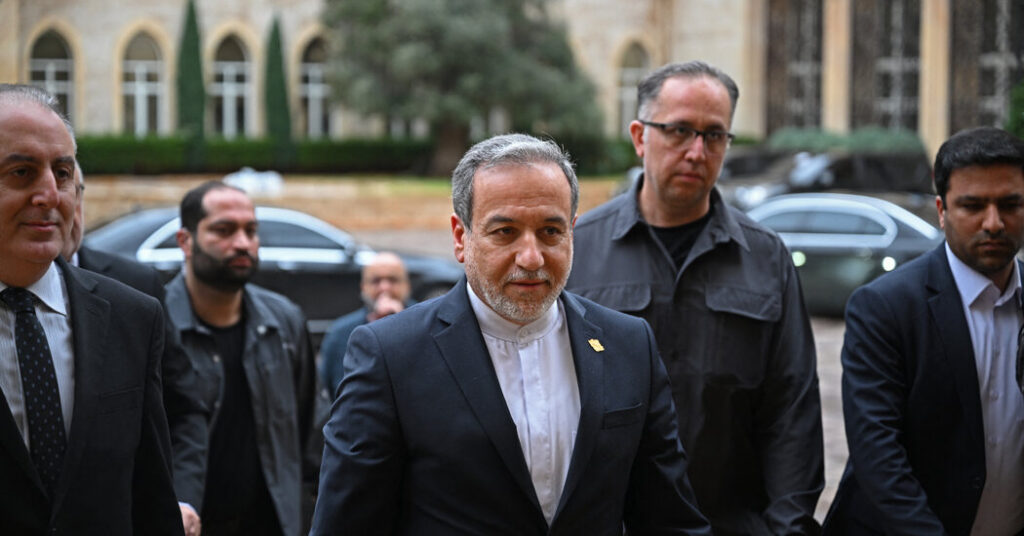
Iran’s foreign minister said Monday that his country was prepared for war but also ready to negotiate after President Trump warned that the United States might intervene to stop the government’s increasingly deadly crackdown on opposition protests.
“We are not looking for war, but we are prepared for war — even more prepared than the previous war,” Abbas Araghchi, the foreign minister, told a conference of foreign ambassadors in the capital, Tehran, broadcast by state television. He appeared to be referring to the 12-day war with Israel this past June, which the United States joined to bomb Iran’s nuclear facilities.
“We are also ready for negotiations, but negotiations that are fair, with equal rights and mutual respect,” he added.
Iran also said on Monday that communication channels were open between Mr. Aragchi and Steve Witkoff, Mr. Trump’s Middle East envoy.
“Iran has never left the negotiating table, but it will not engage in one-sided negotiations,” Esmail Baghaei, a foreign ministry spokesman, told a news conference Monday.
The signal from Iranian authorities that they were open to diplomacy with the United States came after Mr. Trump threatened on Sunday that he might act militarily to curb the government’s repression of widespread demonstrations.
Iran has been roiled in recent weeks by protests that began over economic hardship, then snowballed into a serious challenge to the country’s authoritarian clerical rulers.
On Monday, Iranian state media showed images of crowds in several cities in Iran rallying in support of the government, as well as funeral processions for security personnel killed in the unrest.
“Firm and effective measures to seek justice for the martyrs and those killed in the recent incidents have been taken,” Gholam-Hossein Mohseni-Eje’i, the head of Iran’s judiciary, said on Monday, in comments reported by the semiofficial news agency Tasnim.
Mr. Trump was briefed in recent days on new options for military strikes in Iran but had not made a final decision, according to multiple U.S. officials familiar with the matter.
“We are looking at it very seriously, the military is looking at it, and we’re looking at some very strong options,” Mr. Trump told reporters on Air Force One on Sunday, without providing details. He added: “I’m getting an hourly report, and we’re going to make a determination.”
Mr. Trump later said that “the leaders of Iran” had called him on Saturday and that they wanted to negotiate. He did not give further details.
Talks on Iran’s nuclear program have stalled in recent months.
Iranian authorities are still recovering from the brief war with Israel in June. The conflict killed top security officials, degraded Iran’s military infrastructure and drained the country’s financial resources even further after years of U.S. and European sanctions tied to Iran’s nuclear ambitions.
“I think they are tired of being beat up by the United States,” Mr. Trump said on Air Force One on Sunday, adding that “a meeting is being set up, but we may have to act because of what’s happening.”
On Sunday, human rights groups monitoring the uprisings in Iran began reporting a sharp rise in the death toll as accounts of a violent repression broke through a communications blackout imposed by the Iranian authorities.
The Oslo-based Iran Human Rights group raised its toll for the protests to nearly 200, while the Human Rights Activists News Agency, based in Washington, said it had confirmed the deaths of nearly 500 protesters and almost 50 security personnel.
Videos published on Iranian social media channels Sunday and verified by The New York Times showed dozens of what appeared to be black body bags, lined up on the ground or on stretchers outside the Forensic Diagnostic and Laboratory Center in Kahrizak, a city on the outskirts of Tehran.
Mr. Trump has repeatedly threatened lethal action against the Iranian government if it killed protesters. Asked on Sunday whether Iran’s leaders had crossed a red line, Mr. Trump replied: “It looks like it. There seems to be some people killed who weren’t supposed to be killed.”
Oman has often served as an intermediary between Washington and Tehran. On Saturday, the Omani foreign minister, Badr Albusaidi, said after meeting with Iranian officials in Tehran that he had had a “productive day” that included discussions of “pressing regional and global developments.”
Mr. Albusaidi did not provide details. The Iranian foreign ministry spokesman said on Monday that “ideas were also exchanged on other issues that we always discuss with Oman,” but he did not elaborate.
Aurelien Breeden is a reporter for The Times in Paris, covering news from France.
The post Iran Prepared for War but Ready to Negotiate, Foreign Minister Says appeared first on New York Times.