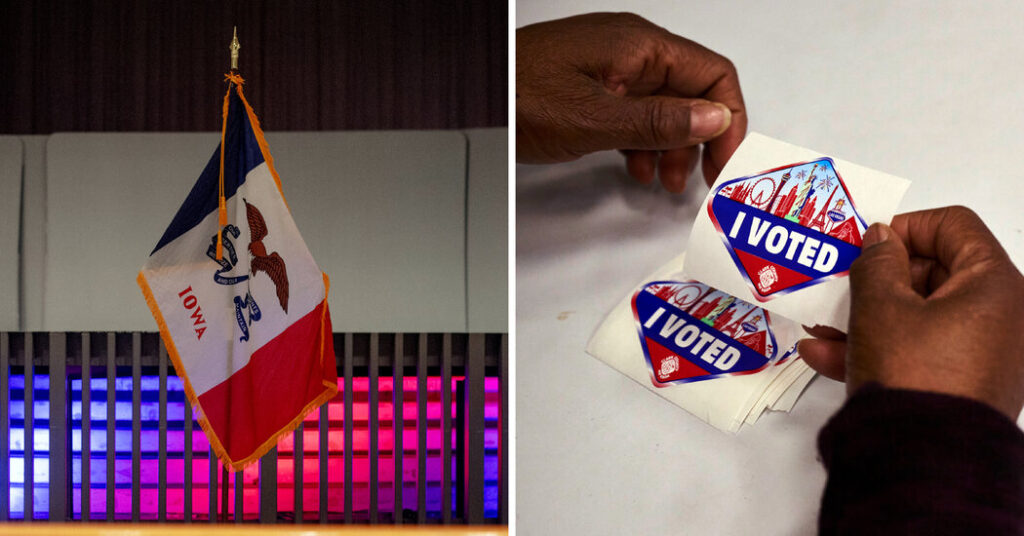
Democratic Party insiders are beginning to puzzle over one of the more consequential decisions for the party’s future: which states should vote first in the 2028 presidential primary elections.
Should Democrats begin the primary race with a battleground state? Is a racially diverse state like Nevada — with its big Latino population — the way to go? Or is a smaller state like New Hampshire, with its long tradition of town hall events and passionate voters, best?
Perhaps the party should return to South Carolina, whose base of Black voters is the heart of the party in a region where Democrats desperately need to improve? Or maybe Democrats should go back to Iowa, full of the types of rural voters whom the party has so thoroughly lost touch with?
Strategists say the order of states will heavily influence how the primary campaign unfolds — and who ultimately winds up as the face of the Democratic Party in 2028.
“The purpose of the order is to tell a story,” said Stuart Appelbaum, an influential union president who sits on the Democratic National Committee panel that will decide which states go first. “The importance of the Democratic primary calendar is establishing a narrative of what the Democratic Party is about.”
The Democratic National Committee has set a Friday deadline for states to apply to be placed in the so-called early window, the month leading up to Super Tuesday.
The debate has only just begun. But early whisper campaigns about the weaknesses of the various options already offer a revealing window into some of the party’s racial, regional and rural-urban divides, according to interviews with more than a dozen state party chairs, D.N.C. members and others involved in the selection process.
Nevada is too far to travel. New Hampshire is too entitled and too white. South Carolina is too Republican. Iowa is also too white — and its time has passed.
Why not a top battleground? Michigan entered the early window in 2024, but critics see it as too likely to bring attention to the party’s fractures over Israel. North Carolina or Georgia would need Republicans to change their election laws.
For decades, Iowa and New Hampshire began the presidential nominating calendar for both parties. But President Joseph R. Biden Jr. shook that up for Democrats’ 2024 primary contest and put South Carolina first, after the state’s Black voters propelled him to the nomination in 2020.
All three states are angling to stay at the front of the line, even as Nevada tries to leapfrog them. Other states, including Michigan and Georgia, are jockeying to be in the early mix.
Party officials say they are starting from scratch for 2028. D.N.C. guidelines say one state each from four regions — the East, the Midwest, the South and the West — will be included in the early primaries before Super Tuesday, potentially along with a fifth bonus state.
“People are going in with an open mind,” said Jane Kleeb, the chair of the Nebraska Democratic Party and an influential committee member who is also a national vice chair. Her state is not applying, she said. “Could it be a totally new calendar? Yes.”
Ms. Kleeb said she was prioritizing not just general-election battlegrounds but also states where Democrats could compete in down-ballot races.
Officials said the most aggressive lobbying so far had come from Nevada, which has voted early in recent cycles but never first.
At the party’s December meeting in Los Angeles, Nevada’s advocates not-so-subtly dropped cactus-themed holiday cards on the seats of the 49 members of the D.N.C. Rules and Bylaws Committee, which will decide the order of the primaries. Later, the Nevada secretary of state, Cisco Aguilar, spoke to the full D.N.C. membership and rankled some with a presumptuous line about looking forward to the chance to run a first-in-the-nation primary.
The D.N.C. has set three broad criteria for early states that are open to interpretation: “rigorousness,” “fairness” and “efficiency.” The party concluded that together, “the lineup of early states must be a comprehensive test of candidates with diverse groups of voters that are key to winning the general election.”
The rules committee members are set to travel to Puerto Rico at the end of January to discuss the calendar, with a final decision still months away.
Nevada’s supporters argue that the Western state has something to please everyone: It’s small. It’s a battleground. It has influential labor unions. It has a diverse population based in Las Vegas. But it also has many rural enclaves across the state.
“The case is clear,” said Hilary Barrett, the Nevada Democratic Party’s executive director. “If Democrats are serious about winning back working-class voters, Nevada should be first in the nation.”
Party officials also have to contend with a patchwork of state laws that have already set some primary calendars. New Hampshire, for instance, has a law that it must hold the first primary nationwide — which it did in 2024, even after Democrats threatened to bar the state’s delegation from the party’s convention. (The delegates were eventually seated.)
“Our laws are clear,” said Ray Buckley, the New Hampshire Democratic Party’s veteran chairman. He said that his state’s voters took their responsibility to vet candidates as seriously as anyone and that “we certainly aren’t out to get any other state,” but that voting first was part of the state’s character.
“It’s in our DNA,” Mr. Buckley said.
Rita Hart, the Iowa Democratic Party chairwoman, said her state was applying to be in the early mix again, and was open to again holding a caucus so it would not conflict with New Hampshire’s law about primaries. The counting of votes in Iowa’s Democratic caucuses in 2020 was a disaster. “Lessons learned,” Ms. Hart said.
“It was a mistake in the last go-around that we didn’t include a state in the middle of the country that had a rural electorate,” she added.
Iowa has one other main argument: Republicans are set to caucus there first in 2028 no matter what the D.N.C. decides, meaning that skipping the state would leave all the attention there to Republicans. “Iowa is unique in that,” Ms. Hart said.
South Carolina’s spot at the very front of the line appears tenuous, according to party officials, largely because Democrats have not seriously competed in recent statewide races there.
But Christale Spain, the chair of South Carolina Democratic Party, said that putting a Southern state first would send a message about the importance of Black voters as well as the party’s geographic priorities.
“If the party wants to change things nationally, we have to start winning in the South,” she said. “South Carolina going first is the South going first.”
Some states that might want to be considered would need approval from Republican-controlled state legislatures.
“It’s not an answer we can have right now,” Charlie Bailey, the chairman of the Georgia Democratic Party, said of changing his state’s laws. But he urged the inclusion of his state — along with South Carolina — in the kickoff group.
“We are the definition of a battleground — it can be won and it can be lost,” Mr. Bailey said, pitching his state’s diversity. “If you can’t win in the South, you can’t have a national governing coalition.”
North Carolina Democrats are also interested in an earlier primary. “You are not going to keep the presidency with just the blue wall,” said Anderson Clayton, the state party chair, referring to Pennsylvania, Michigan and Wisconsin. But her state would also need Republicans to sign off on moving up its primary, and it is uncertain if Democrats there will apply.
Minnesota, which applied to be in the early window four years ago, will not apply this year, according to its Democratic chairman, Richard Carlbom.
One state that moved up its primary by law before 2024 was Michigan. Mr. Biden faced no serious Democratic rival that year, but his support for Israel in the Gaza war led to more than 100,000 “uncommitted” protest votes in the state.
Curtis Hertel, the chair of the Michigan Democratic Party, said no other state would be a better proving ground for an eventual nominee.
“If you’re looking to win in America, it makes sense for states early on that reflect the diversity of America,” Mr. Hertel said. “The states that we have to win at the end of the day, it’s incredibly important to make sure they are early in the process.”
Unlike Democrats in some other states, however, Mr. Hertel isn’t pushing to be at the very front of the line.
“Not saying we have to be first!” he added.
Shane Goldmacher is a Times national political correspondent.
The post Inside Democrats’ Brewing Debate Over Which States Should Vote First in 2028 appeared first on New York Times.