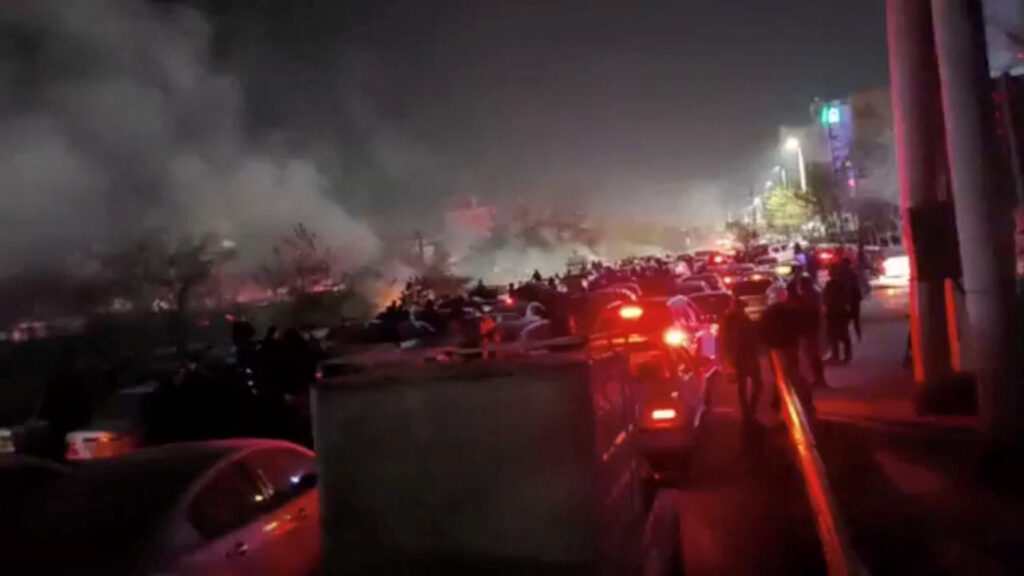
ISTANBUL — Hundreds of demonstrators have been killed in Iran, rights groups said Sunday, as reports of a dramatic escalation in the use of deadly force by security forces began to break through a communications blackout imposed by authorities struggling to contain some of the largest protests since the Islamic republic was founded in 1979.
Trump administration national security officials, meanwhile, were preparing to discuss options, including possible military strikes, a senior U.S. official told The Washington Post.
The Center for Human Rights in Iran, based in New York, said it had received eyewitness accounts and credible reports that hundreds of protesters have been killed since the government shut down access to the internet Thursday night. The Human Rights Activists News Agency, also based in the United States, said 490 protesters had been killed since the protests began Dec. 28.
A senior Western official who was briefed on the matter said hundreds were killed in 48 hours of protests. The official, who spoke on the condition of anonymity because he was not authorized to brief the media, said the spread of protests across a wide geographical area made it difficult to gather credible casualty figures.
The Trump administration is considering military options in response to the crackdown, U.S. officials said late Saturday, speaking on the condition of anonymity to discuss sensitive issues. Officials across the key national security agencies were scheduled to brief President Donald Trump early this week, a senior U.S. official familiar with the matter said Sunday.
The president’s top diplomatic, military and defense advisers were expected to discuss a broad array of options, including both military and nonmilitary responses, the official said.
The planned deliberations, first reported by the Wall Street Journal, were at an early stage, the official said. The president had not settled on a preferred option, they said.
“Iran is looking at FREEDOM, perhaps like never before,” Trump posted Saturday on social media. “The USA stands ready to help!!!”
Options under review, the Journal reported, could include deploying cyberweapons against Iranian military and civilian sites, imposing additional economic sanctions on the Iranian government and launching military strikes.
Iranian parliament speaker Mohammad Bagher Ghalibaf warned Sunday against such strikes. If the country were attacked, he said, it could target the U.S., Israel and international shipping lanes.
Speaking to reporters on Air Force One on Sunday night, Trump declined to say what options the U.S. was considering. He said Tehran reached out to Washington and proposed negotiations. “We may have to act before a meeting. … A meeting is being set up,” he said.
According to the senior Western official, Iran’s supreme leader ordered the crackdown after protesters who had started by voicing economic grievances began to call for regime change and demonstrations grew more violent.
Iranian authorities initially appeared reluctant to use lethal force, but once the protests threatened the regime, the official said, authorities shifted course.
“This is now unequivocally about regime change for many of the protesters, hence also the regime’s escalation into violence,” the official said. The “regime is holding it together for now,” the official continued, but only with “massive violence.”
The internet blackout and calls for nationwide strikes have compounded Iran’s economic crisis, the official said, and trading has ground to a halt.
Some Iranian officials with whom he is in contact appear to be preparing for “the day after,” he said, but he hasn’t seen credible reports of increased regime defections.
The Center for Human Rights in Iran, which works with activists inside the country to document abuses, said witnesses have reported that “hospitals were overwhelmed, blood supplies are critically low, bodies are being piled up, and the number of casualties is rising by the hour.” Many protesters have been shot in the eyes, the center said. Iranian security forces have in the past shot protesters in the eyes with metal pellets and rubber bullets. Witnesses also reported the use of snipers, military rifles and surveillance drones, the center said.
“A massacre is unfolding,” the center said. “The world must act now to prevent further loss of life.” It cautioned that the internet blackout made verifying the number of those killed in the demonstrations “currently impossible.” The Post could not verify the center’s assertions, but it has a record of issuing conservative estimates of deaths in previous protests. It works with a network of activists inside Iran to document human rights abuses, according to its website.
BBC Persian reported that 110 bodies had been transferred to hospitals in Tehran and the northern city of Rasht, according to “informed sources” at the facilities. People were taken to hospitals with bullet wounds in the head, neck and eyes, doctors told the outlet.
Iranian police chief Ahmad-Reza Radan said security forces had “stepped up” their confrontation with “rioters,” Iran’s state broadcaster reported Sunday, and that the “main elements” behind the unrest had been rounded up and would be punished following a legal process.
Radan acknowledged deaths but implied that they were caused by coordinated agitators rather than security forces. His evidence, he said, was that many of them had stab wounds or had been killed by gunshots at close range.
Iranian President Masoud Pezeshkian, speaking to an Iranian journalist on Sunday, cast the protests as the work of Iran’s enemies, who he said were training “terrorists.” He accused them of a variety of atrocities without providing evidence.
Ali Larijani, Iran’s top security official, said “an organized, violent group hijacked … legitimate economic protests to carry out extreme atrocities, killings, burnings, and [Islamic State]-like terrorist acts [that are] clearly unrelated to genuine public protests.”
An Iranian diplomat told The Post that peaceful civil protests had “turned into an armed attack on police and ordinary people and burning public services and places” with “surprising speed.”
“So far,” he said, “the Syrianization of Iran failed.” Rebels in Syria toppled longtime leader Bashar al-Assad in December 2024.
The diplomat, who spoke on the condition of anonymity because he was not authorized to brief the media, accused Israeli intelligence officers of infiltrating the protests and fomenting the violence.
“It was actually the follow-up of the 12-day war,” he said — referring to an exchange of missiles among Iran, Israel and the U.S. in June — and “there was no other option for the Iranian government [but] to shut down internet to disrupt the communication of terrorist cells.”
Israeli Prime Minister Benjamin Netanyahu, speaking Sunday at a government meeting, said Israel was “closely monitoring” events. The people of Israel “stand in awe of the immense bravery of Iran’s citizens,” he said, and Israel “supports their struggle for freedom.”
Victoria Taylor, a former deputy assistant secretary of state for Iraq and Iran, said the lack of a U.S. carrier strike group in the region would complicate any effort to strike Iranian military targets or protect U.S. troops and Israeli interests against retaliation from Iran.
“There are still ways to strike targets, but we are not positioned as we normally would be to undertake strikes of this significance in Iran,” said Taylor, who now heads the Iraq initiative at the Atlantic Council.
If the U.S. were to strike Iranian military targets, she said, “there is no guarantee that prevents the [Islamic Revolutionary Guard Corps] or other regime leaders from assuming control. Even if you take out the supreme leader, you could still wind up with another regime figure assuming leadership.”
Videos shared by BBC Persian and other Persian-language outlets outside Iran showed three days of mass protests in cities including Tehran, the capital, and Mashhad in the northeast. Iranians have called for an end to theocratic government in protests and strikes for two weeks.
Little information has been available since the internet blackout began on Thursday evening. Some Iranians have been able to connect with the outside world briefly using Starlink devices that have been smuggled into the country over the past few years, and videos that have circulated on social media in the past several days appear to indicate a high death toll. Some show what appear to be Iranians at morgues trying to identify the bodies of loved ones.
The Post could not immediately verify those videos.
The protests, sparked by merchants devastated by the precipitous fall of the Iranian currency in the past few months, began on Dec. 28. They spread quickly across the country and were joined by students, workers and others.
George and Hudson reported from Washington. Dan Lamothe, Ellen Nakashima, Warren P. Strobel and Sammy Westfall in Washington and Suzy Haidamous in Beirut contributed to this report.
The post Hundreds of Iranian protesters feared killed; U.S. considers military strikes appeared first on Washington Post.