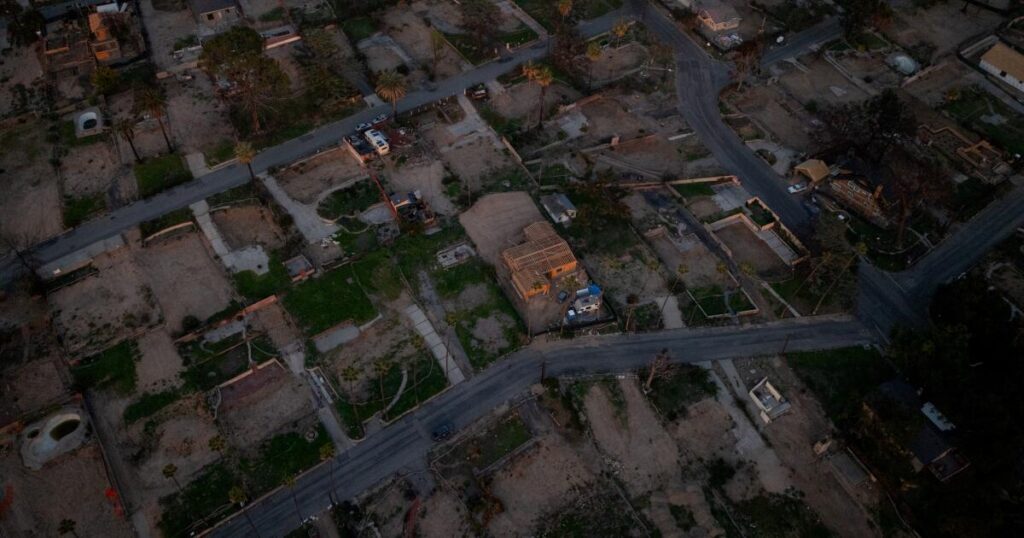
In a remarkable reversal, the U.S. Environmental Protection Agency is expected to announce that the Federal Emergency Management Agency will pay for soil testing for lead at 100 homes that were destroyed by the Eaton fire and cleaned up by federal disaster workers.
The forthcoming announcement would mark an about-face for FEMA officials, who repeatedly resisted calls to test properties for toxic substances after federal contractors finished removing fire debris. The new testing initiative follows reporting by The Times that workers repeatedly violated cleanup protocols, possibly leaving fire contaminants behind or moving them into unwanted areas, according to federal reports.
The EPA plan, presented to a small group of environmental experts and community members on Jan. 5, said the agency would randomly select 100 sites from the 5,600 homes that had burned down in the Eaton fire and where the U.S. Army Corps of Engineers oversaw the removal of ash, debris and a layer of soil. The soil samples would be collected near the surface and about 6 inches below ground.
Sampling is expected to begin next week, with test results published in April.
During the Jan. 5 presentation, some attendees questioned whether the testing would meaningfully assess whether properties are safe to rebuild on.
Local environmental health advocates worry the EPA testing is designed only to justify FEMA’s decision not to undertake comprehensive soil testing, instead of providing real relief to their communities.
“The EPA’s plan to run a study that retroactively validates a limited soil-removal response after the L.A. Fires is deeply concerning, especially when there is ample independent data indicating contamination persists beyond what was addressed,” said Jane Lawton Potelle, executive director of the grassroots environmental health group Eaton Fire Residents United, in a statement. “The hard truth is that meaningful contamination recovery still has not been funded or delivered by the federal government or the State of California.“
The EPA’s proposed approach is narrower than soil-testing efforts for previous fires in California. Although lead is one of the most common and dangerous contaminants left behind after fires, federal and state disaster officials have traditionally tested soil for 17 toxic metals, including cancer-causing arsenic and toxic mercury.
The EPA plan also calls for taking soil from 30 different parts of each cleanup area and combining them into one singular representative sample. That method doesn’t align with California’s soil-testing policy and could obscure “hot spots” of contamination on a property.
“If you don’t want to find a high number [of contaminants], you take a lot of samples and you mix them together,” said Andrew Whelton, a Purdue University professor who researches natural disasters.
“Based on the experimental design of [the EPA plan], I do not understand the purpose of what they’re doing, because it is not meant to determine if the properties are safe or not,” Whelton added.
For nearly a year, FEMA refused to pay for soil testing, insisting it was time-consuming, costly and unnecessary. FEMA, along with the U.S. Army Corps of Engineers, maintained that removing ash, debris and a layer of soil would be enough to rid properties of toxic substances.
But those claims were unsubstantiated. Historic fire data showed about 20% of properties still contain toxic substances above California’s benchmarks for residential properties.
What’s more, a trove of federal reports obtained by The Times revealed federal contractors repeatedly deviated from their cleanup plans, possibly leaving dozens of properties with toxic ash and debris.
FEMA hired inspectors to observe the cleanup process and document any issues; the resulting reports say, in some cases, that workers sprayed contaminated pool water on properties, walked through recently clean properties with dirty boot covers and mixed clean and contaminated soil by using improper equipment.
In one of the most egregious violations, an inspector noted that an official with Environmental Chemical Corp., the primary contractor hired to oversee debris removal in the Eaton and Palisades fires, ordered a work crew to dump ash and debris onto a neighboring property.
A spokesperson for the Army Corps said “all deficiencies logged by” federal inspectors were “addressed and corrected.”
“Our robust quality assurance program was staffed with hundreds of quality assurance inspectors and engineers,” the spokesperson said. “The deficiencies that were identified in the article were corrected immediately or before Final Sign Off.”
The agency did not provide any details about how workers resolved the alleged illegal dumping, or any other deficiencies.
Numerous soil-testing efforts had already found contamination above state standards. Los Angeles Times journalists launched a soil-testing project and published the first evidence that fire-destroyed homes in the Eaton fire still contained elevated levels of soil contamination, even after federal cleanup workers finished removing debris.
Los Angeles County and UCLA-led soil testing initiatives also found elevated levels of contaminants at Army Corps-cleared properties.
EPA officials said the agency would share soil-testing results with property owners, in addition to Los Angeles County and state agencies. However, they did not say whether they intended to remove another layer of soil if lead levels exceed state and federal standards.
U.S. Rep. Judy Chu (D-Monterey Park), who previously called on federal disaster agencies to provide comprehensive soil testing for fire victims, sent an email to her constituents last week saying she is “seeking assurance that they take action if the results of their testing find contamination.”
The Army Corps and its contractors initially aimed to demobilize by Jan. 8, 2026, the one-year anniversary of the fires, but federal cleanup efforts finished much earlier than expected. Federal cleanup workers removed fire debris from the final home enrolled in the federal program in Los Angeles’ Pacific Palisades in early September.
Federal and state officials hailed the Army Corps efforts as the fastest major cleanup in modern American history.
As of publication, FEMA and the EPA have not responded to questions sent by The Times regarding specifics of the testing plan.
The post FEMA to pay for lead testing at 100 homes destroyed in Eaton fire, after months of saying it was unnecessary appeared first on Los Angeles Times.