The killing of a Minneapolis woman by an immigration agent and the subsequent attempt to label her a “domestic terrorist” have caused outrage in the city and across the country.
But the case has striking similarities to a spate of incidents involving agents who have been dispatched across the country to carry out President Donald Trump’s aggressive deportation agenda during his second term.
[time-brightcove not-tgx=”true”]
Renee Good, a 37-year-old mother of three, was fatally shot by an Immigration and Customs Enforcement (ICE) agent, Jonathan Ross, in Minneapolis on Wednesday as she tried to drive away from officers during a protest against the agency.
Read more: Anti-ICE Protests Spread Across the U.S. After Fatal Shooting of Minneapolis Woman
An investigation published by the Wall Street Journal on Saturday identified 13 instances of immigration agents firing at or into civilian vehicles since July, leaving at least eight people shot, with two confirmed dead—including Good. It found that at least five of those shot were U.S. citizens.
Those numbers are particularly striking when considering that immigration agents have opened fire a total of 16 times since Trump returned to office, according to data compiled by The Trace, a non-profit newsroom focused on gun violence in the U.S.
The White House has defended the killing of Good, claiming that the agent’s life was under threat. But in many incidents, federal authorities have claimed the same, only to be later contradicted by video evidence.
Contradictory claims
The shootings are taking place in the context of what President Trump has billed as the “largest deportation operation in American history,” which is being carried out by agents from various federal agencies with varying degrees of training.
The Department of Homeland Security (DHS) has hired thousands of new recruits to meet that ambitious goal, lowering its hiring standards in the process and becoming more aggressive in its tactics.
Those tactics involve so-called “enforcement surges”, in which large numbers of federal agents move into mostly Democratic-led cities and conduct sweeping raids, leading to more violent confrontations with members of the public, including U.S. citizens.
Some experts have suggested that poor training on the part of DHS may have contributed to the shootings. In at least some cases, immigration officers moved into the vehicle’s path as it moved—something law enforcement officers are trained not to do. The Journal investigation found that in at least one of the shootings, agents “boxed in” a car, a tactic police are trained to use only in felony stops.
But in every case, federal authorities justify the agent’s actions by claiming the car was being used as a weapon, or the agent’s life was in danger, even when evidence contradicts those claims.
In a lengthy response to TIME, the DHS, which oversees federal immigration agents, claimed the use of force was justified in all 13 shootings because the vehicle posed a threat to the agent who fired the weapon.
“It’s a pattern of vehicles being used as weapons by violent agitators to attack our law enforcement. Dangerous criminals – whether they be illegal aliens or U.S. citizens – are assaulting law enforcement and turning their vehicles into weapons to attack law enforcement,” Assistant Secretary Tricia McLaughlin said.
“Our officers are experiencing a 3,200% increase in vehicular attacks. When faced with dangerous circumstances, DHS law enforcement used their training to protect themselves, their fellow officers, and the public,” she added.
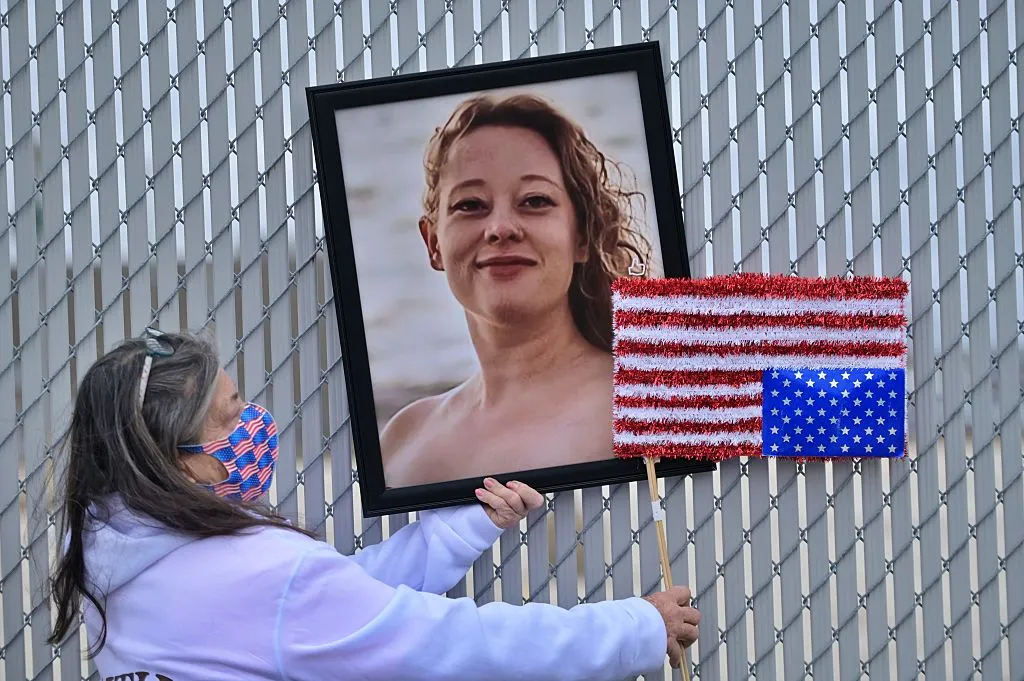
In the case of Good’s shooting, DHS told TIME that she “weaponized her vehicle, attempting to run over our law enforcement officers in an attempt to kill them—an act of domestic terrorism.”
But videos of the incident from bystanders and from the agents themselves contradict that account. They appear to show Ross positioned to the side of Good’s vehicle when he fired the shots that killed her, with her wheels turned away from him.
The discrepancy between the DHS account of a deadly incident and the video evidence is part of a pattern.
In September, Silverio Villegas-Gonzalez, an undocumented immigrant, was killed by an ICE agent in the Chicago area following an incident in which the DHS said an agent was “seriously injured” after being dragged a “significant distance” by the car. Later, video evidence raised questions about that account after it showed the officer fully mobile and describing his own injuries as “nothing major.”
Last October, Marimar Martinez, a 30-year-old American woman, was shot and injured by a Border Patrol agent when she was driving around a predominantly Hispanic neighborhood in Chicago and warning people about the presence of federal law enforcement. “Do something, b-tch,” the agent shouted before firing an assault rifle at her, footage of the incident reportedly showed.
In that case, as in the shootings in Portland and Minneapolis, agents claimed that they were defending themselves from a car ramming. The agents arrested Martinez, who survived, but the charges were dismissed after her attorneys claimed to have shown footage in court showing that, in fact, agents had rammed her car.
Just the day after Good was killed, U.S. Border Patrol agents shot Luis David Nico Moncada and Yorlenys Betzabeth Zambrano-Contreras in Portland. McLaughlin said the pair “weaponized their vehicle,” although no video has been produced of the incident.
The shootings under Trump have coincided with a shift to what critics have described as “military-style” tactics by immigration agents.
One notable example was an early morning raid of a Chicago apartment building in October last year in which armed federal agents rappelled from helicopters, kicking down doors and throwing flash bang grenades, rounding up adults and screaming children alike.
Illinois Gov. J.B. Pritzker condemned the “military-style tactics” and likened it to the behavior of an “authoritarian regime.”
‘Villifying’ opponents
The White House has spent days defending the agent who shot Good, alleging that she tried to ram the officer. Vice President JD Vance said on X that “his life was endangered and he fired in self defense,” despite video evidence suggesting otherwise. Trump described the 37-year-old mother of three as a “high-level agitator” and “a professional troublemaker.”
Local leaders, however, have cast the government’s efforts to portray Good as an extremist as an effort to vilify those opposed to Trump’s immigration agenda.
Jacob Frey, the Democratic mayor of Minneapolis who has emerged as a key critic of the Administration in the days after Good’s death, wrote in an opinion piece for the New York Times headlined ‘I’m the Mayor of Minneapolis. Trump Is Lying to You’ that the Administration’s “false narrative about this week’s shooting, and the demonization of the victim,” was about “vilifying not just immigrants, but all who welcome them and their contributions to our communities.”
Ilhan Omar, Democratic Rep. for Minnesota, said it was “unacceptable” for Noem, Trump and Vance to pass judgment on Good before an investigation had taken place.
“It’s indefensible for Trump, Vance, and Noem to spread conspiracies about the woman murdered by ICE in Minneapolis. We saw it happen with our own eyes. Renee Nicole Good should be alive,” she wrote on X.
The investigation into the killing has been taken on by the Federal Bureau of Investigation (F.B.I.), local officials announced on Thursday, with local authorities blocked from involvement.
Frey and other local leaders suggested that such an investigation would provide the results the Administration wanted.
“We in Minneapolis want a fair investigation,” Frey said at a press conference.
Senator Tina Smith, Democrat of Minnesota, accused the Trump administration of “attempting to cover up” the events that led to the shooting.
“They are blocking state investigators from participating in any way in this investigation,” Smith said on ABC’s “This Week” on Sunday.
Anger over the killing has been highest in Minneapolis, where tens of thousands have taken to the streets in the days since, but hundreds of anti-ICE demonstrations have also taken place across the country over the weekend.
In Washington, D.C., Democrats have called for investigations and for the withholding of funding.
Democratic House minority leader Hakeem Jeffries called Good’s killing “an abomination” at a joint press conference with the Senate Democratic leader, Chuck Schumer, on Thursday.
“Blood is clearly on the hands of those individuals within the administration who’ve been pushing an extreme policy that has nothing to do with immigration enforcement connected to removing violent felons from this country,” he added.
Connecticut Sen. Chris Murphy, the top Democrat on the subcommittee that handles Homeland Security funding, is reportedly planning to introduce legislation to require immigration agents to present a warrant for arrests, and for Border Patrol agents to remain at the border.
— Additional reporting by Miranda Jeyaretnam.
The post Fatal ICE Shooting Sparks Scrutiny of Killings in Trump’s Immigration Crackdown appeared first on TIME.