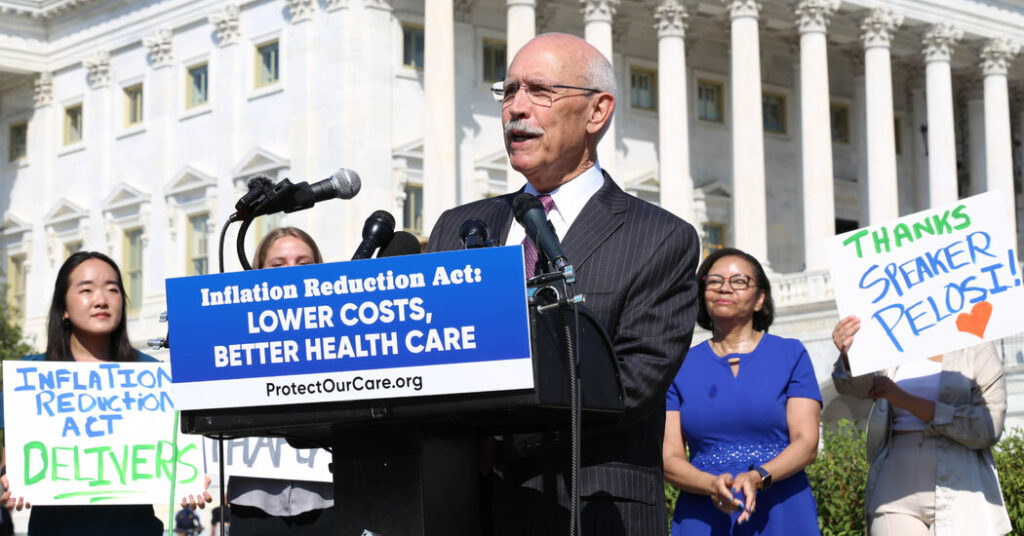
David Mitchell, a public relations executive who, after receiving a cancer diagnosis in 2010, set aside plans to retire and instead became one of the country’s leading voices in the campaign to lower prescription drug prices, died on Jan. 2 at his home in Annapolis, Md. He was 75.
His family said in a statement that the cause was multiple myeloma, a type of blood cancer he had kept at bay for 15 years.
Mr. Mitchell had a master’s degree in labor relations and a 30-year career as a founding partner of GMMB, a Washington-based communications firm. But at the top of his résumé, above all that, he listed his primary occupation as “Cancer Patient, November 2010-Present.”
By 2016, his medications were costing $300,000 a year. He was able to cover that through his insurance, but he knew that many others could not. He grew frustrated, then angry.
“It’s like extortion,” he told the medical news website Stat in 2017. “It’s no different than Tony Soprano walking into a store and saying, ‘Someone may get hurt if you don’t give us the money.’”
He decided he was in a position to do something. He understood public relations, having spent decades leading campaigns on a wide range of public health issues, including tobacco, drunk driving and immunization awareness.
In late 2016 he founded Patients for Affordable Drugs, which he used as a vehicle to drive a nationwide effort to bring transparency and lower prices to medication. His thorough grasp of the nuances of an incredibly complex industry made him a go-to voice for news media interviews and congressional testimony.
But his group was far from a one-man show: It recorded tens of thousands of interviews with patients in all 50 states, and brought many of them to its hearings and rallies.
Over the years, Mr. Mitchell and Patients for Affordable Drugs racked up a long list of legislative accomplishments. Several states passed laws to force price transparency that were written or influenced by the group, and it is widely credited with the inclusion of an annual cap on medication prices in the Inflation Reduction Act of 2022.
Under that law, which limited drug costs for Medicare patients to $3,500 a year — and eventually to $2,000 — Mr. Mitchell saw his out-of-pocket costs go from $16,525 to just $3,308.
“I want to tell the drug companies that it’s time for patients to say we’re not going to be frightened any longer by your threats not to give us drugs we need if we don’t pay prices you demand,” he told Stat.
David Emerson Mitchell was born on May 4, 1950, in Detroit. His father, Henry Mitchell, was a police officer and his mother, Catherine (Perri) Mitchell, was a substitute teacher.
Though his mother urged him to become a lawyer, he was unsure about college until he spent a summer on a tractor-assembly line, a hard, repetitive job that made him see the benefit of higher education.
He enrolled as a journalism major at Wayne State University in Detroit, and completed his undergraduate studies at Michigan State University in 1977. He received his master’s degree in 1978, also from Michigan State.
He spent seven years working for the United Auto Workers union, including three years as the head of its communications department, before helping to found GMMB in 1986.
The firm became a reliable source for projects on public health and safety topics, and Mr. Mitchell worked with clients in government agencies, major nonprofits and private industry, in the process accumulating a long list of contacts to draw on after founding Patients for Affordable Drugs.
GMMB also taught him how the world of public advocacy worked in Washington. He saw firsthand how much money companies and corporate lobbyists poured into ostensibly independent groups, particularly when it came to health care.
He believed that all that money was one reason not a single patient advocacy group tackled drug prices.
Pharmaceutical companies “remind me of an octopus with many, many tentacles, and at the end of each tentacle is a wad of cash,” he told the website Talking Points Memo in 2025. “Everybody relies on the money.”
That is why he insisted that Patients for Affordable Drugs would never take industry money. Instead, he relied on a few philanthropic grants and individual donations, including tens of thousands of dollars of his own money.
Mr. Mitchell’s first marriage, to Rebecca Ford, ended in divorce. He married Nicole Solomon in 1999.
His wife survives him, as do his three children from his first marriage, Nate, Claire and Ben; his son from his second marriage, Sam; one grandson; and his sisters Jocelyn Bierenkoven, Marie Mitoff and Patricia Kiekaefer.
Mrs. Solomon-Mitchell is also a cancer survivor, and she worked closely with her husband at Patients for Affordable Drugs until last year, when he stepped back to focus on his health.
Mr. Mitchell said that seeing so many people fight for — and even occasionally secure — lower drug costs gave him hope, but he was also realistic about the limits of the American health care system.
“In the U.S. every patient should know that, contrary to propaganda from those who make money on our system, we don’t have the best health care system in the world,” he told The British Medical Journal in 2018. “We have the most expensive health care system in the world.”
Clay Risen is a Times reporter on the Obituaries desk.
The post David Mitchell, Who Led Fight on Drug Prices, Dies at 75 appeared first on New York Times.