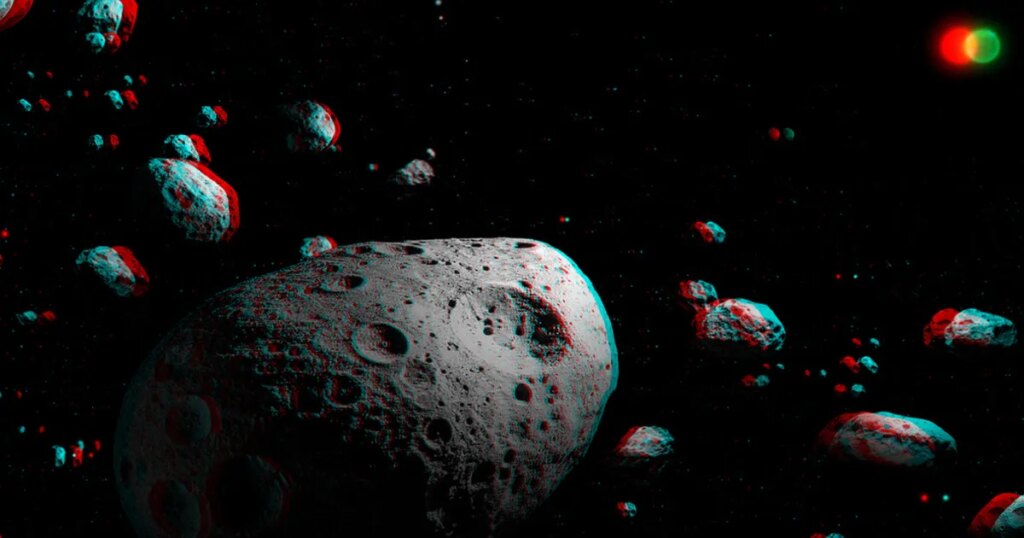
Using early data from the Vera C. Rubin Observatory, which is set to kick off full operations later this spring, an international team of astronomers has discovered an asteroid that spins so fast, it should’ve torn itself apart.
The unusual cosmic lump — dubbed 2025 MN45, 2,300 feet in diameter and located in the Main Asteroid Belt between the orbits of Mars and Jupiter — completes a full rotation every minute and 53 seconds, as detailed in a new paper published in The Astrophysical Journal Letters.
While that may not sound like all that fast at first blush, it’s an astonishing feat considering the object’s sheer bulk. The centrifugal forces involved should’ve already overcome its estimated structural integrity, the researchers found, especially if it were a “rubble pile” made up of smaller rocks, like many other asteroids in the Main Belt.
It’s an especially surprising finding, considering that most distant asteroids were thought to be spinning at much slower rates, as Science Alert points out.
“For objects in the main asteroid belt, the fast-rotation limit to avoid being fragmented is 2.2 hours; asteroids spinning faster than this must be structurally strong to remain intact,” the paper reads. “The faster an asteroid spins above this limit, and the larger its size, the stronger the material it must be made from.”
The team used data collected during the Rubin Observatory’s commissioning phase in the spring of last year to discover 2025 MN45, one of three “ultrafast rotators” that complete a full rotation in less than five minutes. They also found 16 “superfast” rotators with periods between 13 minutes and 2.2 hours. All 19 are larger in diameter than the length of an American football field.
“Clearly, this asteroid must be made of material that has very high strength in order to keep it in one piece as it spins so rapidly,” said Sarah Greenstreet, study lead and assistant astronomer at the National Science Foundation National Optical-Infrared Astronomy Research Laboratory (NOIRLab), in a statement. “We calculate that it would need a cohesive strength similar to that of solid rock.”
“This is somewhat surprising since most asteroids are believed to be what we call ‘rubble pile’ asteroids, which means they are made of many, many small pieces of rock and debris that coalesced under gravity during Solar System formation or subsequent collisions,” she added.
Asteroids beyond the orbit of Mars are very faint and extremely hard to spot. But thanks to the Rubin Observatory’s extremely light-sensitive sensors, the team was able to discover the most distant fast rotators ever spotted.
It’s the first peer-reviewed study that’s based on data from the observatory, and a sure sign that many more discoveries from it are still to come.
“As this study demonstrates, even in early commissioning, Rubin is successfully allowing us to study a population of relatively small, very-rapidly-rotating main-belt asteroids that hadn’t been reachable before,” Greenstreet said.
More on asteroids: Scientists Announce Results After Scanning 3I/ATLAS for Alien Signals
The post Asteroid Behaving Strangely appeared first on Futurism.