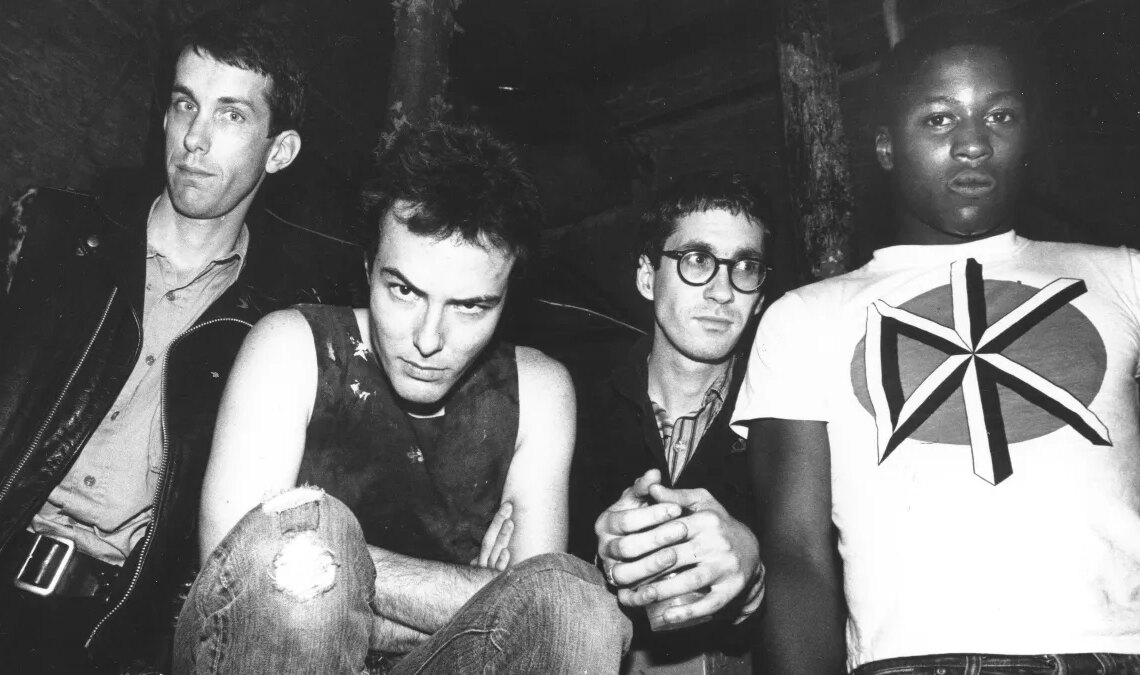
We typically identify punk by its brash, in-your-face, sometimes unintelligible delivery. But when you really consider the lyrics, you’ll usually find pure anarchic poetry, depending on who you’re listening to. Sure, there’s the occasional “Sex and Violence” by The Exploited-type situation (which is poetry in its own way). But here are four other iconic punk songs that showcase truly brilliant writing.
“Where Do Ya Draw The Line?” by Dead Kennedys
When Bedtime For Democracy was released in November 1986, the Dead Kennedys were already on their way out. They’d played what would become their last show with frontman Jello Biafra. Additionally, they were exhausted by an obscenity trial following their 1985 album Frankenchrist. Their subsequent final album touched on this exhaustion as well as their usual lyrical punk fare. Out of the many explosive Dead Kennedys tracks, it’s hard to pick just one. But “Where Do Ya Draw the Line?” is an example of the band’s typically recognizable fire at the end of its life.
“Seems like the more I think I know / The more I find I don’t,” opens the first verse. This leads into, “Anarchy sounds good to me / Then someone asks, ‘Who’d fix the sewers?‘” The fourth verse digs into the idea of performative activism before it was really called that. “What better way to turn people off / Than to twist ideas for change / Into one more church that forgets / We’re all human beings?” Essentially, if you’re making up exclusionary rules for your little activist club, you’re just another oppressor in a long line.
“Big A Little A” by Crass
“Big A Little A” was originally released in 1980 on a double single with “Nagasaki Nightmare”. An early Crass offering, it reads more like a manifesto than a punk song. The verses are jammed to capacity with Crass’ anti-statist ideals. But beyond their anarcho-punk rejection of sovereign states, “Big A Little A” also made a clear statement about individualism.
“Be exactly who you want to be, do what you want to do / I am he and she is she but you’re the only you,” starts the fourth verse. This final lap for the single makes as many statements as possible. But instead of weighing the song down at the end, it presents a sort of pacifist blueprint to anarchy. Essentially, if you don’t like what’s happening in society, you can work to change it. But Crass still reveals the reality of violent anarchy. “But no one ever changed the church by pulling down a steeple / And you’ll never change the system by bombing number ten / Systems aren’t just made of bricks they’re mostly made of people / You may send them into hiding but they’ll be back again.”
“Super Powers Enable Me To Blend In With Machinery” by Dillinger Four
Dillinger Four made their full-length debut in 1998 with Midwestern Songs of the Americas. Here, their unique take on melodic punk songs sets them apart. This primed them for a celebrated career full of clever lyrics and innovative vocals. “Super Powers Enable Me To Blend In With Machinery” became one of those cleverly penned tracks that says way more than it might seem at first.
“It’s all wrinkled elbow shirts and poker faces on this bus,” sets the scene of a depressing morning commute. “But there’s something about the city’s gray that seems to say all there is to say / Riddled with regiment, vindictive intent, faking loyalty and getting paid.” As the track continues, the speaker interacts with another passenger. She claims there’s “‘no dignity in plastic seats.’” But her next comment, “‘the only good boss is one that’s dead,’” draws laughter and camaraderie from everyone on the bus. “Work ethics crumbled into ‘them and us.’” And while “the slow decay of the day-to-day” says “take your paycheck / Accept your place and fade away,” the speaker notes that “there was dignity in plastic seats that day.”
“Waiting Room” by Fugazi
Fugazi’s “Waiting Room,” originally released on their 1988 self-titled debut EP, is a post-hardcore, punk-flavored classic. The wailing second line, “I wait, I wait, I wait, I wait,” plays constantly on the mental jukeboxes of anyone who worries too much about when their life will really begin. “Waiting Room” serves as a litany against wasted potential, in a way that touches on the anxiety of feeling left behind.
By the second verse, however, the speaker is over that. He’s going to “fight for what I wanna be / And I won’t make the same mistakes / Because I know how much time that wastes.” This is spiritual enlightenment in the form of a punk song. Get rid of what you don’t need (“I don’t want the news (I cannot use it) / I don’t want the news (I won’t live by it)”) and get your a** out of the waiting room. In a way, this is reminiscent of a quote from Terrance McKenna: “Take it easy, dude. But take it.”
Photo by Anne Fishbein/Michael Ochs Archives/Getty Images
The post 4 Beautifully Written Punk Songs That Showcase the Poetry Hiding Behind the Noise appeared first on VICE.