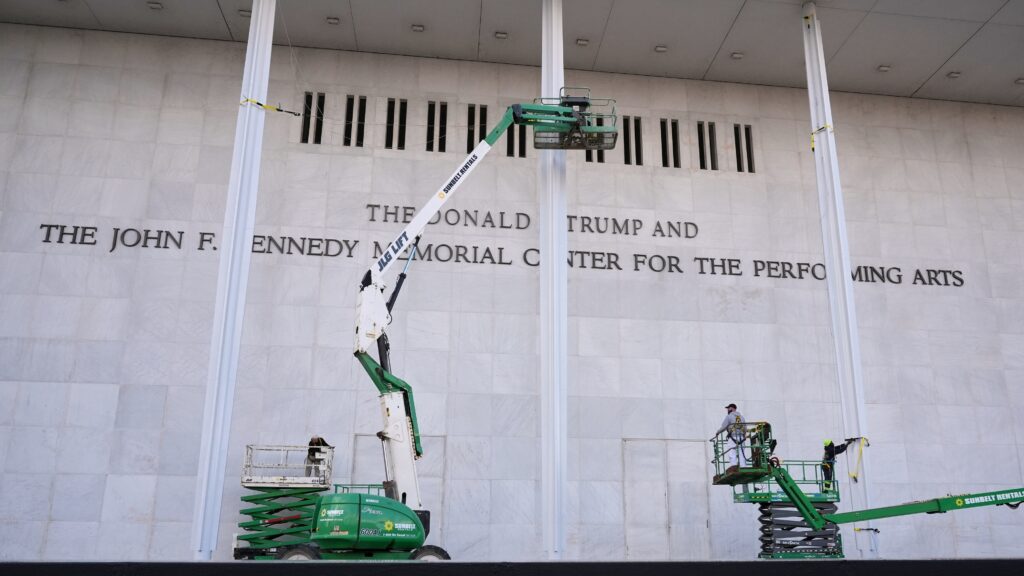
On Friday, the Washington National Opera said it would part ways with the John F. Kennedy Center for the Performing Arts. Good for the Washington National Opera.
Some will consider this an act of institutional courage, which it is. Some will call it capitulation to a “woke mob,” which, as an idea, is kind of pointless to engage with. However it’s characterized from the inside or interpreted from the outside, the move to sever ties between the two ideologically divergent institutions is a sound one for everyone involved. The Washington National Opera has acted in service of its audience and in protection of the art form. That’s what an opera company is for.
“As Washington National Opera begins its 70th anniversary year, the Board and staff have made the difficult decision to seek an end to our 15-year Affiliation Agreement with the Kennedy Center,” reads a statement posted to the company’s new stand-alone website. “We will be moving our performances to new venues as we return to operating as a fully independent entity.”
“Our repertory will continue to include diverse offerings, from monumental classics to more contemporary works, presented in bold visual productions with first-class musical values,” the opera’s artistic director, Francesca Zambello, wrote in a statement. “It promises to be a journey of great discovery for all of us and can’t imagine better traveling companions than the WNO family.”
With the plummeting ticket sales, empty seats and the rumbles of a growing clash of cultures within the walls of the board-rebranded center, it was clear from Act I that this pairing was doomed.
And the breakup is real. The “Trump Kennedy Center” website has scrubbed its links to the company, and the opera has declared that the affiliation “was never intended to be permanent,” marking the start of its 70th season as “a new chapter” on its website.
In a post on X, Kennedy Center spokeswoman Roma Daravi cited “longstanding financial strain” as the root cause for the conscious uncoupling, which the center says it initiated: “The relationship with the WNO has presented ongoing financial challenges for well over a decade,” she wrote. “… When financial commitments are not met year over year, we have to make tough decisions for the financial health of the Trump Kennedy Center.”
In an X post, Kennedy Center President Richard Grenell saidthe separation would ensure “the flexibility and funds to bring in operas from around the world and across the U.S.”
The opera troupe is singing a different tune, blaming a new business model imposed by Grenell that is plainly incompatible with the machinery of opera itself. The statement also points to the recent reduction (or outright elimination) of shared services between the company and the center, redirecting operations such as marketing, human resources, development and finance (among others) back to members of an already overtaxed opera staff.
“The current requirement from the center’s management is for WNO to demonstrate that each production or event is fully underwritten through anticipated ticket sales and secured contributed revenue sources before it can be approved,” the statement reads. “This is impractical for WNO, since seasons must be conceived and developed well in advance of funding opportunities and the timing of when it is optimal to project revenue from ticket sales.”
The planning of operas — from the recruitment of talent to the development of the productions themselves to the grants and donations that must be secured to fund them — can extend well beyond two years.
And the programming of operas, especially in the case of the Washington National Opera, often involves a precise balancing act of sensibilities, in which more popular seat-filling productions help support the company’s parallel mission of presenting new or lesser-known works that tend to sell fewer tickets but play a crucial part in developing and advancing the form. (To that end, the location of the company’s forthcoming production of Scott Joplin’s “Treemonisha” is yet to be revealed.)
“Yet, even without securing the majority of advance funding,” the statement adds, “WNO has successfully operated within a balanced budget for several years, in part thanks to past support from the Kennedy Center.”
It took only a change of leadership and an overhaul of priorities at the center for decades of “past support” of the WNO to curdle into “longstanding strain.” The characterization suggests that, whatever the priorities of the Trump-run Kennedy Center, opera isn’t one of them.
The WNO is not the first but is certainly the most significant organization to exit the center. Washington Performing Arts moved nearly 50 percent of its programming for the 2025-2026 season to other venues. On Facebook, WPA President and CEO Jenny Bilfield called the WNO’s move a “principled, pragmatic, and courageous decision.”
As this sentiment echoes through comment sections on the operatic ends of social media, the news of the split could inspire a groundswell of support from longtime patrons who pumped the brakes on their operagoing in 2025 amid the Trump takeover. It may even serve to restore projects that were thought lost — like the D.C. premiere of gay romance “Fellow Travelers,” withdrawn in March from the WNO’s 2025-2026 season by creators Gregory Spears and Greg Pierce.
Even if the Kennedy Center no longer wished to subsidize the opera, the troupe’s exit deals a blow — artistically and reputationally — to the arts complex, which now suffers from an institutional asymmetry that feels glaring. Together with the National Symphony Orchestra, the Washington National Opera was a supporting pillar of the center’s identity as a monument to the arts — as part of the architecture of the place as its twin halls.
As the WNO exits the Opera House, the spotlight is left to drift toward the Concert Hall, where the NSO faces another side of the same predicament, if even more pronounced: slumping ticket sales, squandered momentum, postponed concerts because of interference. Speaking to The Washington Post in the fall, current and former staff members attributedthe drop in attendance to an apparent boycott over last year’s Trump takeover.
As the WNO forges its own road forward, it’s getting hard not to see the orchestra — which instituted its own administrative merger with the center in 1986 — as playing chicken with its audience.
Could the National Symphony Orchestra consider a similar declaration of independence? An orchestra is, after all, far more portable than an opera company, and the NSO already appears regularly at alternate local venues, such as the Anthem, Capital One Hall and Wolf Trap. And if it stays put, what then? What future does one company see at the center that the other does not?
Yes, the opera’s departure has thrown the company into a future of uncertainty, but better that than the certainty of no future. Surviving in the arts means following your instincts, and the WNO deserves applause (and support) for sticking to its work and fighting for opera’s life.
The post Washington National Opera parts ways with the Kennedy Center — and it’s for the best appeared first on Washington Post.