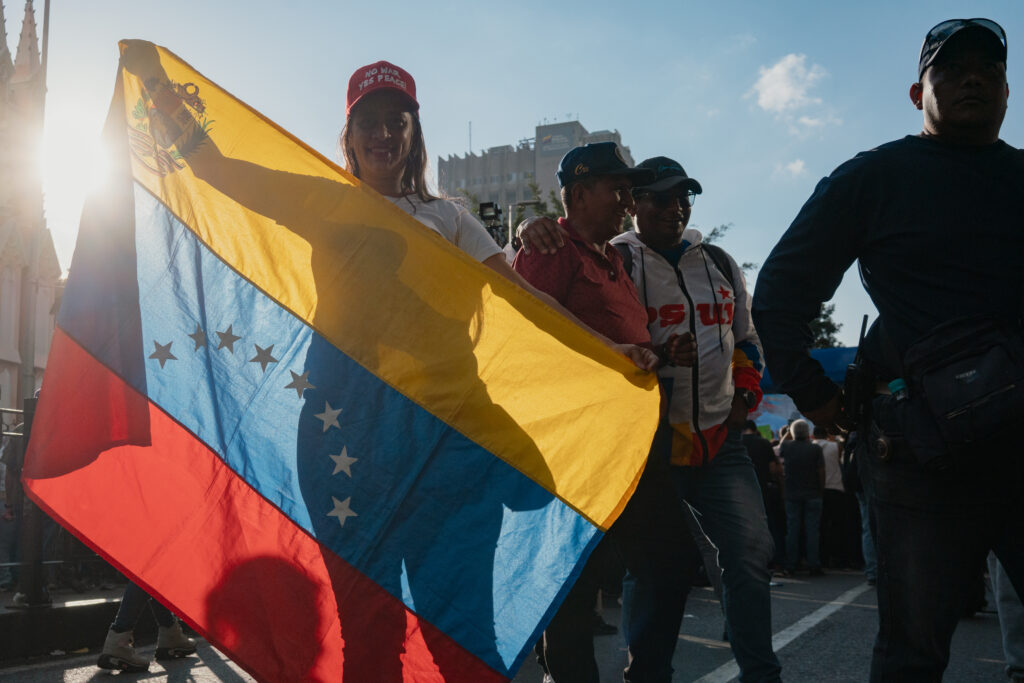
Politically connected U.S. business interests are searching for the fastest route to Caracas to start vetting investment opportunities in oil- and resource-rich Venezuela, where the economy could be primed to open up after President Donald Trump ordered the removal of leader Nicolás Maduro.
The economic opportunity for American firms in Venezuela could be the greatest windfall since the collapse of the Soviet Union, some prospective investors say.
The country is home to the world’s largest proven oil basin, and to extract it, Venezuela boosters say, the country will need new pipelines, repaired roadways, better seaports, more housing and health care, and everything in between. All of that could represent an opportunity, some U.S. executives hope. Future Venezuelan bonds — when the U.S. government eases crippling sanctions — are the talk of financial group chats, investors told The Washington Post.
There’s also a wealth of other commodities in the country — which is larger than Texas — that U.S. officials have said they want Washington to control, or at least play a part in rebuilding. Others warn that any investment could involve sinking money into a failed state whose top export is now being requisitioned by the United States.
At least so far, some investors seem undeterred.
“Back in the day, it was oil, oil, oil. Now we’re looking at one of the largest reserves of natural gas in the world. That means there’s probably more oil,” said Hans Humes, the chairman of Greylock Capital Management, which holds some of the country’s public debt. “There’s minerals, diamonds, gold. There’s an incredible amount of commodity wealth down there. And people talk about de-risking? Give me a break. Everyone who works in commodities is used to working in some politically fraught environments.”
But Venezuela and its interim president, Delcy Rodríguez, still face the task of convincing foreign investors that the country can overcome decades of “Chavismo” — the repressive economic regime of deceased leader Hugo Chávez, which Maduro carried on — to be a hospitable home for those dollars.
“What you need is to give up state socialism and to enhance the rule of law, get rid of the narcotraficantes and the cartels, but after that you still have a huge problem of a human capital deficit. All the engineers and scientists and high-skill individuals, they all left,” said Ariel Cohen, a senior fellow at the Atlantic Council, a Washington think tank. “That will take time.”
Trump, so far, appears pleased with Rodríguez’s government. He wrote on social media that he called off a planned second attack on Venezuela after authorities there began releasing political prisoners, and that the two nations were “working well together, especially as it pertains to rebuilding, in a much bigger, better, and more modern form, their oil and gas infrastructure.”
During a meeting Friday at the White House with oil executives, Trump said Venezuela’s new leaders “seem to be an ally.” He promised security guarantees for firms that reenter the Venezuelan market and said fossil fuel agreements would “more closely integrate the economies of two major energy powers in the Western Hemisphere.”
Still, some companies are more eager than others to rush in.
“You’ve brought optimism to the table,” Luis Rodriguez, the chief executive of Raisa Energy, said at the event. “And if the conditions are met, the opportunities are absolutely immense.”
Trump also signed an executive order Friday to prevent lawsuits or other legal actions from seizing Venezuelan oil revenue held in U.S. Treasury accounts. A White House fact sheet says the order “affirms the funds are sovereign property of Venezuela held in U.S. custody for governmental and diplomatic purposes, not subject to private claims.” The order also ensures the revenue is “preserved to advance U.S. foreign policy objectives,” the fact sheet says.
Western oil companies have fought in court for decades to recoup their investments from Venezuela after being forced out of the country by Chávez. Exxon is still owed about $1 billion, and ConocoPhillips is still owed almost $9 billion as a result of its assets being expropriated there.
At Friday’s White House meeting, the president indicated that firms that are owed money will not get special consideration, saying: “We’re not going to look at what people lost in the past because that was their fault. That was a different president. You’re going to make a lot of money, but we’re not going to go back.”
Exxon chief executive Darren Woods said Venezuela was “uninvestable” for his company without significant changes to commercial and legal frameworks, and investment protections.
In Caracas, the government is eager for American investment that could inject dollars into the flailing domestic economy, according to people who have consulted with Rodríguez government officials, speaking on the condition of anonymity because of the fragile state of the country. The bolivar has plummeted against the dollar in the past year, according to the Federal Reserve.
Rodríguez, who was previously the country’s minister of economy and finance, is said to understand the value of international — and, potentially, American — investment to stabilize Caracas’s economy.
In 2023, she led the government to push back the legal deadline on repaying $60 billion to international bondholders. Venezuela had stopped making payments on the debt years earlier and could have reneged on the agreements. Instead, the government and the state oil company, PDVSA, preserved the claims for five years, or until the U.S. lifted sanctions.
“A lot of the bad experiences that occurred during Chávez, if you look at the past 10 years under Delcy, no one has been expropriated,” said one of her outside economic advisers. “With the bondholders, she’s maintained their claims. She knows it’s important to return to the international markets, and she wants to maintain relationships with them.”
Some firms have quietly been investing in Venezuela in recent years, focusing on non-oil assets that they believed were undervalued and navigating around the U.S. sanctions. Those investors are now fielding calls from their peers across the financial sector who have questions about how to make money in a post-Maduro Venezuela.
Daniel Rottenberg, a Venezuelan investor who started his career at Lehman Brothers, runs Arqos Capital, an investment fund that since 2019 has purchased increasing amounts of prime real estate in Caracas.
“The recovery of the private sector that began a few years ago went largely unnoticed abroad. It helped fuel the economy, which has been growing around 5 percent per year since bottoming in 2020,” Rottenberg said. “We looked at the intrinsic value of the assets and saw an opportunity.”
Some of the offices Arqos purchased were sold by multinational corporations that left the country during the Maduro regime. The fund transformed the former Procter & Gamble building in Caracas into a tech accelerator and co-working space.
Since the U.S. raid that extracted Maduro from the country, Rottenberg has fielded hundreds of messages from a range of international investors — from large family offices and funds to endowments and foundations — suddenly eager to invest in Venezuela, he said.
“Deploying capital there is very challenging. The amount of money that wants to go in will be difficult to absorb,” he said.
But Rottenberg remains optimistic.
“With a recovery in oil production, GDP could double in three years. Not just from oil, but with the help of the private sector. GDP dropped 75 percent from 2013 to 2019, and we are coming from a very low base,” he said.
Investors in sovereign wealth funds and asset managers who invest in bonds are also among those who have expressed interest in opportunities in Venezuela, said Charles Myers, the chairman of the consulting firm Signum Global Advisors and a former head of investment at the advisory firm Evercore.
Myers is planning a trip for about 20 investors to meet with officials on the ground about investment opportunities in the country, potentially in March if conditions allow. Despite the overwhelming challenges with the infrastructure, he said there is a feeling of “cautious optimism” among investors.
Forty investors have expressed interest in the trip, but he declined to disclose which firms because of nondisclosure agreements. He is communicating with the White House and Trump administration about his plans.
Myers has led similar trips to review reconstruction opportunities in Syria and Ukraine.
“People are missing what the opportunity is,” he said. “When countries emerge from these situations, they can rebuild much faster.”
Sieff reported from Bogotá, Colombia. Maegan Vazquez contributed to this report.
The post Trump’s Venezuela plan lures investors with oil, minerals — and risk appeared first on Washington Post.