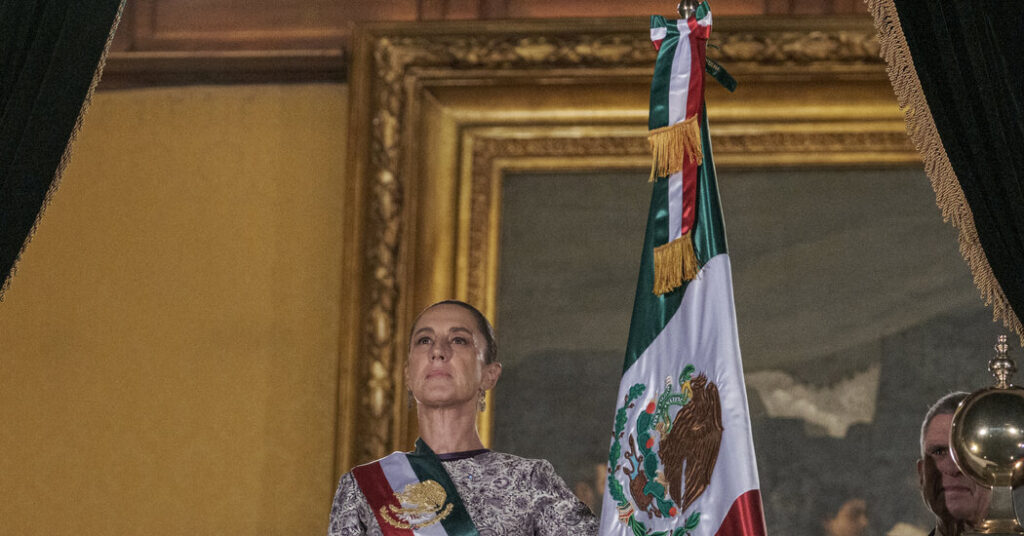
Since President Trump took office and began pressing Mexico to crack down on drug cartels, President Claudia Sheinbaum has projected confidence in the two nations’ bilateral relationship while defending Mexican sovereignty.
But in the aftermath of the U.S. strike in Venezuela, Mr. Trump’s threats of military action against Mexico have grown more direct. He said in a Fox News interview on Thursday night that the United States would “start now hitting land, with regard to the cartels,” specifically those in Mexico.
The interview came days after the capture of Venezuela’s president, Nicolás Maduro, and left Ms. Sheinbaum and her inner circle agonizing over the right tone to strike in the country’s response and every message going forward, knowing the White House would be closely watching, according to three senior Mexican officials who spoke on the condition of anonymity given the sensitive nature of the situation.
Mexican officials for months watched with unease as Mr. Trump floated the idea of “helping” to dismantle drug cartels — including having boots on the ground or targeted strikes — but many aides thought the threats were mostly bluster, two officials said. They believed that the two countries’ deep economic ties and improved security cooperation would shield Mexico from unilateral action.
But that assumption has been shattered, the officials said.
“When we saw what they did in Venezuela, it made us think, ‘Oh boy, this is more serious than we thought, and we are on the list of who could be next, and worse, we have been warned,’” said one senior government official, who also requested anonymity because he was not authorized to speak freely.
In the past few days, Ms. Sheinbaum has tried to thread a narrow diplomatic needle: rejecting U.S. military intervention in Venezuela — and by extension any suggestion of similar action in Mexico — while avoiding language that could provoke the U.S. president.
But the Trump administration has already shown it was unhappy with some of Ms. Sheinbaum’s words.
Hours after the strike in Venezuela, the Mexican president posted a passage on X from the U.N. charter that says countries should refrain from using force against the sovereignty of another nation. The White House responded with a clip of Mr. Trump saying in a television interview that Ms. Sheinbaum was “a good woman, but the cartels are running Mexico.”
The response made Mexican officials quickly realize they had to rethink how to communicate their position and, as one aide put it, proceed with absolute caution.
The morning after the Fox News interview, Ms. Sheinbaum said she had directed the Mexican foreign minister to speak with his American counterpart, Secretary of State Marco Rubio.
Ms. Sheinbaum has repeatedly tried to play down the threat of U.S. military intervention in Mexico. But on Tuesday, she admitted that the U.S. designations of fentanyl as a weapon of mass destruction and cartel groups as terrorist organizations may give the Trump administration “more elements” to justify it.
Now, Ms. Sheinbaum — who must also appease her leftist political party that holds a large majority in Mexico, and has never outright condemned Mr. Maduro — has little room for error in balancing how far Mexico can assert its convictions without paying a price, the officials said.
Part of the Mexican government’s concern is the indictment charging Mr. Maduro, which mentions Mexico 25 times.
U.S. prosecutors have charged Mr. Maduro with narco-terrorism and conspiracy to import cocaine and accused him of partnering with drug traffickers, including the powerful Mexican Sinaloa Cartel, to ship cocaine to the United States through Mexico. They also say Mr. Maduro facilitated the movement of drug money back to Venezuela from Mexico.
Ms. Sheinbaum is acutely sensitive to her country being linked to Mr. Maduro, and even bristled publicly at a major Mexican newspaper for featuring those accusations on its front page.
To gauge the level of risk Mexico might face, the country’s officials spent much of last week analyzing Mr. Trump’s every word. Ms. Sheinbaum’s team tracked how often Mexico was mentioned in U.S. media coverage, comparing those references with those of other countries, including Colombia, Greenland and Cuba.
A chart compiled by the president’s team and reviewed by The New York Times showed that mentions of Mexico rose steadily from the day of the Venezuela attack but then dropped sharply after Monday, as references to Greenland — a territory Mr. Trump has vowed to seize — surged.
The official who shared the chart expressed relief that Mexico was, for now, out of the spotlight.
Despite the unified public front Mexico has sought to project, sharp disagreements have emerged within the cabinet over how carefully its reaction to the U.S. strike in Venezuela should be calibrated, three officials said.
There is broad agreement that Mexico should oppose the U.S. attack and Mr. Maduro’s seizure, in keeping with international law and the country’s longstanding doctrine of nonintervention. But officials and analysts said that expressing that position without triggering diplomatic repercussions has become a high-wire political act.
Some cabinet members worry that Ms. Sheinbaum’s repeated public condemnations of the attacks in Venezuela may backfire, according to one Mexican official and one person close to the administration with direct knowledge of the disagreements. Top aides are particularly concerned about its effect on ongoing tariff negotiations, as well as on the planned review of the United States-Mexico-Canada free trade agreement this summer, the officials said.
Over the past year, Mr. Trump has cited illegal immigration and drugs, specifically fentanyl, as justifications for tariffs on Mexico.
Mexican officials fear that the heightened threat of unilateral military action gives Mr. Trump even greater leverage in negotiations and, in the event of a U.S. strike, could have disastrous economic consequences for Mexico, the United States’ largest trading partner.
“The president is boxed in on all sides,” said Jesús Silva-Herzog, a political analyst in Mexico City.
Mr. Trump said that he had repeatedly offered Ms. Sheinbaum to send the U.S. military into her country to help combat the cartels. But she has consistently rejected that to preserve Mexican sovereignty and in favor of cooperation.
Ms. Sheinbaum tried to reassure the public that such threats are Mr. Trump’s “way of speaking,” arguing that the economic ties and security relationship between the two countries were too deep to unravel.
Her government nevertheless moved aggressively to demonstrate its attention to security, further policing the border, arresting thousands of cartel members, seizing large quantities of drugs including fentanyl and raiding drug labs. They also handed over at least 55 high-level traffickers long sought by U.S. authorities.
Mexico expanded intelligence sharing and formal security coordination with Washington, and last month aligned itself further with the United States by imposing tariffs on imports from countries including China.
Still, the Trump administration has continued to push Mexico to do more.
Two Mexican officials said the country’s main focus now was to emphasize its commitment to the United States by hitting the cartels even harder. The Sheinbaum administration could and should go after — and even turn over to the United States — Mexican officials suspected of ties to organized crime, one official said.
As another official put it, actions speak louder than words.
Jack Nicas contributed reporting.
James Wagner covers news and culture in Latin America for The Times. He is based in Mexico City.
The post Trump Threats and Venezuela Strike Leave Mexico Agonizing Over How to Respond appeared first on New York Times.