By the time dawn broke on Jan. 3, WhatsApp had already lit up across Latin America with frantic messages from heads of state, grappling with how to respond to perhaps the region’s biggest political event in decades.
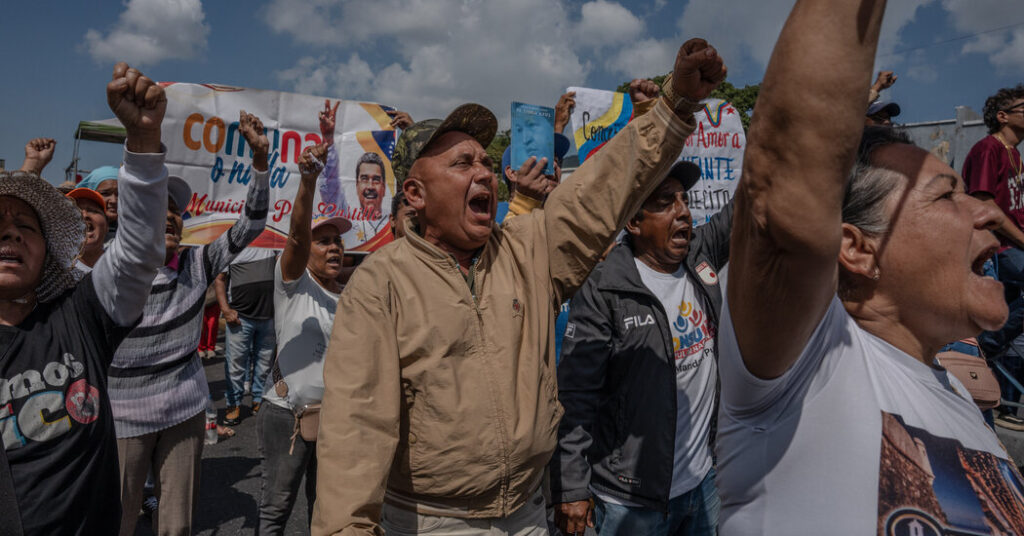
It was what some had wanted and others had feared: The United States had just swept into Venezuela and captured its president.
The responses exposed the fault lines that were already cracking Latin America apart.
The region’s three largest nations — Brazil, Mexico and Colombia, all led by leftists — criticized the American seizure of President Nicolás Maduro with varying degrees of outrage and diplomacy.
A growing roster of right-wing countries, including Argentina, El Salvador and Ecuador, cheered on President Trump.
And a collection of smaller nations, like Guatemala and Peru, kept their heads down so Washington might not notice.
The divergent reactions show how an increasingly aggressive Trump administration is scrambling the politics of Latin America. While their public responses may be different, they all appear to share a common goal in a new era of U.S. interventionism: self-preservation.
“All of the countries are trying to avoid a conflict with Trump,” said Jorge G. Castañeda, a former Mexican foreign minister.
Mr. Trump has made it abundantly clear he wants to control the Americas, stating explicitly that “American dominance in the Western Hemisphere will never be questioned again.”
A look at Latin America’s four largest countries shows the new pressure Mr. Trump is putting on the region, and the limits he is running up against as well.
Mexico
Few foreign leaders are as exposed to Mr. Trump’s demands as President Claudia Sheinbaum of Mexico.
To meet them, her government has taken on drug cartels, stepped up enforcement at the border and imposed up to 50 percent tariffs on many Chinese goods.
In exchange, Mr. Trump says he likes her — while continuing to threaten unilateral strikes inside her country. On Thursday, Mr. Trump appeared to push past rhetoric and into plans. “We are going to start now hitting land with regard to the cartels,” he told Fox News. “The cartels are running Mexico.”
That pledge, days after U.S. aircraft bombed Venezuela, tightened the vice on Ms. Sheinbaum. Ms. Sheinbaum has in turn offered a fairly cautious reaction to Venezuela.
Ms. Sheinbaum has categorically rejected U.S. military action inside other nations, especially her own, but her responses on Venezuela have been carefully worded. “Intervention has never brought democracy, never generated prosperity and never created lasting stability,” she said on Monday.
To avoid antagonizing Mr. Trump and the United States, her nation’s biggest trading partner by far, Ms. Sheinbaum has also been wary of tying Mexico too forcefully to global condemnations of the attack on Venezuela, according to a senior Mexican official who spoke on the condition of anonymity to discuss private deliberations.
While she agreed to sign a joint rejection of the U.S. action — along with Brazil, Colombia, Chile Uruguay and Spain — Mexico’s Foreign Ministry did not release it publicly. That 280-word statement also avoided mentioning the United States by name.
After Ms. Sheinbaum spoke with President Luiz Inácio Lula da Silva of Brazil on Thursday, the Brazilian leader posted that the two leaders “repudiate the attacks.” Ms. Sheinbaum did not post.
Then on Friday, Venezuela’s interim leader, Delcy Rodríguez, spoke with Mr. Lula and President Gustavo Petro of Colombia. But Ms. Sheinbaum did not speak with her, the Mexican official said.
Instead, her government is increasingly concerned about U.S. strikes on her territory and is focused on trying to prevent them by hitting cartels harder and deepening a security partnership with the United States, the Mexican official said.
Brazil
Mr. Lula has more latitude to stand up to the United States.
When Mr. Trump imposed steep tariffs on Brazil to try to scuttle the criminal case against an ally, former President Jair Bolsonaro, Mr. Lula denounced the interference in Brazil’s judicial system and stood his ground.
Perhaps surprisingly, Mr. Lula came out on top: Mr. Bolsonaro went to prison; Mr. Lula got a chummy meeting with Mr. Trump; and Mr. Trump dropped the tariffs.
But Brazil is hardly Mexico. Mr. Lula’s defiance is enabled in large part by Brazil’s size, its distance from the United States and, most importantly, its enormous economic relationship with China. Brazil’s trade with China roughly doubles its trade with the United States.
On Friday, Mr. Lula got even more leverage: Brazil was one of four South American nations to secure a free-trade deal with the European Union.
Mr. Lula has also found that pushing back on Washington is good politics at home. His poll numbers rose during his feud, and he is now favored to win a fourth term this year.
So when the United States attacked Venezuela, Mr. Lula issued one of the clearest rebukes, calling it “yet another extremely dangerous precedent.”
At the same time, Mr. Lula has also been tactful. A punishing new fight with Mr. Trump, especially to defend an unpopular autocrat in Mr. Maduro, is risky for his presidential campaign, especially given Brazil’s energized, pro-Trump right. While speaking out, Mr. Lula has largely avoided naming Mr. Trump.
“Of course we want to have good relations with the United States. It’s a very important country in every sense. But there’s no way to avoid condemning this action,” Celso Amorim, Mr. Lula’s chief foreign policy adviser, said in an interview.
Before the Venezuela attack, “things were moving in a positive way,” he added, referring to the U.S.-Brazil relationship. “I still hope that’s possible.”
As Latin America’s elder statesman, Mr. Lula has tried to defuse tensions in the background. In a call on Thursday, Mr. Lula and Mr. Petro of Colombia discussed building a sort of diplomatic coalition against Mr. Trump’s interventions, hoping to win support from Mexico, Chile, France and Spain. But the idea was preliminary, according to a person present for the conversation.
Colombia
Mr. Petro had been far less diplomatic early on.
After Mr. Maduro’s capture, he posted online incessantly, sparring with Elon Musk, sharing gruesome photos of what appeared to be a casualty and saying, “Latin America must emancipate itself again.”
Mr. Trump, who had already targeted Mr. Petro, sharpened his threats. He called Mr. Petro a “sick man,” accused him of trafficking cocaine and said he “is not going to be doing it very long.” Asked whether he was considering military action against Colombia, he replied, “It sounds good to me.”
It set off an immediate crisis. Mr. Petro called on Colombians to take to the streets and said he would take up arms himself. The government expanded his personal security.
Then, suddenly, the two leaders appeared to make up.
In a nearly hourlong call on Wednesday partly brokered by Senator Rand Paul, a Republican from Kentucky wary of foreign wars, Mr. Petro spoke for most of the time, pledging to fight drug cartels. “I appreciated his call and tone,” Mr. Trump wrote online. They agreed to soon meet.
It was not Mr. Petro’s first gesture of conciliation. He has continued Colombia’s close coordination with U.S. authorities against drug trafficking, including increasing eradication of coca crops, despite once opposing the policy.
He, too, has political realities. While Mr. Petro is restricted to one term, his handpicked successor is on the ballot in May, and Colombians want to get along with Mr. Trump to avoid more tariffs — or an attack.
Argentina
Argentina was once so mired in financial crisis that it was hardly much of a player on the global stage. Mr. Trump has helped change that.
President Javier Milei has become Mr. Trump’s most enthusiastic ally in the region and, by extension, the leader of the Latin American right.
His efforts have paid off. When Mr. Milei was facing an economic and political meltdown last year, Mr. Trump threw him a $20 billion lifeline. One goal was to help Mr. Milei gain control of Argentina’s Congress in midterm elections. It worked. (It also enriched Mr. Trump’s allies.)
That help has come with strings attached. Argentina has agreed to changes Washington has sought, including on intellectual property and opening up its critical minerals. Mr. Milei’s embrace of American influence has also angered many Argentines.
But on the international front, Mr. Milei is in a relatively comfortable position. While other Latin American nations are being threatened with force, Mr. Milei is being praised. The Argentine president “continues to deliver with full force,” Treasury Secretary Scott Bessent wrote online on Friday.
More allies are also emerging. Buoyed by concerns over insecurity and by Mr. Trump’s influence, Chile, Bolivia and Honduras have all swung to the right in recent months. And this year, Brazil, Colombia and Peru could follow, giving Mr. Trump like-minded leaders up and down the Americas.
Annie Correal contributed reporting from Bogotá, Colombia.
Jack Nicas is The Times’s Mexico City bureau chief, leading coverage of Mexico, Central America and the Caribbean.
The post Trump Is the Political Earthquake Shaking Latin America appeared first on New York Times.