Under the cover of darkness 67 million years ago, a dog-size dinosaur crept up to the nest of a bigger, unsuspecting contemporary. Its goal: to snatch a large egg.
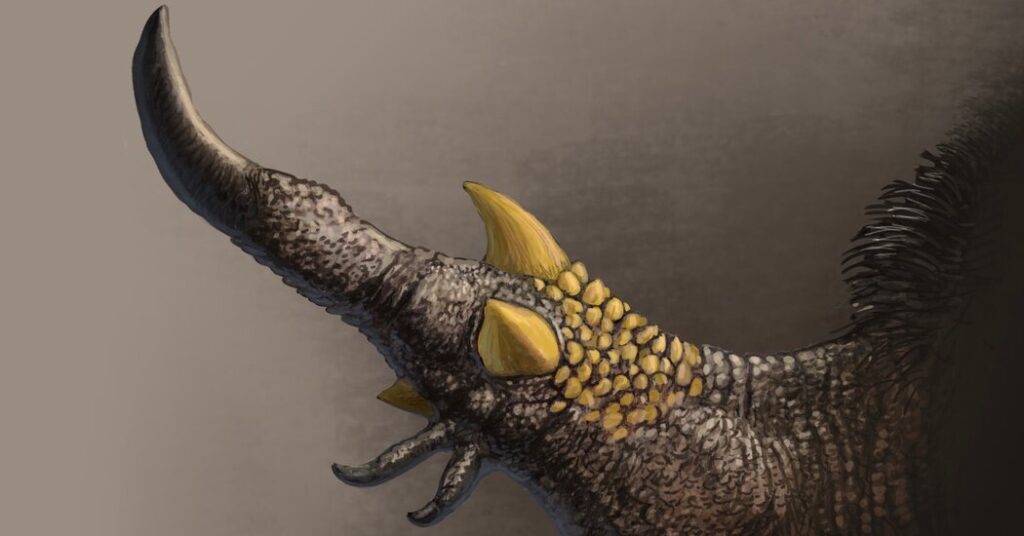
The tiny thief had a handy hack to get to that meal: a multitooled forelimb comprising a giant claw, two side digits and a set of spikes that were ideal for clutching the smooth surface of an egg.
Researchers described this bizarre hand, and the dinosaur it belonged to, in December in the Proceedings of the Zoological Institute of the Russian Academy of Sciences. The team named the species Manipulonyx reshetovi.
The spike-covered hand of Manipulonyx (or “manipulating claw”) turned heads.
“I’ve honestly never been more flabbergasted by any dinosaur fossil,” said Stephen Brusatte, a paleontologist at the University of Edinburgh who was not involved in the study. At first glance, he wondered if it could be “some kind of lobster larvae or starfish,” he said.
A Russian paleontologist unearthed a fragmentary skeleton of the animal in 1979 in the Gobi Desert in Mongolia. The area’s rocks date back to the Late Cretaceous period some 67 million years ago, when this region was a swampy river delta home to diverse dinosaurs, including armored ankylosaurs, dome-headed pachycephalosaurs and the Tyrannosaurus rex cousin Tarbosaurus.
Scurrying underfoot were Manipulonyx, which belonged to a family of diminutive dinosaurs known as alvarezsaurids. These animals possessed tiny forearms that ended in one large digit with a hook-like claw. The other fingers were much smaller. That led some scientists to mistake the dinosaurs for flightless birds.
How alvarezsaurids used their peculiar paws has incited debate. Some scientists think the mysterious mitts dug up insects like modern anteaters. Others have argued that the long-legged dinosaurs could not reach the ground, because of their short arms, and instead ate eggs.
Adding to the confusion was that paleontologists had yet to find the delicate carpal bones in the animal’s wrists that connected their hands and forearms.
That is why Alexander Averianov, a paleontologist at the Zoological Institute of the Russian Academy of Sciences, was so excited when he came across the Manipulonyx specimen and realized the animal’s arms were intact. “The Manipulonyx skeleton is unique in its superb preservation,” said Dr. Averianov, lead author of the new paper. “It is the only known specimen to show articulated carpal bones, reduced side fingers and hand spikes.”
Manipulonyx’s hand spikes were likely encased in keratin, the same material in fingernails. One was on the inside of the dinosaur’s hand, with another wedged between its large finger and its smaller side fingers. The third spike jutted out of the reptile’s palm.
According to Michael Pittman, a paleontologist at the Chinese University of Hong Kong who was not involved in the study, these spikes were “totally unexpected” based on other alvarezsaurid fossils. In 2011, Dr. Pittman helped describe Linhenykus, an alvarezsaurid that possessed only one finger. He said the new fossils were just as surprising, which is “quite a feat for a dinosaur group already known for its strange arms and hands.”
Dr. Averianov believes that other alvarezsaurids closely related to Manipulonyx had barbed hands, but that feature has yet to turn up in the fossil record.
He and his colleagues posit that Manipulonyx used the spikes and the side fingers to grip the slippery surfaces of eggs before using their large claw to crack the shells. They suspect that Manipulonyx raided nests at night — alvarezsaurids most likely possessed large eyes and good hearing.
Alvarezsaurids appear to have had a penchant for pilfering eggs from oviraptorosaurs, a group of dinosaurs with parrot-like beaks once thought to be egg snatchers, too. Further research suggested that oviraptorosaurs were instead doting parents that vigilantly guarded their nests. Another alvarezsaurid skeleton in China was found alongside bits of eggshell from an oviraptorid dinosaur. The original label attached to the Manipulonyx specimen also notes nearby fossilized eggshells.
Dr. Brusatte thinks the egg-snatching hypothesis is plausible, but he wouldn’t rule out the dinosaurs using their hands for something even stranger.
“All I’m confident in saying is that they weren’t using these arms and hands to fly or swim,” he said. “Beyond that, let your imaginations run wild.”
The post This Dinosaur Really Knew How to Get a Grip appeared first on New York Times.