After the dot-com bubble burst in the early 2000s, Candace Nelson reevaluated her career. She had just been laid off from a boutique investment banking firm in San Francisco’s tech startup scene, and realized she wanted a change.
From her home, she launched a custom cake service that soon morphed into an idea for a cupcake-focused bakery. Nelson and her husband — whom she met at the Bay Area firm where she had worked — then pooled their savings, moved to Southern California and together opened Sprinkles Cupcakes from a 600-square-foot Beverly Hills storefront.
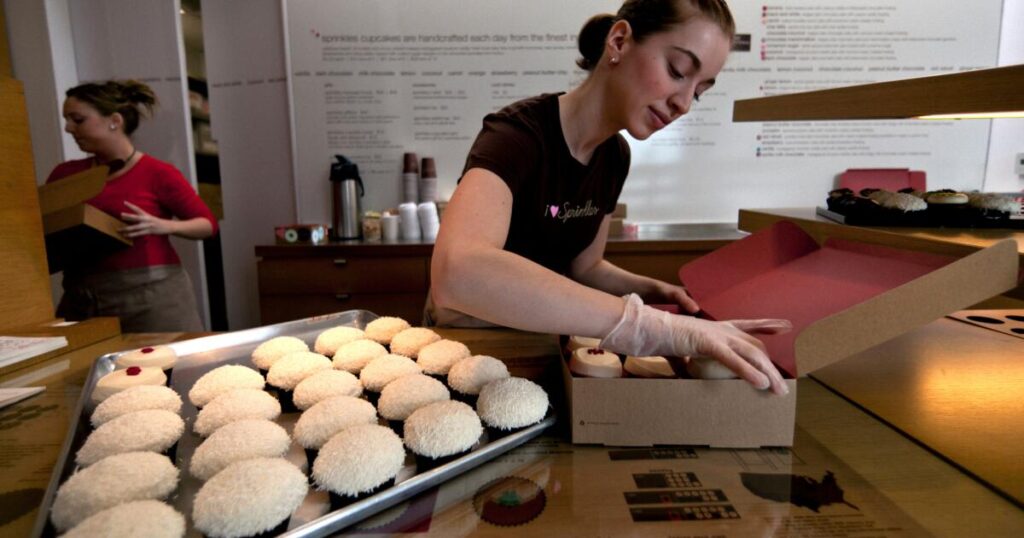
The store quickly sold out on opening day in 2005, and over the next two decades, the Sprinkles brand exploded across the country, opening dozens of locations of its specialty bakeries as well as mall kiosks and its signature around-the-clock cupcake ATMs in several states.
“It was an unproven concept and a big risk,” Nelson told the Times in 2013, at which point the business had 400 employees at 14 locations and dispensed upward of a thousand cupcakes a day from its Beverly Hills ATM alone.
But now, the iconic cupcake brand is no longer.
Sprinkles abruptly shut down all of its locations on Dec. 31, leaving hundreds of retail employees across Arizona; California; Washington, D.C.; Florida; Nevada; Texas; and Utah in a lurch with little notice, no severance and scrambling to fulfill a surge of orders from customers clamoring to get their last tastes.
Although Nelson long ago exited the company, having sold it to private equity firm KarpReilly LLC in 2012, she shared her disappointment with its fate on social media.
“As many of you know, I started Sprinkles in 2005 with a KitchenAid mixer and a big idea,” Nelson said in the post. “It’s surreal to see this chapter come to a close — and it’s not how I imagined the story would unfold.”
The company, now headquartered in Austin, Texas, made no formal announcement regarding the closures and Nelson has not said more than what she posted online. The company did share a comment with KTLA, saying “After thoughtful consideration, we’ve made the very difficult decision to transition away from operating company-owned Sprinkles bakeries.” Neither Nelson nor representatives of Sprinkles and KarpReilly responded to The Times’ requests for comment.
Sprinkles’ demise comes at a tough time for the food and beverage industry. At brick-and-mortar food retail locations, the non-negotiable ingredient and labor costs can be high. And shifting consumer sentiments away from sugar-filled sweets and toward more healthy and functional options, strained pocketbooks, as well as pushes by federal and state governments to nix artificial colors and flavoring, are creating uncertainties for businesses, those in the food industry said.
“Over the last 10 years the consumer has wizened up tremendously and is looking at the back of the label and choosing where to spend their sweets,” said David Jacobowitz, founder of Austin-based Nebula Snacks, an online food retailer.
At the same time, it’s also not uncommon for businesses owned by private-equity firms to close on a whim, where relentlessly profit-driven decisions might be made simply to pursue more lucrative projects. In recent years, private-equity deals have been seen to milk businesses for profitby slashing costs and quality, and have appeared to play a role in the breakup of some legacy retail brands, including Toys ‘R’ Us, Red Lobster, TGI Fridays and fabrics chain JoAnn Inc. On the flip side, private equity can help infuse much-needed cash into a business and extend its life.
Stevie León and her co-workers received a text the night before New Year’s Eve informing them the franchise Sprinkles location in Sarasota, Fla., where they worked would close permanently after their shifts the next day.
León, 33, said her position as a scratch baker mixing batter and frosting cupcakes overnight had been a dream job, since she had been searching for ways to develop baking skills without paying for expensive schooling.
“I really thought it was my forever job and it was taken away literally in a day,” she said. “I’m just taking it one day at a time.”
Ivy Hernandez, 27, the general manager at the Sarasota store, said that after the news was delivered to her boss, the franchise owner, they rushed to learn their options to keep the store afloat but quickly learned it could be legally precarious to continue operating. The store had been open less than a year.
A nearby corporate store, Hernandez said, had been in disarray for months, with employees contending with broken fridges and lapsed ingredient shipments, as managers implored higher-ups to pay the bills so the business could operate properly.
“It really felt like they were trying to do everything they could to screw everyone over as hard as possible until the end,” Hernandez said.
Sprinkles did not respond to questions about the franchise program or allegations of mismanagement in the lead-up to the closure.
The obsession with tiny cakes in paper cups traces back to an episode of “Sex and the City” aired in 2000 showing Miranda and Carrie savoring cupcakes on a bench outside a Brooklyn bakery called Magnolia’s Cupcakes.
“Big wasn’t a crush, he was a crash,” Carrie says to Miranda as she peels down the wrapper on a cupcake topped with bright pink buttercream frosting. She punctuates the quip by taking a big bite, leaving a glob of frosting on her face.
The scene sparked a tourism phenomenon for the bakery — which went on to create a “Carrie” line of cupcakes — and helped propel the burgeoning cupcake industry and companies like Sprinkles Cupcakes, Crumbs Bake Shop and Baked by Melissa to new heights.
Within a decade there was already talk of a “Cupcake Bubble,” coined by writer Daniel Gross in a 2009 Slate article where he argued that the 2008 economic recessionlaid the groundwork for a proliferation of cupcake stores across America, because a lot of people could figure out how to make tasty cupcakes cheaply and scale up without a huge capital investment.
Amid the decimation of many other local retail businesses, one could take over storefronts in heavily trafficked areas for cheap. As a result, “casual baking turned into an urban industry,” Gross said.
The cupcake fervor hit its peak when Crumbs, which had started as a single bakery on Manhattan’s Upper West Side in 2003, went public in a reverse merger worth $66 million in 2011. The wildly popular mini-cakes were selling at $4.50 a pop. But it became clear very quickly that it had grown too large, too fast. It closed in 2014after it lost its stock listing on Nasdaq and defaulted on about $14.3 million in financing.
Analysts at the time said consumers were cooling on opulent deserts and suggested tougher times were ahead for bakeries that focused solely on cupcakes.
But Baked by Melissa has thus far proved those analysts wrong. The company has remained privately owned, and according to its founder, is focused on nationwide e-commerce operations — and on expanding the brand beyond sweets. Founder Melissa Ben-Ishay has gained a following on social media by sharing recipes for nutritious, easy-to-make meals.
“Businesses that prioritize quick value increases to get acquired often crash,” Ben-Ishay told Forbes last year. “We’re committed to maintaining product quality and steady, long-term growth.”
Before its unceremonious and sudden closure, Spinkles company leadership had pushed to diversify its business as part of a strategy to recover from a pandemic-era lull.
Chief Executive Dan Mesches told trade publication Nation’s Restaurant News in 2021 that comparable sales had grown since pre-pandemic years. He said the company had ramped up its direct-to-consumer and off-premises offerings and created a line of chocolates made to look like the tops of their cupcakes. The company also introduced a new franchise program with the goal of opening some 200 locations in the U.S. and abroad over three years.
“Innovation is everything for us,” Mesches said.
Sprinkles was known for, among other things, inventive and somewhat corny methods of customer delivery. Besides the trademark ATMs, the company’s vending machines found at many airports made loud, attention-drawing jingles, drawing dramatic complaints and jokes from TikTok travelers. In the 2010s, the company debuted a custom-built truck — “the Sprinklesmobile” — to deliver cupcakes to cities without physical locations.
Frances Hughes, co-founder of online wholesale marketplace Starch, said there’s no question that gourmet sweet treats are still in vogue. But brick-and-mortar locations are much more risky, with more unpredictability. Having large fixed costs makes a business “extremely sensitive to small changes in traffic or frequency,” while online or e-commerce models can be more flexible.
“I think cupcakes as a product still have demand. But the novelty paths that support that rapid retail expansion have passed,” Hughes said.
When Nelson, the Sprinkles founder, posted her somber message about the closure, she asked people to share memories of the company. Many offered heartfelt responses, her comments flooded with stories, for example, of poor college students making the trek to the Beverly Hills location for a limited number of first-come, first-served free cupcakes.
But many of the comments also criticized Nelson’s sale to private equity.
“You sold it to PE and expected it to not close?? What planet are you living on? I don’t begrudge you for selling as that’s entirely your choice but to think any PE firm cares about a company in the slightest is insanity,” one Instagram user said.
Nicole Rucker, an L.A.-based pastry chef and owner of Fat+Flour Pie Shop, said she didn’t observe a decline in the quality of the product after the private-equity takeover. She has been a longtime admirer of the company, driving up from San Diego to sample the cupcakes when its store opened. The simple attractiveness of the box and the logo, and the consistency in the way cupcakes were decorated, “was inspiring,” she said.
“It had a strong hold on people for years,” Rucker said.
Rucker said however that when a private-equity-owned business shutters, she doesn’t feel sadness: “I would rather give my money to a fellow small-business owner, because I would rather know that every dollar and every sale matters.”
Michelle Wainwright, the owner and founder of Indiana-based bakery Cute as a Cupcake! said that although the niche cupcake industry may no longer be in its heyday — with “Sex and the City” no longer airing and competitive baking show “Cupcake Wars” (which Candace Nelson served as a judge on) now canceled — they are still versatile treats, with great potential for creativity.
And they are sentimental to her, because she uses her grandmother’s recipe.
“Cupcakes are still a winner,” Wainwright said. “It’s my belief that a life with out cupcakes is a life without love.”
The post The rise and fall of the Sprinkles empire that made cupcakes cool appeared first on Los Angeles Times.