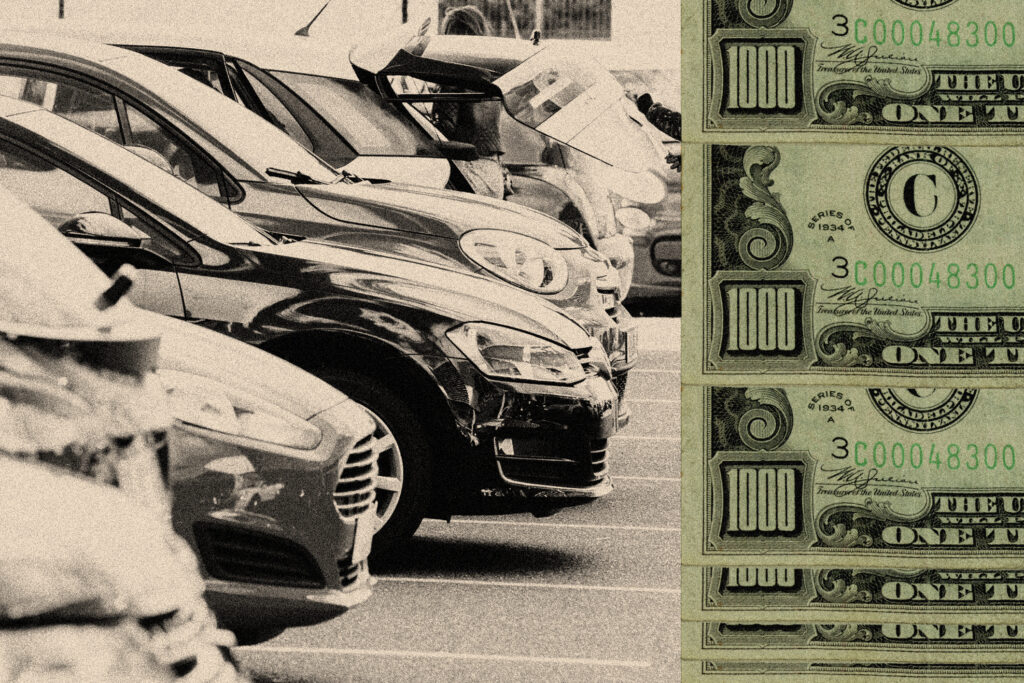
The affordability crisis in America is not a hoax. Just ask anyone in the market for a car.
Whether it’s new or used, landing a vehicle with a manageable monthly payment is increasingly difficult. According to the car-shopping site Edmunds, more than 20 percent of new-car buyers are locked into monthly payments of $1,000 or more. That’s 1 in 5 and an all-time high.
But here is the truly troubling part: Holding down car ownership costs used to be a relatively simple call — buy used, not new — but that advice is losing utility as prices for pre-owned vehicles soar.
According to Edmunds, 6.3 percent of used-car buyers face monthly payments of at least $1,000 based on fourth-quarter data. Shoppers, on average, are financing nearly $30,000 of that purchase, stretching those payments out over 70 months.
For most Americans, a car isn’t a luxury; it’s a requirement to get to work and keep the lights on, food on the table and a roof over their heads. But these numbers show that buying a car — new or used — has become a debt trap for many. The average monthly payment in the fourth quarter was $772 for new and $570 on used with interest rates of 6.7 percent and 10.6 percent, respectively.
“Combine super-high prices of these vehicles with interest rates that we haven’t seen since 2007, 2008, and we have this perfect storm of where you’re borrowing a lot of money, expensively,” said Joseph Yoon, a consumer insights analyst for Edmunds.
If you’re looking for a vehicle, be realistic about what you can afford. Here are some critical questions you should ask yourself long before you start shopping.
What is the total cost of ownership?
Dealers want you to focus only on the monthly payment to deflect from the high interest rates available now and an extended loan term. But you have to look at the interest paid over the life of the loan, money that could be invested for retirement.
Remember that new cars typically carry higher insurance premiums. And keep in mind that the higher the car’s price, the more sales tax you will pay.
Tools like Edmunds’s car affordability calculator can be incredibly helpful. Use the calculator before you start any car shopping.
What’s my monthly budget?
It used to be that housing or rent was a household’s biggest expense, far exceeding any vehicle-related cost, Yoon said. “But now those things are neck and neck for a lot of people.”
If your monthly car payment is starting to look like your rent or mortgage check, you’re probably overextended. To maintain a healthy financial balance in your budget, aim to keep it between 10 and 15 percent of your net pay.
“Your total budget for transportation, including the loan and insurance payments, gas, and maintenance costs, should not exceed 20 percent of your net monthly income,” according to advice from Kelley Blue Book, which also has an affordability calculator.
How long can I afford to go?
A four-digit monthly payment is obviously “shocking,” Yoon said. “But you have to realize we have that number because the average monthly payment is almost $800. And we’re not talking about extravagant, luxurious vehicles. We are talking about cars that families are buying.”
Four-year auto loans were once the norm. Now, to ease the financial sting of steep vehicle prices and higher auto-loan interest rates, car buyers are extending their loan terms to seven years or longer. Will we soon have a 10-year auto loan?
The larger the loan payment, the more likely it will compete with other essential saving goals.
Keep the loan term as short as possible. Don’t just default to the longer terms the dealer may suggest to get you into the car.
If you have to extend the loan past six years, which is already a long time, it’s a clear sign you probably can’t afford the car.
Will I be car poor?
An increasing number of consumers with auto loans were upside-down, meaning they owed more on the vehicle than it was worth.
According to the latest report from Edmunds, 28.1 percent of trade-ins applied toward a new-vehicle purchase had negative equity, a record high. The average amount owed on an upside-down loan reached an all-time high of $6,905 in the third quarter of last year.
More alarmingly, 24.7 percent of these drivers owed more than $10,000, and 8.3 percent owed more than $15,000.
Here’s why this can become a problem. Borrowers who lack the cash to pay off their previous loan often roll that negative equity into the new one. That’s how some car buyers end up with monthly payments of more than $1,000.
“If you have a vehicle right now, and you’re shopping for another car for whatever reason it may be, please, please, please, make sure that you’re not underwater,” Yoon said.
Can I keep my current car longer?
Your car’s at the repair shop. The service agent calls with an estimate that makes you want to scream.
After the initial shock, you might look up your car’s value and see it’s less than the repair bill. You start wondering whether it would be better to just replace it.
But is it better?
A $2,000 transmission repair is far less expensive than borrowing for a $30,000 used car.
However, at some point, if your car is becoming unsafe or so unreliable that you are constantly stranded, replacing it makes financial sense. In this case, Yoon said, be sure to get an independent quote for the value of your vehicle before you go to the dealership.
Is the purchase a want or a need?
Be honest with yourself.
Do you really need to buy a $60,000 SUV when a $25,000 used sedan with the same safety features will do?
Do you need that third row or extended cargo space for the occasional times you need to move furniture?
Affordability is increasingly difficult in today’s car market because so much is out of your control. But by doing the math, you can ensure your next vehicle purchase doesn’t become a financial anchor that weighs down your budget for the next decade.
The post The new vs. used car debate is dead. They’re both expensive debt traps. appeared first on Washington Post.