Geopolitics are being reduced to videos lasting just a few minutes. Social media has surpassed traditional media, not only in the speed with which it is created and shared, but also in its ability to frame our reality. People have the illusion of knowing what is happening and why within just a few hours—or less—of major world events. But reality is more complicated.
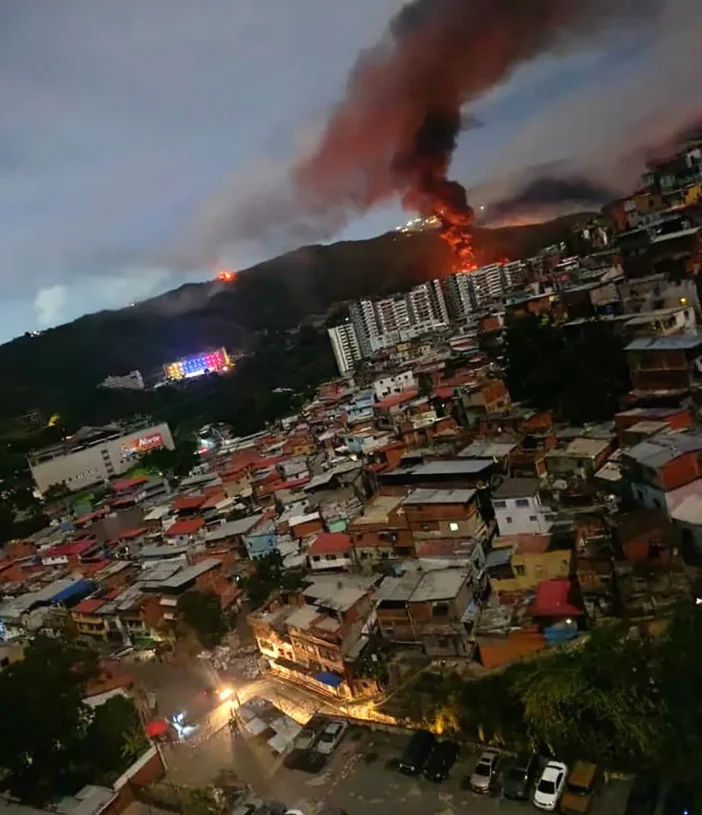
In the early hours of January 3, the United States attacked Venezuela. The sky thundered over Caracas with multiple explosions. Cuban president Miguel Díaz-Canel acknowledged that 32 Cuban soldiers died in combat during the US intervention. The attacks caused at least 80 deaths among other military personnel and civilians, according to reporting from The New York Times. The attack included the capture of president Nicolás Maduro, who was transferred to New York to be tried for narcoterrorism conspiracy and other charges.
Hours later, US president Donald Trump said he would run the South American country until there was a transition he considered satisfactory. At the same time, he said, US oil companies would revive the Venezuelan oil industry. Later, from Caracas, Venezuela’s vice president Delcy Rodríguez called for Maduro’s release, saying that the country “will never again be a slave or colony of any empire.” Maduro, meanwhile, slept in the Metropolitan Detention Center in Brooklyn, where he had been transferred after his capture.
The attack has returned the world to an era that many thought was long over, of direct US military involvement in the affairs of Latin American countries. And it’s playing out very differently from what you might have seen on TikTok.
The Collapse of Fact-Checking in the Digital World
WIRED asked Julio Juárez, a psychological researcher at the Universidad Nacional Autónoma de México (UNAM) and academic secretary of the Center for Interdisciplinary Research in Sciences and Humanities (CEIICH), to analyze how the practice of verifying claims with sources has collapsed in the current digital world.
“The time that traditional media needed to verify information has been devoured by the speed of social media platforms. From the first reports of the attack on Venezuela, social media operated as a massive amplifier that not only transmitted different perspectives but also constructed reality,” says Juárez. “It is the sign of an era where digital communication has primacy: It defines what happens and why. Donald Trump’s narrative was not random; it was an exercise in legitimization that polarized public opinion. Today, citizens face the challenge of exercising critical judgment in an environment that’s designed to provoke immediate reactions, not nuanced reflection.”
On his Truth Social account, Trump announced early in the morning after the military strike that the US had successfully carried out a “large-scale attack on Venezuela.” Maduro had been captured and taken out of the country by helicopter along with his wife, Cilia Flores. Both were transported by a military aircraft to a US ship, which took them to Guantanamo, where they then boarded a plane that took them to New York.
Historia Para Tontos (History for Dummies), a Spanish-language Instagram account that has disseminated its takes on history through the use of maps and satire, summarized the geopolitical tension of early 2026 in a viral video. In the clip, while an optimistic Mexico celebrates the arrival of the new year, an imperial US boasts: “I just bombed Venezuela and captured Maduro for the sake of world security.” The punchline is a critique of American exceptionalism, as the character continues, “And the world is me.”
Comments quickly followed. “Where was the concern for international law when Maduro violated our human and civil rights year after year for more than a decade? Where were those laws when they starved us, killed our students for protesting peacefully, and let political prisoners die? Where were YOU, Mexico, during those 25 years when we were crying out for help? Did you raise your voice to defend our sovereignty when Maduro stole the elections last year? Were you outraged to learn that Cuba, China, Iran, and Russia were stealing our oil and natural resources? Stupid international laws have watched us bleed to death for almost three decades. Do us a favor and keep quiet and look the other way. Thank you. Sincerely, Venezuela,” wrote Dayani López in one reply.
In an interview with WIRED, sociologist Rafael Uzcategui, codirector of the Laboratorio de Paz in Caracas, says: “I’m bothered by the misunderstanding and biased narratives that people, for ideological reasons, continue to impose from outside, when it is now very easy to obtain accurate information about the situation in Venezuela. We’ve made a great effort to work with international human rights institutions, whose reports have provided an important diagnosis, which is public and easily accessible, of the deterioration of the situation. We believed that the evidence would be sufficient to raise awareness among the international community, especially those who claim to be humanitarians and protectors of human rights. Given this double standard, I would prefer them to be more sincere and say, ‘human rights violations only occur when it’s our opponents who commit them.’”
History and Geopolitics for Dummies
Tecayahuatzin Mancilla, the voice behind Historia Para Tontos and a graduate with a degree in international relations from the Aragón Faculty of Higher Studies at UNAM, spoke to WIRED about the video he posted. “It focuses more on issues of international law and the historical reality of Latin America through US interventions, especially in the 20th century,” he explained. “The fact that there is no international arrest warrant against the dictator Maduro calls into question the legitimacy of the action by the United States. What I wanted to expose is precisely how the United States violates international law whenever it’s in their interest to do so; we’ve seen it in the Middle East and we are seeing it again in Latin America after a hiatus of some 32 years.”
“What’s so funny? It’s infuriating to see the US invade a neighboring country, but it’s even more infuriating that Venezuelans themselves are applauding it,” said another comment on the video. Opinions were clearly divided in this polarized conversation.
“Digital blackouts within Venezuela reveal a very specific oppressive agenda, which follows a pattern of persecution and human rights violations,” explains one Venezuelan citizen who preferred to remain anonymous. “Social media content—even seemingly harmless content, such as comedic sketches or cartoons—manages to convey what is happening in Venezuela from an alternative perspective. This narrative makes its way through an algorithm that attempts to depoliticize content,” she says. “On the other hand, historical memory is constructed by the media outlets that survive in Venezuela and that manage to continue to report on the situation, putting themselves at risk with virtually no resources. In the case of the Alianza Rebelde—a collective of media organizations focused on investigative reporting and which includes El Pitazo, Runrunes, and TalCual—they are making a truly important effort to disseminate information.”
“But we all weave the narrative collectively. It is constructed by voices from the diaspora, not only those from within the country. That is why we must be increasingly aware of the narrative we want to construct for the future, and think about how to ensure that this narrative is not limited to ephemeral social media, but that it instead endures. To do this, we need to have uncomfortable conversations about how we imagine the future of the country.”
“I’ve spoken with many Venezuelan friends, and something they all told me was: ‘We don’t agree with bombing our country, but some of us see it as the only way to remove a dictator from power,’” says Mancilla. “Many say that legal, political, and electoral avenues had been tried without success; only direct intervention managed to overthrow him. Obviously, as a Mexican viewing this all from the outside, I don’t share that pain because I didn’t experience it … But there are also Venezuelans who support the regime and denounce this intervention as a violation of their sovereignty. There is a lot of polarization, and both opinions are valid because everyone has their own ideology, perspective, and experiences.”
“There’s a mixture of celebration and euphoria, echoing Trump’s triumphalist logic: ‘I freed them,’ ‘I made a courageous decision,’ ‘It was a flawless military operation,’” Juárez says. “It’s very propagandistic, which suits him very well in the current context of the United States as he’s facing a midterm election; it serves to send a signal to the region and the world.”
“The big challenge is the quality of content, as there is a lot of noise, misinformation, and banal commentary. However, we trust that users have the ability to consume and share content from reliable sources,” says Uzcátegui, codirector of Laboratorio de Paz. “Political discussion is completely banned in Venezuela. Even private spaces for political conversation have almost completely disappeared due to fear. We know that people continue to consume content, but they are careful not to leave a digital trail—no retweets or likes, for example. Social media is the last place where people can get information about the real situation.”
“The number of trustworthy spaces has been drastically reduced,” he says. “In Venezuela’s case, WhatsApp chats are where information is most widely shared, as was seen in the 2024 presidential elections. The challenge now is to feed these archipelagos, these places that people have retreated to due to fears of persecution, with quality content.”
The Challenge for Social Networks: Maintaining Order
The great challenge for these networks that have emerged as the new public square is assuring order, Juárez affirms. “How do you organize this conversation? Not only distinguishing accurate from false information, but dealing with information bubbles, memes of Maduro as a DJ, and everything from humorous comments to hardline political propaganda. Who brings order to all that?” he asks. “I think traditional media still has a fundamental role to play. They are the most qualified to, at a minimum, organize the conversation. They tell us not what to think, but instead say: ‘Look, this happened, these are the implications, this is what people are talking about, and this is why we need to be careful about this other thing.’ Someone has to take charge of organizing the conversation because if you go to one’s timeline on TikTok, X, or Instagram, you’ll find chaos. We’ve gone from hard news to unfiltered hate speech,” he says.
For Mancilla, there is a lot of misinformation echoing around social media. “It has recently caused a breakdown in dialogue. I notice that people are sometimes afraid of dialogue because they are afraid of being wrong. They get stuck on one idea. There is no longer anywhere that you can say, ‘I understand your point, listen to mine. That has been lost on social media; everything is framed in black and white. There are no nuances,” he says. “One person feels backed by 10,000 others and believes they are right, closing themselves off to any other ideas. We all have ideals, but we should be open to listening to each other, even when we disagree. That’s the goal of dialogue. In my international relations program, we were told that dialogue is complementary and it’s very good when different sides disagree, because it means there is a good debate. There were no winners, just shared ideas. Social media no longer allows for that sort of openness.”
For Juárez, the main factor behind digital disruption is disintermediation. Basically, that each of us is now our own media outlet. “That’s what these platforms have sold us: You choose what to be informed about and you stay inside a bubble. You seek out information that confirms what you already knew or thought. If you think what happened in Venezuela was good, you will look for information that supports that, and vice versa. It creates an environment where we only hear what we want to hear.”
According to the Digital News Report 2025, the migration to digital platforms—especially by younger generations—is becoming increasingly evident: 16 percent of those surveyed reported turning to TikTok frequently for news. The figure for WhatsApp was 19 percent, Facebook 36 percent, and YouTube 30 percent.
Beyond the Algorithm
Polarization doesn’t need a malicious algorithm to disrupt public conversation; it is an inevitable consequence of the basic design of social platforms. By emulating environments which emphasize certain forms of connection and dialogue, a persistent loop emerges where emotional content is the most visible and, eventually, it shapes the very architecture of the network. It is not a question of users actively seeking conflict or platforms being designed with any malicious intent, but rather the result of a rewarding emotional reaction over measured analysis.
For Petter Törnberg, who worked on the study, “this toxicity is an unintended consequence of the structure of posts and followers. The act of sharing content is often impulsive and deeply partisan; users react to anger or scandal, propagating a narrative that, in turn, shapes their own digital environment. This feedback loop between emotional action and network structure creates an ecosystem where toxicity becomes the organic norm. Ultimately, the mere existence of basic functions such as forwarding and liking seems to be enough to generate these negative results, turning networks into echo chambers that feed on our own reactive psychology.”
“I believe that digital platforms can continue to be a space for resistance and solutions. But in order to avoid becoming echo chambers, there must be a genuine intention to engage in dialogue. And that doesn’t always happen when we are going through a very difficult time,” explains an anonymous Venezuelan source who spoke to WIRED. “When our emotional wounds override reason, it’s very difficult to understand the perspectives of others. For this to be possible, first the wound has to be identified and understood, and sometimes we won’t be able to find the equanimity to engage in a dialogue. However, that dialogue must inevitably occur.”
“We are now experiencing a great deal of polarization among Venezuelans inside and outside the country because of this event, which I personally consider to be a violent act of foreign intervention. I can understand the joy of those who celebrate Nicolás Maduro’s imprisonment as a moment of justice. But at the same time, I am against foreign intervention, against Donald Trump, and against them taking our resources from us,” this Venezuelan source explains. “We have done everything; we have made every effort possible. We are in this situation because we are cornered and vulnerable to US imperialism, but also from Russia and China. Power has led us to this situation of extreme vulnerability. Digital platforms, however, can be spaces of resistance.”
Too Much Information; Too Little Attention
Due to an information overload, our attention span, which is a finite resource, is stretched too thin, explains Juárez: “There comes a point where we shut down and say, ‘That’s it, this is what I think.’ We generally invest as little psychological energy as possible and use shortcuts to reach our conclusions: I saw the video, I saw the quote, I saw the tweet, and that’s it; I’m done. We simplify because simplification serves as an antidote to saturation. When we are drowning in information, we feel disoriented and anxious. The level of that anxiety depends on our proximity to an event. That desire to embrace a certain viewpoint wins out when what we need is to weigh the many real implications of a situation.”
“My main concern is that we have lost the ability to discern between what is false and what is true. We are willing to accept prefabricated stories. If we lose that ability as citizens, we also lose our agency,” Juárez says. “What we are seeing in Venezuela is not the final episode in a story, it is the beginning of a dynamic that will not stop here.”
This story was originally appeared on WIRED en Español and was translated from Spanish by John Newton.
The post The Danger of Reducing America’s Venezuela Invasion to a 60-Second Video appeared first on Wired.