On an icy Friday morning, Mahad Omar watched armed federal agents run down the street and tackle one of his neighbors to the ground. They handcuffed the man and put him inside a black-tinted S.U.V.
Mr. Omar, 28, an Uber driver, immigrated to Minneapolis from Somalia two decades ago. He had never imagined seeing something like that in his community.
“Minneapolis is a great city,” Mr. Omar said after the agents had left and residents emerged from their homes to discuss in hushed voices what they had seen from their yards and windows. Several women wept.
“It’s never been like this,”said Mr. Omar, one of thousands of Somalis who fled civil war in their country and came to the United States through a federal refugee program, many of them settling in Minnesota.
Cities around the country have taken their turn in the glare of President Trump’s immigration enforcement campaign, and now Minneapolis is the focus. The federal crackdown, triggered in large part by a viral video purporting to show widespread fraud at Somali-run day care centers, is concentrated among the city’s Somali-Americans.
Somali residents, lawmakers and civic leaders in Minneapolis and beyond say they have been accustomed for decades to being treated with suspicion for being Black, immigrant or Muslim. But the disparagement from Mr. Trump and his allies, both in his first term and now, has solidified into a more direct rhetorical attack on them.
Now, many said, they feel targeted simply for being Somali.
“Maybe they got tired of attacking Muslims,” Imam Yusuf Abdulle, director of the Islamic Association of North America, which oversees more than three dozen Islamic centers and groups across the country. “Now, they have another name, another reason,” he said, citing Vice President JD Vance’s use of the words “the Somali problem.”
Most Somali Americans in Minneapolis say that in recent weeks they have been subject to a level of intense scrutiny far beyond anything that had come before. The tensions ratcheted up further last week after a federal agent shot and killed a woman, Renee Nicole Good, at the wheel of her S.U.V., which was partially blocking a lane in a Minneapolis neighborhood. The killing has ignited protests nationwide, but has evidently not diverted the federal pressure in Minneapolis from its focus on Somalis.
Representative Ilhan Omar, who in 2018 became the first Somali-American elected to Congress, spoke on Saturday morning outside a federal building in Minneapolis, where she said she and two other congressional Democrats were denied full entry to inspect the detainee holding area.
“He’s trying to scare them and terrorize them every single day,” she said. “And what we know is that Somalis are not intimidated.”
President Trump’s derision of immigrants stretches back decades and has largely focused on people from African and developing nations. At times, that has included Somalis, with Mr. Trump calling their resettlement in Minneapolis a “disaster,” and repeatedly attacking Representative Omar. He unleashed an especially xenophobic tirade at Somali Americans in December, when at the tail end of a Cabinet meeting, he called Somali immigrants “garbage” as he denounced a fraud scandal in Minneapolis involving social services run by Somalis.
“President Trump is right,” said White House spokeswoman Abigail Jackson on Saturday. “Aliens who come to our country, complain about how much they hate America, fail to contribute to our economy, rip off Americans, and refuse to assimilate into our society should not be here.”
Last week, Mr. Trump said his administration was taking steps to strip some naturalized Somali Americans of their U.S. citizenship.
First Refugees, Then Citizens
The attacks have reverberated across Somali communities in the United States, where refugees began arriving in large numbers in the early 1990s, fleeing a country that was engulfed in civil war. In 1990, there were around 3,000 Somali-born people nationwide. Many of them in Southern California where the climate was familiar, according to Ahmed Ismail Yusuf, a writer and teacher who was raised in a nomadic family in Somalia and now lives in Minneapolis.
In 1992, though, a handful of young Somali men found work at a poultry plant in southwest Minnesota, and word began to spread of a friendly (if cold-weathered) place with plenty of jobs, good wages and a low cost of living.
Now there are 260,000 people across the country with Somali heritage, and roughly 42 percent of them live in Minnesota, mostly in and around Minneapolis and -St. Paul. The majority are U.S.-born, and more than 92 percent are U.S. citizens. The rest have various forms of legal protection, including visas and asylum, or are undocumented.
Nationwide, about 700 Somalis nationwide were living and working under the Temporary Protected Status program, a humanitarian initiative for people from troubled nations. Trump officials have long targeted the program, and in November they moved to revoke the program’s protection of Somali immigrants.
Still, Minnesota has a long history of immigrant resettlement and has, for the most part, been a welcoming place.
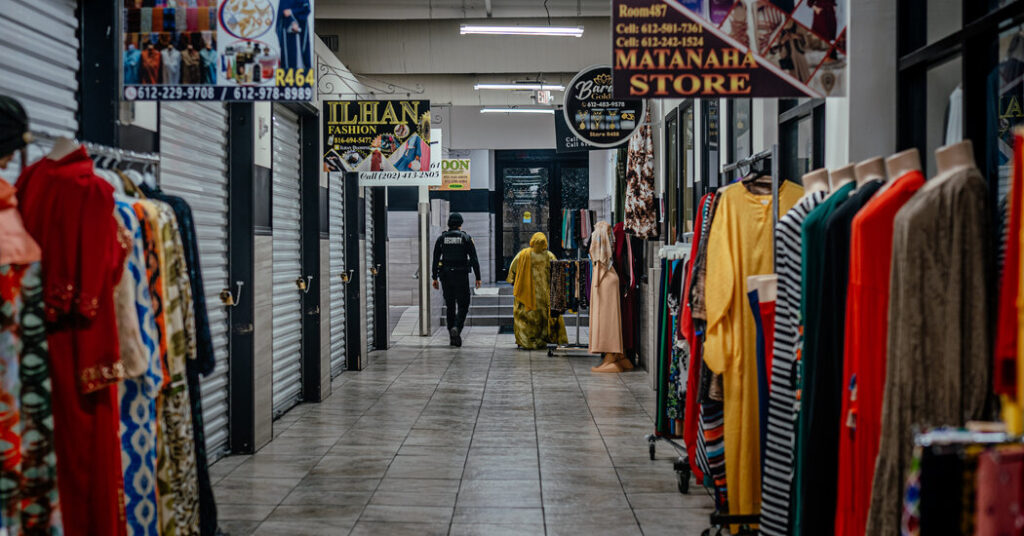
In the southern part of the city, the scent of spices, perfumes and homemade foods waft through the Karmel Mall of Somalia, a thriving cultural hub that includes shops, child care centers, a senior care facility, a mosque and a Quran school. Further north, stores in the Cedar-Riverside area, known as “Little Mogadishu,” attract new arrivals.
Over time, poverty levels in the Somali community have dropped, and homeownership has increased. Many Somalis have found work in home health care or opened small businesses. Some opened child care centers, said Ismail Mohamed, an Ohio state representative and one the first Somali-Americans to be elected to the Ohio General Assembly, because they wanted their children to be looked after by people who shared their language and religious values.
Somali-Americans have also become involved in politics, winning seats on city councils, in state legislatures and in Congress.
Suspicion and Scrutiny
Still, the Somali community has at times been viewed with suspicion. After the Sept. 11 attacks, when anti-Muslim sentiment spread nationwide, agencies that people used to send money to relatives in Somalia were temporarily shut down. In the late 2000s, when federal authorities discovered that around 20 Somali-Americans had left Minnesota to join terror groups overseas, federal law enforcement agencies began working with the community to prevent the radicalization of young men.
In 2016, after President Trump denounced Somali refugees at a nearby campaign rally, the Dar Al-Farooq mosque in Bloomington, Minn., which has a largely Somali congregation, began receiving threatening emails and calls. The harassment peaked in 2017 when a white supremacist bombed the mosque.
The last few weeks, though, have felt altogether different.
Armed immigration agents have been marching through apartment complexes and shopping malls, demanding to see documents and handcuffing some people. Black tinted S.U.V.s have circled residential blocks while local volunteers kept watch and blew whistles to warn others in the neighborhood that the agents were coming.
Somali-American schoolchildren have come home in tears, saying that classmates had called them “garbage.” Strangers with no evident connection to the government have walked into cafes and Somali-run businesses and demanded to see people’s papers.
“Just going to the grocery store, people look at you differently,” said Mina Omar, 27, a nurse who was born and raised in Minneapolis. She recalled coming to the defense of an elderly woman recently when another shopper demanded that the woman “go back home.”
Sidewalks in Somali neighborhoods, once bustling, are now quiet.
Tricia McLaughlin, a spokeswoman for the Department of Homeland Security, said on Saturday that “claims law enforcement officers are ‘terrorizing the Somali community’ is absolute garbage.”
“Our law enforcement are arresting criminal illegal aliens who are terrorizing American citizens,” she said.
A Viral Video Inflamed Tensions
Although Mr. Trump had been making bigoted remarks about Somalis for some time, declaring that “they come from hell” and “we don’t want them in our country,” the deep chill in Minneapolis set in following the posting of a viral video that purported to expose extensive fraud at Somali-run child care centers in Minnesota.
“Once I saw the video,” said Mr. Yusuf, the writer, “I was actually punched in the gut. I just knew something terrible was just on the horizon.”
Federal prosecutors in Minnesota have described a brazen and sprawling fraud scandal in which people stole millions and possibly billions of dollars from state social service organizations. Of the 98 people who have been charged in connection with the fraud so far, 85 are of Somali descent, according to the White House.
“ICE’s homeland security investigations are conducting operations to identify, arrest, remove criminals who are defrauding the American people in Minnesota,” Ms. McLaughlin said. “We will root out this fraud and hold those who steal from American taxpayers accountable.”
Abdulahi Farah, a Somali American community organizer, and other Somali leaders said that fraud should be investigated and rooted out because child care and senior centers are desperately needed in Minnesota and should function with integrity. But he and others said they saw in the White House’s reaction an orchestrated attempt to entirely take away the services, denigrate all Somali immigrants and use them as scapegoats.
“It’s a way to distract Americans,” Mr. Farah said.
Fraud allegations in Minneapolis first became public years ago, but the viral video, which was posted online in late December, attracted sudden, intense nationwide scrutiny to a community that was used to being overlooked.
“We are just like a blip, literally — in a population of, like, 330 million, we are such a small, insignificant group,” said Mr. Mohamed, the Ohio state representative. “I don’t think I would have naturally thought that the vice president and the president, Elon Musk and everyone would be tweeting about Somalis.”
Some Somali Americans have felt heartened by the surge in protests against the Trump administration’s actions since Ms. Good was killed. Mr. Farah, the mosque leader, likened her spirit to that of the neighbors and community volunteers who helped rebuild his mosque and who stood outside with signs spelling messages of love and solidarity to successfully deter harassers.
On a snowy Saturday evening, Mr. Farah and other organizers were passing out Sambusas, or East African pastries, they had bought from ailing Somali restaurants to people stopping by to pay their respects at a memorial for Ms. Good.
A day earlier, Taher Muse, 38, the owner of an auto shop in Minneapolis, ran toward a man who had been stopped by federal immigration agents down the block, shouting at him that he had a right not to answer any questions. Within minutes, a caravan of black S.U.V.s pulled up outside Mr. Muse’s garage.
Mr. Muse, who was born in Mogadishu, arrived in Minneapolis when he was two years old, as his parents fled the Somali civil war. He became a U.S. citizen long ago, and opened his auto repair shop last year after working at a laundry list of other jobs — including as a poultry factory worker, a truck driver, and an employee at a rental car company.
Now federal agents were asking Mr. Muse and his workers for their identification. Among the agents was Gregory Bovino, a top Border Patrol official and key figure in the federal immigration crackdown. Mr. Muse and the other workers at the garage refused to answer any questions and waved the agents off.
“I thought they would stop after killing Renée Good, but they are still out here harassing people,” Mr. Muse said later Friday afternoon, after the federal agents had left. Still, he said, he believed there were limits to what the administration could do.
“This country is better than they think it is,” he said.
Kirsten Noyes and Jeff Adelson contribued research.
Jazmine Ulloa is a national reporter covering immigration for The Times.
The post Somalis Fled Civil War and Built a Community. Now They Are a Target. appeared first on New York Times.