The top Democrat on the Senate Intelligence Committee raised questions on Sunday about whether a military strike to support protesters in Iran would backfire, strengthening the Iranian government rather than weakening it.
On Saturday, The New York Times reported that officials had briefed President Trump on options for possible military strikes on Iran in order to follow through on his threat to attack the country for cracking down on protests driven by economic grievances.
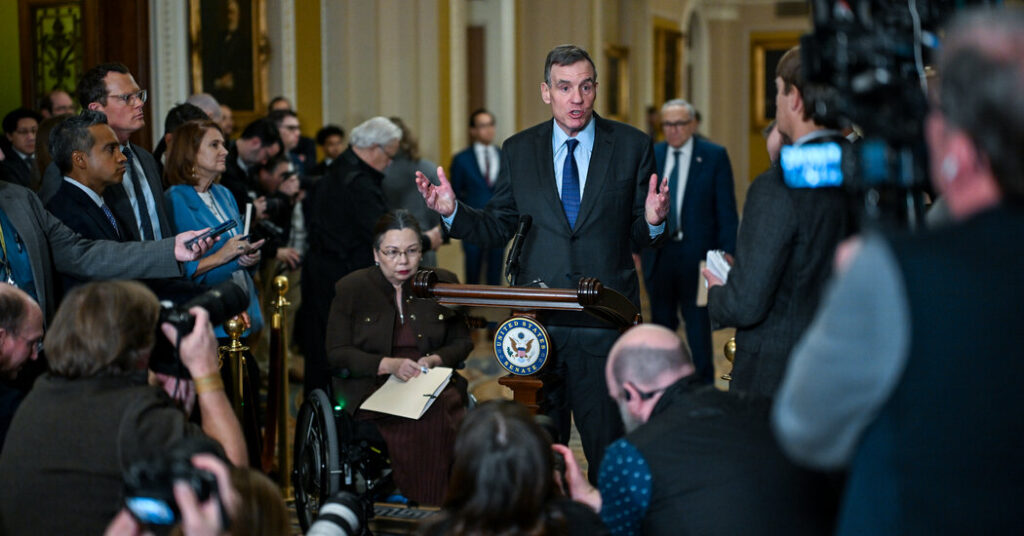
In interviews with CNN and Fox, Senator Mark Warner of Virginia, the ranking Democrat on the Intelligence Committee, said he was skeptical of a military strike in Iran because American intervention there has had unintended consequences.
“The last time America intervened militarily in Iran was 1953, when a C.I.A.-led coup overthrew the Iranian regime to protect oil, by the way,” Mr. Warner told CNN. “And that, ultimately, most historians would say, was what led to the ayatollah’s rise in the 1970s.”
Mr. Warner said the United States did not have strong visibility into Iran, where the government has turned off the internet in hopes of stopping the spread of the protests.
U.S. intelligence agencies have not made firm predictions about what the results of the protests will be, but have been focused closely on them in recent days, according to American officials. While the United States has worked to build up its intelligence gathering in Iran, its network of sources has been devastated in the past, leaving Washington struggling to improve its understanding.
Recent American intelligence reports have highlighted how the protests are growing and posing a real threat to the government in Tehran. Spy agencies have told policymakers that they believe the Iranian government is trying to put down the protests, but in such a heavy-handed manner as to give Mr. Trump an excuse to take action.
Still, critically, the intelligence reports have not been able to assess whether the protesters or the government will have more endurance. The protest movement may need some sort of outside support to continue, the intelligence reports have said, according to officials briefed on the material.
Mr. Warner said the outside support should come in the form of international pressure rather than a U.S. military operation. Any sort of U.S. strike carries the risk of uniting more of the country on the side of the government, he said.
The internal dynamics of a country like Iran are “extraordinarily complex,” he said, and any U.S. involvement needs to happen with the utmost care.
“I don’t think we have enough visibility at this point to start at least planning major military actions,” he said on CNN.
Julian E. Barnes covers the U.S. intelligence agencies and international security matters for The Times. He has written about security issues for more than two decades.
The post Senate Democrat Says a U.S. Strike on Iran Risks Strengthening Its Government appeared first on New York Times.