On a late October evening, well into the school year, six Russian soldiers wearing balaclavas burst into an apartment in occupied southern Ukraine. “Do you go to school?” one demanded of Ksenia, who was 15 at the time.
“I do, but I’m sick now,” she lied.
The soldiers confiscated Ksenia’s phone and laptop, she said, and arrested her stepfather on suspicion of pro-Ukrainian views. They forced her to end her boycott of a Russian-language school, she said — a school she described as requiring students to listen to the Russian national anthem, watch “documentaries” portraying Russia as Ukraine’s savior and attend classes on Russian patriotism.
“Teachers told us that it is very important to cheer for your country,” she said. They meant Russia, which had invaded her country and arrested her family members.
Militarism and Russian chauvinism are defining features of the education system Moscow has imposed on occupied territory in Ukraine over nearly four years of war, according to education experts, rights groups, and parents and a dozen children interviewed by The New York Times who attended the classes. The experts and rights group say the aim is to Russify children, erasing their Ukrainian cultural and linguistic identity.
“Russification is so pervasive and toxic that children believe in it,” said Kateryna Rashevska, an international law expert at the Regional Center for Human Rights, a Ukrainian nongovernmental group.
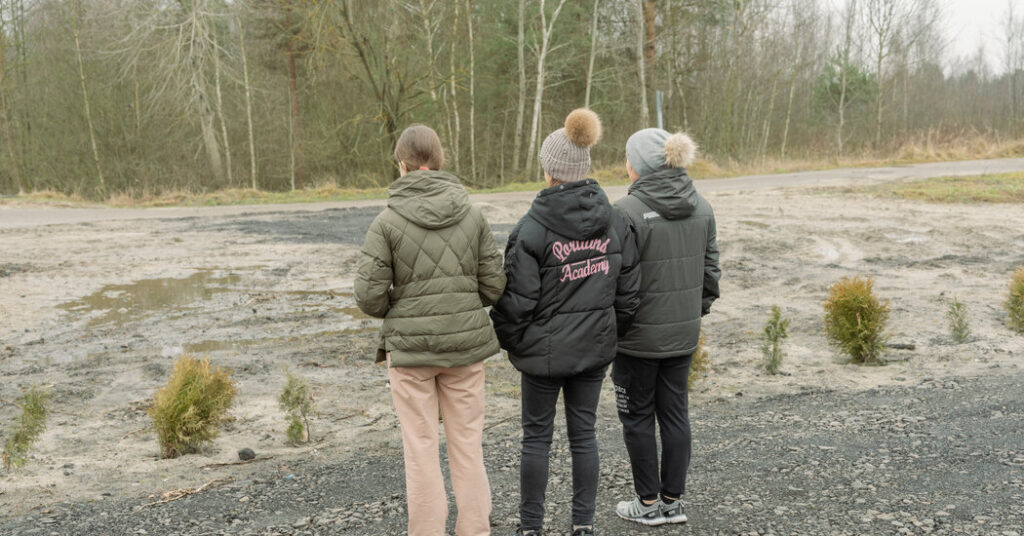
Children and parents were interviewed after they had made their way back to unoccupied Ukraine; their last names are not used in this article because nearly all still have relatives in occupied areas who would be at risk of persecution if the children’s full names were made public.
The people who escape to Ukrainian-controlled territory come in a small but steady stream by going to Russia, through Belarus and then to a remote border crossing into the village of Domanove, in the northwestern corner of Ukraine. It is a roundabout trek of as much as a thousand miles, often made partly on foot.
Ukrainians making the journey have to clear bureaucratic hurdles, sometimes inventing tales of sick relatives they need to visit. They also must pass through dreaded “filtration” camps where the Russian authorities interrogate, register and sometimes detain them, deciding whether they may leave.
Dozens of children turn up every month at the border crossing, many of them teenagers traveling alone, as Ksenia did, according to Ukrainian organizations that help children from occupied territories.
Yana, 17, walked alone through the checkpoint recently, afraid and exhausted, her head pulled into her shoulders and her bell-bottom jeans wet above the ankles from trudging through fields. She had left her parents behind in occupied territory, taking four days to make the trip.
“‘Ukraine will not be back, so we are switching to Russian,’” she said teachers declared on the first day of school.
As an occupying power, Russia is obligated by treaties it has signed to uphold children’s existing identity, traditions and education, Danielle Bell, the head of the U.N. Human Rights Monitoring Mission in Ukraine, said in a written comment to The New York Times. Russia has violated these obligations, she said.
Yana said teachers showed Russian World War II movies and photographed the students as they watched, documenting their participation. She didn’t like being photographed by the Russians but had no choice. She said she tried not to listen to the films.
One day, she said, all children without Russian passports were told to board a bus and driven to an office to have passports issued.
Children are told repeatedly that Russia played a heroic role fighting fascism in World War II and that the war against Ukraine is a continuation of that struggle, a message also delivered in schools in Russia itself.
A 19-year-old woman from the Russian-occupied Luhansk region of Ukraine who now lives in Kyiv said students back home were told that in Ukraine, there was a Nazi regime just like Hitler’s, one of the Kremlin’s false claims justifying the invasion.
Olha, 18, recalled a recurring homework assignment, to watch President Vladimir V. Putin’s news conferences and take a selfie with the laptop screen in the background, so that the Russian leader’s face was also visible. The assignment was completed by uploading the photo to the school’s website.
Some parents in occupied territory try to keep their children out of schools, teaching them at home or enrolling them in online Ukrainian programs, but the Russian authorities have threatened to strip parental rights for doing this, say parents and rights groups that spoke to The Times.
Tetiana, 37, who escaped across the Belarusian border with her two daughters last month, said the police had come to her home and threatened to take her children away if they did not start attending school.
Another woman, who is also named Tetiana and crossed recently, said she fled with her daughter, Maria, 8, and her son, Oleksiy, 18, after the local authorities called with a warning that they would take her children.
She added that she also feared that Oleksiy would be drafted into the Russian army.
Students are required to take courses on Russian military history, according to the interviews. The curriculum also has mandatory elements like “Important Conversations,” which are pro-Kremlin discussions of current events, and “Lessons of Courage,” about heroic deeds of Russian soldiers.
These begin in the first grade, said Oleksandra, 36, who lived in Russian-occupied Crimea until October with her husband, David, and two sons, ages 9 and 11. Every Monday, her boys had the “Important Conversations” lesson, she said.
“My children were taught to draw tanks instead of the usual things,” Oleksandra said. “They were also marching in the schoolyard.”
Teachers asked her children about their attitude toward the fighting in Ukraine, she said. She suspected that the questioning was aimed at determining the parents’ political views. “We started feeling that sooner or later they would come to our home,” she said.
“You need to be either on the same page with Russians or leave,” she added.
The schools sign children up as early as first grade for the Young Army club, whose members wear military-style uniforms, experts say. There are also police and emergency-service clubs for children, with their own uniforms.
A study released in September by the Humanitarian Research Lab at the Yale School of Public Health documented at least 210 sites in Russia and in occupied areas with school programs where Ukrainian children were taught Russian nationalist curriculums or military training.
Some children try to resist the propaganda, while others are drawn in. It can depend on “the different conditions and the level of danger where they were,” said Olena Rozvadovska, a founder of the Voices of Children charity, which provides psychological support to children who have returned from occupation. Children seek safety by conforming, she said.
“To be honest, when so many grown-ups around me were saying that Ukraine started the war, I started believing them,” said Danylo, 16, who spent six months in a Russian-run children’s camp and school.
He had lived with his family in the southern city of Kherson, which Russian forces overran in 2022, and which Ukraine recaptured later that year. While Kherson was still under Russian control, when he was 13, the authorities sent him to the camp, in Crimea. Soon after, Ukraine took control of Kherson, leaving Danylo in the camp on the other side of the front line. He remained there for six months, until his mother got him out.
Every morning in the camp, he listened to the Russian national anthem while standing at attention, he said. Each time the camp had visitors, Danylo and the other children marched through the yard to greet them, chanting, “Go forward, Russia!”
Oleksandra Mykolyshyn contributed reporting from Kyiv, Ukraine.
Maria Varenikova covers Ukraine and its war with Russia.
The post Schools in Occupied Ukraine Aim to Turn Children Into Russian Nationalists appeared first on New York Times.