Since his election in May as the first American pope, Leo XIV has become a political and temperamental counterweight to an incendiary American president.
A face-off between the two most prominent Americans on the world stage was inevitable, if only for the contrast between President Trump’s blustery inconstancy and Leo’s soft-spoken yet firm dignity. The pope is “neither quiet nor shy — if he has something to say, he will say it,” in the words of his eldest brother, Louis Prevost, a Trump devotee whom the president has hosted in the Oval Office and at Mar-a-Lago.
Indeed, after Mr. Trump sent forces to seize the Venezuelan leader Nicolás Maduro, the pope declared that Venezuela’s “sovereignty” must be guaranteed along with “the rule of law enshrined in its Constitution.” Leo had already urged the United States not to follow through on threats against Venezuela and criticized the administration’s military buildup in the Caribbean. He also repeatedly lamented the treatment of immigrants by U.S. authorities and called on American clergy members to be vocal and active on the issue, which they have been.
But rather than viewing Leo’s statements as one half of a mano-a-mano between pope and president, they may be better seen as the articulation of a post-Trump global order, one informed by universal values and institutional norms rather than tribal and individual self-interest. Leo is not looking for a fight with Mr. Trump; he is looking past him. When he challenges the president’s policies, he does so as an American-born pope recalling the American-inspired system that Mr. Trump is dismantling — one that values statesmanship over gamesmanship, the common good over national conquest and common decency over jingoist bullying.
In early December Leo met with President Volodymyr Zelensky of Ukraine and said he would like to visit the country, which has suffered a yearslong assault from Russia. Hours later, he criticized the Trump administration’s peace plan: “Trying to reach a peace agreement without including Europe in the discussions is not realistic,” he said. “The war is in Europe.”
Soon after, in remarks that could have been aimed at the MAGA movement, Leo told European politicians on the center-right that “the mark of any civilized society is that differences are debated with courtesy and respect.” He later told diplomats that honesty is the greatest virtue in “an international context plagued by prevarications and conflict” and he blasted the “war of words armed with lies, propaganda and hypocrisy.”
Throughout the Christmas season and into the new year, Leo continued to call for a world based on old ideals, pushing for “the strengthening of supranational institutions, not their delegitimization.” He lectured civic leaders on how to be responsible public servants. On Christmas he urged world leaders to pursue peace through dialogue — even as Mr. Trump was launching military strikes on Islamic militias in Nigeria, ostensibly to protect Christians.
In his state of the world address to the diplomatic corps at the Vatican on Friday, Leo delivered his most thoroughgoing defense of postwar multilateralism, calling the rule of law “the foundation of all peaceful civil coexistence.”
“A diplomacy that promotes dialogue and seeks consensus among all parties is being replaced by a diplomacy based on force,” the pope said. “The principle established after the Second World War, which prohibited nations from using force to violate the borders of others, has been completely undermined.”
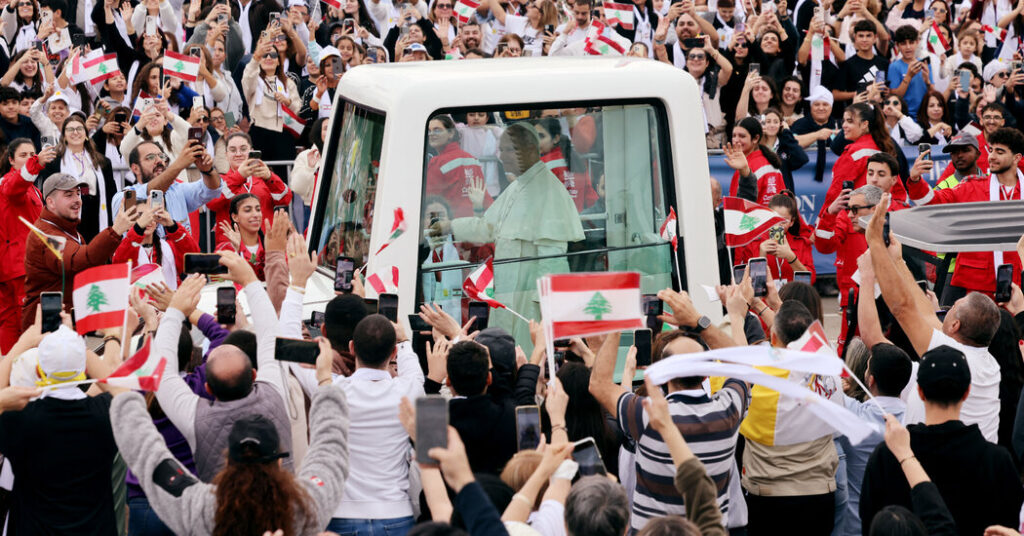
Leo obviously has no hard power to deploy and his is not a nostalgia for a durable yet flawed Pax Americana. But his voice, with its American accent, is filling a void. During Leo’s first international papal trip last fall, to Turkey and Lebanon, he showed himself to be a classic American internationalist speaking in a classically Christian register. La Croix’s Vatican reporter Mikael Corre noted that the trip was marked by “the exact opposite of the diplomacy we now associate with the United States: no hyper-personalization, no show of force, no shocking announcements or thunderous slogans.”
Since Benedict XV tried and failed to stop World War I, popes have sought to address the global political reality in which they have found themselves. In the 1980s the Polish pope, John Paul II, helped Ronald Reagan hasten the end of the Soviet empire, but he was at a loss in navigating the cultural and political upheavals that followed. His successor, Benedict XVI, elected in 2005, was an inward-looking theologian whose focus was “less diplomacy and more Gospel,” as one Vatican reporter put it. That left the papacy adrift internationally and internally.
Francis, the Argentine pope elected in 2013, provided a powerful rhetorical and moral language that could stand up to the noisy demagogues and populist nationalism that emerged during his papacy, an era he framed as “a third war, one fought piecemeal.” The solution, Francis said, would be “artisanal” or “handcrafted” peace between individuals and among communities.
Pope Leo has brought an even more insistent focus on peace. His vocabulary evokes Pope John XXIII’s Cold War-era encyclical addressed to “all men of good will” and its focus on human rights and interstate relations, and a pragmatic sensibility that recalls the founders of Europe’s unification, Robert Schuman, Alcide De Gasperi and Konrad Adenauer, all devout Catholics. His worldview is also informed by decades of living in Peru and his global travels as head of the Augustinian order to which he belongs, and by the input of the cardinals from around the world who almost certainly elected him in part because he epitomizes the America they miss.
Will it make any difference? Mr. Trump and his Catholic allies in the administration thought nothing of criticizing Pope Francis, and they don’t appear too interested in heeding Leo. “I haven’t heard any statements from the pope,” Mr. Trump told Politico last month before going on to sing the praises of the pope’s brother Louis. Mr. Trump’s vice president, JD Vance, a Catholic, has also dismissed Leo’s view on the negotiations to end the war in Ukraine as too “Eurocentric.”
The Catholic Church, it is said, thinks in centuries, and Pope Leo is unlikely to worry about such pushback. He is a fit 70-year-old who could potentially set a papal record as the oldest pope to die in office, outlasting another Leo, Leo XIII, who was 93 at his death in 1903. Donald Trump, who turns 80 on June 14, has three years left in his second term and faces political headwinds that has conservatives talking about a post-MAGA vision for the Republican Party. Of course, even three more years of Mr. Trump could do incalculable damage not only to the United States but to the global commonwealth.
When Leo was elected, there were regular references to the first pope to take that name, Leo the Great, who served in the fifth century amid the declining Roman Empire. As barbarian armies swept across Europe, that first Pope Leo led a delegation to northern Italy to meet Attila the Hun and his invading forces. Leo’s holiness and diplomacy (perhaps aided by a menacing vision Attila was said to have had of SS. Peter and Paul brandishing swords) is credited with persuading Attila to turn back and spare the Italian peninsula.
But a more apt parallel for our current circumstances might be the legend of Leo’s meeting three years later, in 455, with Gaiseric the Vandal outside Rome. On that occasion, it is said, Leo was able to persuade the barbarian king only to spare several large churches so that thousands of Romans could find sanctuary from the ensuing devastation. In the aftermath, Leo and his successors were able to rebuild city and society.
Catholicism has a knack for preserving the best of the past to help seed a better future. Today’s Leo may be the surest guardian of a legacy that America, and the world, will desperately need.
David Gibson is the director of the Center on Religion and Culture at Fordham University and has covered the Vatican as a journalist for four decades.
The Times is committed to publishing a diversity of letters to the editor. We’d like to hear what you think about this or any of our articles. Here are some tips. And here’s our email: [email protected].
Follow the New York Times Opinion section on Facebook, Instagram, TikTok, Bluesky, WhatsApp and Threads.
The post Pope Leo Confronts Trump on His Own Terms appeared first on New York Times.