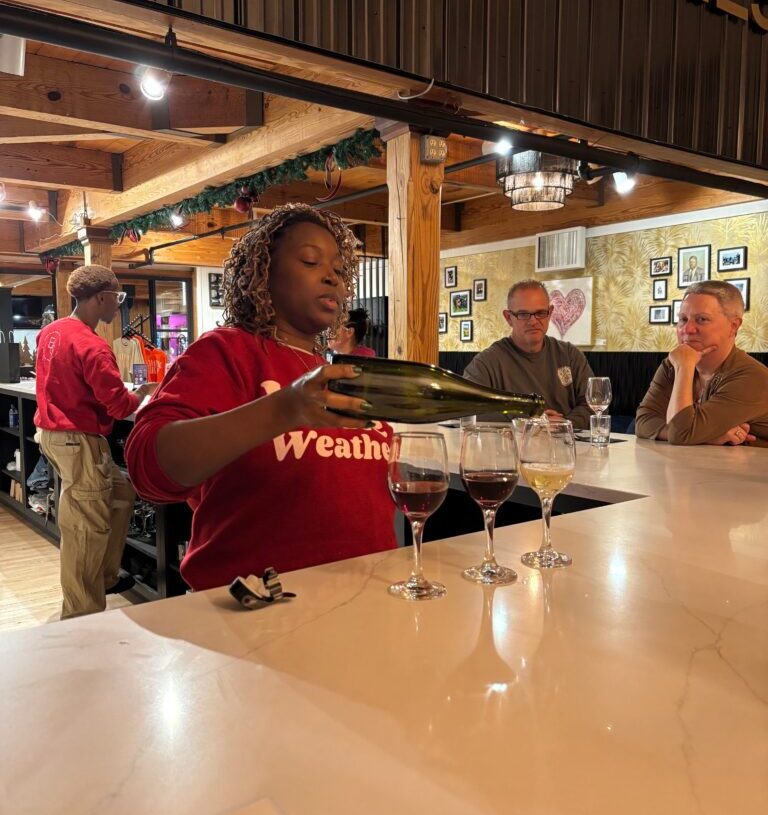
Ifeoma C. Onyia visits the vines in front of her Maryland home each day.
She likes to check on them as if they were family members, asking them what they need and encouraging them to continue their rest before they bloom again at the winery she has owned in Laurel since 2021.
It pleases her to know that Clyopatra Winery & Vineyard exists in Prince George’s County, where there is a rich Black American culture and a growing, influential African immigrant population that makes the area as multifaceted as the wine she produces.
Onyia also delights in being among a new and growing class of Black winemakers who are diversifying Maryland’s wine offerings as well as the face of wine ownership in the region.
“It’s a huge responsibility,” she said about operating the state’s only Black-owned winery with a vineyard. “I’m learning and I’m trying to be a teacher.”
Black wine producers comprise less than 1 percent of the about 11,000 such businesses in the nation, or about 110, according to the Association of African American Vintners. There are about 200 Asian-owned wine producers in the country with Asian owners and about 110 that are Latino-owned, according to estimates from other industry groups.
For years, Black winemakers have had to make their way around heavy regulations, limited starter capital and casual racism about their place in the industry. However, oenologists like Onyia have broken ground in Maryland.
They are among about 80 winemakers in the state who are eager to make it a premier wine destination in the Mid-Atlantic region on par with neighboring Virginia, offering a wide assortment of varietals beyond the sweet wine most people tend to associate with Maryland.
Onyia, who is of Igbo Nigerian heritage with stints of life there and in England, said her accent and her name have spawned uncertainty about her role in wine making.
But, despite an initial lack of experience running a wine business, she has drawn strength from her heritage.
Childhood trips to Udi, a town atop a hill in Nigeria known for its sweet palm wine, are woven into Onyia’s memories. Her visions conjure people bringing wine to her father, a local chief, the bowls from calabash trees bubbling with yeast from extracted palm wine. She recalls her questions to her father about how and where grapes can grow. Her father’s gentle encouragement to explore wine was one that stayed with her throughout her life.
“This is something I have a love for. This is something that I have passion for,” Onyia said. “To get into it and have people look at me like, ‘Are you crazy to be here?’ Take a look because I can’t back down. Remember: I’m a Black female. We don’t back down.”
Pandemic to profit
When the world paused during the covid-19 pandemic, people everywhere turned to popular hobbies like sourdough bread making, drawing and outdoor exercise. For some of Maryland’s newest vignerons, the pandemic presented an opportunity to turn an interest in wine into a business.
Hollywood often depicts entering the wine industry as simple as buying or inheriting land and figuring out the bumps along the way.
Joy Shepherd and Brittany Woodland took the négociant, or merchant’s, route to open Rose Garden Wines, an herbal-infused wine brand based in College Park, Maryland.
The two friends were among the millions of people at home during the pandemic, craving connection and speaking to one another via FaceTime. As Shepherd sipped on a glass of sparkling wine, with Woodland savoring her loose-leaf herbal tea of chamomile, hibiscus and elderberry, an idea formed to start their own herbal-infused wine company.
They leveraged their combined backgrounds in wine and beer festival production, communications and herbalism to make their vision materialize.
The friends sat in Shepherd’s kitchen with local store-bought wines and Woodland’s herbs and spices to come up with recipes that worked for both their palettes, eventually sending over their sample recipes to a female winemaker they would meet during a trip to France.
They were unable to receive grant funding. Being a new business made it challenging for investors to want to bank on them, Woodland said. Getting their wine in front of people was a crucial effort that resulted in them securing a loan of about $20,000 through M & T Bank in Prince George’s County.
“The wine industry, it’s not cheap,” Shepherd said. “We weren’t born into this. We don’t have millions on the side just waiting to produce a business like this.”
Multiple obstacles
Maryland’s 80 wine producers account for $1.8 billion in annual wages and nearly $70 million a year in tourist spending, according to National Association of American Wineries.
The majority of individual wineries are family heirlooms with land, with know-how and capital passed down through generations. Those advantages have often not been available to Black winemakers, which can make stomping through the wine business a scary unknown.
Like most of the region, land in Maryland is expensive, with not much available to cultivate grapes and establish a winery, said Janna Howley, executive director of the Maryland Wineries Association, a nonprofit trade organization representing Maryland’s wineries.
The price of land varies, based on the location in Maryland along with the cost per acre to grow grapevines, ranging from $10,000 to $25,000 per acre before factoring in specialized equipment or land purchase.
“There’s buying grapevines, all the materials to get them planted,” Howley noted. “All of this happens while you’re not making wine from any of those grapes.”
Building a wine business also requires a detailed business proposal and the ability to raise capital to support the venture, a feat that can feeling daunting for those new to the business.
Land costs, systemic discrimination by the U.S. Department of Agriculture and exploitative systems such as sharecropping have led to the decline in Black agricultural ownership, overall, and created the current financial barriers for Black winemakers.
Although Maryland is among one of the most diverse states, who owns land doesn’t reflect that diversity. Black farmers make up barely 1 percent of all farmers in Maryland with a majority of them living in Prince George’s County. That percentage is reflective of national data.
When Black cellarmasters like Onyia finally do have land and a seat at the winemaker’s table, it doesn’t always guarantee acceptance. Sometimes, they’ve endured what they perceive to be veiled racism.
“I remember one meeting I went to and somebody said to me, “ ‘Haven’t we scared you off enough? Onyia recalled of a time when her presence was questioned with other vineyard owners. “I said, ‘No sir, you haven’t, I’m still here.’ ”
Building a legacy
Onyia often thinks of Michelle Obama talking about the duty and weight that accompany being the first in something.
“To be the first in anything, you have to be very strategic about how you do things because if I make a mistake or mess up then the folks coming behind me I’ve just messed it up for them,” Onyia said. “It’s just making sure that as I’m going, I’m setting up templates that I’m able to hand to anybody else to say, ‘This is how you do it. This is what I did. This worked for me.’ ”
Jon’ll Boyd, who co-founded Boyd Cru Wines with her husband, Matthew Boyd, considers who is right behind her: her children.
To get started, Jon’ll Boyd, who has a background in event planning, took a wine business management course at Washington State University and completed a three-month apprenticeship in New York’s Finger Lakes region with a female winemaker.
Her apprenticeship created an appreciation for local grapes as a source for the best wine, which is why Boyd Cru Wines uses only Maryland-grown grapes.
Boyd’s sons, 9 and 12, watched her and her husband establish the business, helped their parents with harvesting grapes and transporting them to the production facility and aided in stocking the storage room, Boyd said.
“They’re very much integrated into the business,” Boyd said. “We do look at this as legacy building. We do look at this as something that hopefully will be a part their legacy and that they can then pass on to their kids at some point.”
Shepherd and Woodland, who do not have kids, smile when they think of nieces and nephews who proudly tell people that their auntie owns a wine brand.
“It’s important for kids to see that, so that they know that it’s possible,” Woodland said. “They can grow up with the lens of saying, ‘Oh! I can do that, too.’ ”
Made in Maryland
Virginia wineries have benefited from dedicated state funding over the years to bolster the industry. Maryland has followed suit in recent years to support its wine and alcohol industry. Lately, the local industry has been affected by a growing presence of invasive lanternflies, especially in Virginia.
Howley is hopeful that state funds will boost marketing and promotion for Maryland wines. Howley’s organization launched a “Make Mine a Maryland” campaign to promote wines and brews made in the state.
“Maryland is kind of like America in miniature,” Howley said. “We’ve got rocky mountains in the west all the way to beaches in the east. We’re growing grapes and making wine in every region.”
At Onyia’s vineyard, the soil is rich with limestone, shell and gravel — components that offer a unique acidity.
For the new year, she’s looking forward to breaking ground on the 40 acres of land she purchased in south Laurel, where she will open Clyopatra Winery and Vineyard Village Resort.
Onyia is planning a 20-bedroom, boutique-style hotel, with a tasting room and a golf range. There will also be a vegetable garden where she will offer internships and apprenticeships to teach children how to get into agriculture.
“The village resort now makes us the largest Black-owned winery in the East Coast,” Onyia said. “It means that people like me can feel so happy to come over and learn.”
The post Maryland’s increasing diversity has meant more Black-owned wineries appeared first on Washington Post.