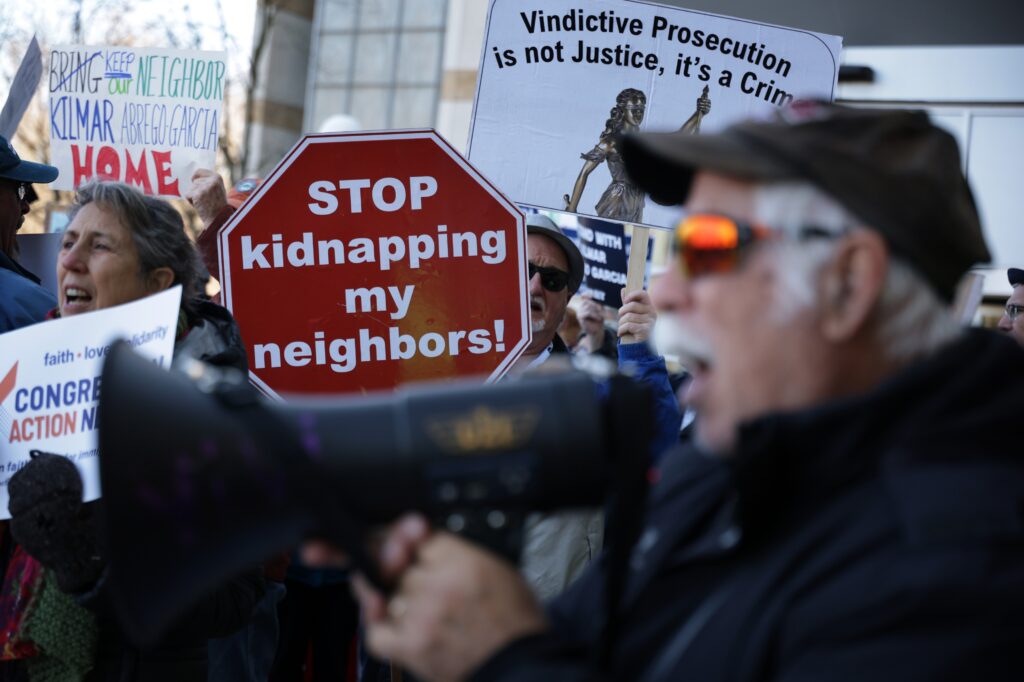
Outraged by the Trump administration’s escalating immigration enforcement tactics, a Maryland lawmaker proposed banning agents recruited and hired to carry out the president’s mass deportations from ever working in state public safety jobs.
“It says something about the morals of the person — the character of the person — if they see what’s happening on TV, they see what happening in the streets and say, ‘You know what? I want to join that,’ ” said Del. Adrian Boafo (D-Prince George’s), the bill’s sponsor.
“Something’s off about that,” he said.
Boafo announced his “ICE Breaker Act of 2026” hours before a U.S. Immigration and Customs Enforcement officer fatally shot a 37-year-old woman in Minneapolis on Wednesday, which sparked protests and renewed accusations that President Donald Trump unleashed a reckless force into communities.
Across the country, Democrats have been grappling with how to respond to ramped up immigration enforcement that they say has terrorized communities and is often carried out by agents wearing masks. California Gov. Gavin Newsom (D), for example, signed a law banning masked agents; the Trump administration has filed a lawsuit to block it.
Boafo’s legislation would specifically ban ICE enforcement agents hired after Trump’s inauguration on Jan. 20 of last year from holding jobs in state law enforcement.
He conceived it after The Washington Post reported on the Trump administration’s planned $100 million “wartime recruitment” strategy, he said.
The push to attract thousands of new agents targets military enthusiasts and people interested in gun culture, using rhetoric that emphasizes messages such as “destroy the flood” and “the enemies are at the gates.”
“These are the type of folks that were recruited, quite literally, to just wreak havoc,” Boafo said.
He noted federal experience is often a gateway to other jobs, and eventually the immigration enforcement surge will end, potentially flooding the law enforcement job market in the D.C.-area with former agents.
“I don’t want them a part of Maryland’s police force. So this is not just about the moment now right? It’s also about in the future,” he said.
The idea drew backlash from Republicans in the state, who questioned its legality and see the ban as a proxy for barring people from jobs based on their political views.
“This is a dumb idea,” Del. Kathy Szeliga (R-Harford) said.
“Law enforcement hiring should be based on the training, experience, and conduct of the candidate, not a partisan litmus test tied to some president you don’t like,” she said.
House Minority Leader Jason C. Buckel (R-Allegany), an attorney, said the bill has “questionable legality to begin with” and called it “a politically posturing bill and not worthy of serious consideration.”
Buckel said barring people from state employment because of prior jobs they held — particularly over political disputes — “leads to some really messy places.”
“I get it. I get it that people are upset,” Buckel said.
“What’s happening in some of these incidents are terrible. Tragic,” he said. “But to suggest that the response to that is to bar federal workers from working for state government? I’m pretty sure that most ICE agents aren’t suited up with gear on the streets. A lot of them are bureaucrats.”
Joyce E. Smithey, chair of the Maryland Bar Association’s labor and employment chapter and a managing partner of Smithey Law Group, said a “creative” lawyer could argue such a ban violates free speech rights.
But employers aren’t banned from discriminating against a person because of their prior job experience, she said.
“I think it is legal, overall. States are given a lot of latitude to set who they want to hire,” Smithey said. “In certain types of employment, you’re allowed to be more picky … Law enforcement is in this category.”
She added that such a ban was novel and it was likely to provoke a lawsuit if passed.
“This is a pretty transparent attempt to get at the ICE agenda, for sure,” Smithey said. “I think the state would win.”
The proposal is among several anti-ICE bills that Maryland Democrats have crafted ahead of the General Assembly session that begins Wednesday. The party holds supermajorities in both chambers, and leaders in the House of Delegates and Senate will also be considering outlawing the controversial 287 (g) programs that deputize local law enforcement to help with federal law enforcement and forbidding ICE agents from wearing identity-concealing masks.
California enacted similar anti-masking laws, the “No Secret Police Act” and “No Vigilantes Act” in September. In the Trump administration lawsuit to stop it, the Justice Department argued that only the federal government can regulate federal agents.
“The laws would recklessly endanger the lives of federal agents and their family members and compromise the operational effectiveness of federal law enforcement activities,” the Justice Department wrote in court documents that cites a Department of Homeland Security news releases asserting a 8,000 percent increase in death threats against ICE law enforcement.
“The threats to federal officers are serious and potentially deadly,” the government argued in the lawsuit. “They range from taunting, online doxing, and stalking, to ‘vehicles being used as weapons toward’ officers and even bounties being ‘placed on their heads for their murders.’”
Maryland House Majority Leader David Moon (D-Montgomery) has proposed a “digital unmasking” law to identify these agents another way: requiring Maryland law enforcement to proactively investigate and collect identifying information on every masked federal immigration agent conducting an operation within the state’s borders.
“I’ve wondered if something bad happens, will there be any for accountability for people?” Moon said. “This is a way to reassure the public that Maryland is doing something to keep the avenues open for the rule of law and redress.”
The digital profiles of masked ICE agents would be not be public, but in a state law enforcement database that could be used to identify a federal agent “credibly accused” of criminal violence or unconstitutional acts, he said.
Boafo said that even if his bill barring future state employment of ICE agents doesn’t pass, the debate has value because it “gives room for hope for folks that we’re doing all we can, as a state to fight ICE.”
The post Maryland bill seeks to ban Trump’s ICE agents from joining state police appeared first on Washington Post.