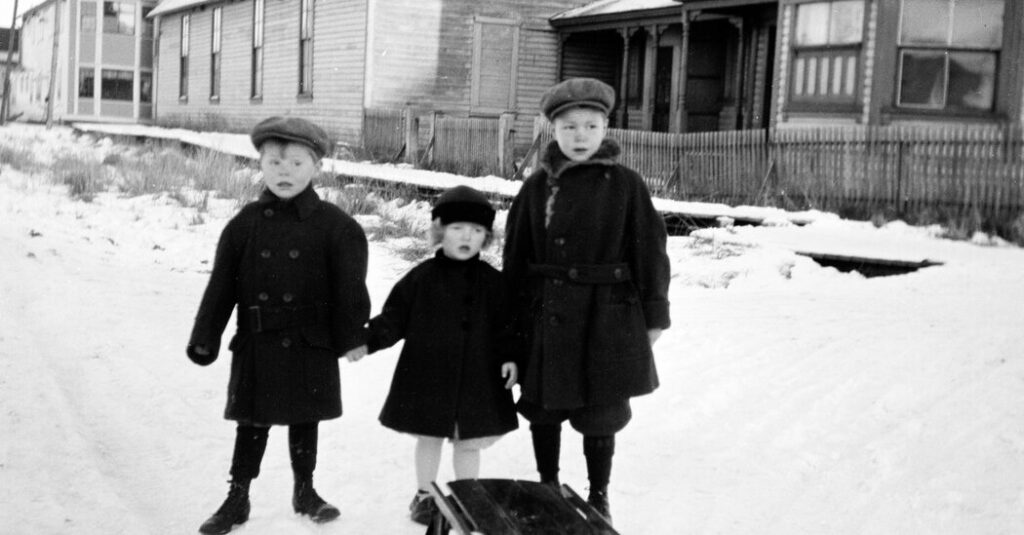
Jirdes Winther Baxter, the last known survivor of a 1925 diphtheria epidemic in Nome, Alaska, which prompted a legendary sled dog relay of nearly 700 miles that delivered a lifesaving serum to the isolated frontier town, died in Juneau, the capital, on Jan. 5. She was 101.
Her death, in a hospital, was confirmed by a son, Fred J. Baxter.
A copy of medical records from 1925, possessed by Mr. Baxter, a retired lawyer, indicates that Jirdes (pronounced JER-diss) Winther, then 11 months old, was hospitalized in Nome on Jan. 30 with diphtheria and what she later called a high fever.
Her Norwegian-born mother, Ragnhild, and one of her brothers, John, were admitted on Feb. 2. Her father, Johan, and another brother, Gudmund, did not contract the highly contagious and dangerous bacterial disease, which can clog airways, severely restricting breathing, and also damage the heart and kidneys.
There was only one doctor, Curtis Welch, in the gold-rush town of 1,400 inhabitants. After two young children died of diphtheria by mid-January, Nome instituted a quarantine advised by Dr. Welch, who realized that a pandemic seemed “almost inevitable.”
He sent alerts, via radio telegram, to other towns in Alaska and pleaded for emergency help from the U.S. Public Health Service. The nearest supply of antitoxin, made from the blood of horses, was at a hospital 1,000 miles away in Anchorage.
The only available planes had open cockpits and were unsuitable in temperatures that plunged well below zero. Nome’s port, near the Arctic Circle on the Bering Sea, was icebound. There was no local train service.
A plan was devised to carry 300,000 units of antitoxin by train from Anchorage about 300 miles north to the railhead of Nenana in interior Alaska. From there, sled dogs would ferry the serum 674 miles west to Nome, a relay that would involve 20 mushers and about 150 dogs and would come to be known as the 1925 Serum Run and the Great Race of Mercy.
For days, millions were enthralled by radio and newspaper accounts, including front-page headlines in The New York Times (“Serum Relief Near for Stricken Nome”) of the rush to keep a threatened town alive.
Bill Shannon, the first musher on the relay, retrieved the 20-pound package of serum — contained in glass vials and housed in a metal cylinder — from the train in Nenana. He insulated the container with bearskin and took off on a 52-mile stretch as midnight approached on Jan. 27.
Mushers handed off the antitoxin and rested at roadhouses along the relay, enduring aching cold and wind and blizzards that sometimes made the trail disappear. On Feb. 2, the serum arrived in Nome after five days and seven hours, frozen but quickly thawed by Dr. Welch and administered to the sick.
On Jan. 30 and 31, Jirdes Winther had received experimental doses of expired antitoxin before the new serum arrived by dogsled, Dr. Welch’s records, copied by Mr. Baxter, indicate. Her mother and her brother received the fresh serum.
Another batch of antitoxin arrived in Nome by relay in mid-February. The epidemic was declared under control. Five to seven people died of diphtheria in Nome during the epidemic, according to various accounts, and perhaps 100 more died in area Inuit villages.
The three stricken Winthers survived and were released from quarantine on Feb. 25, Jirdes’s first birthday. Her mother was the sickest family member and experienced long-lasting respiratory problems. Dr. Welch’s records seem to indicate that she received more doses of the newly arrived antitoxin than any other resident of Nome.
Without the serum, “she probably wouldn’t have lived,” Mr. Baxter said of his grandmother in an interview.
In 2005, when Ms. Winther Baxter was 80, she served as an honorary musher at the ceremonial start of the Iditarod Trail Sled Dog Race, which has sometimes been reported to have been inspired by the Serum Run. The race’s website, though, says that while it has honored the Serum Run, it was not begun to commemorate it.
Too young at the time to remember the epidemic, Ms. Winther Baxter spoke little about it through the years, family members said.
“She would say, “Oh, that’s just the way life was,” Anna Baxter, a granddaughter, said in an interview.
Ms. Winther Baxter did feel strongly, her granddaughter said, about a disputed aspect of the Serum Run, which was commemorated via movies, documentaries, books and statues erected in New York City to celebrate two Siberian huskies that helped relay the serum.
Ms. Winther Baxter believed — as many now do — that Balto, a husky that helped lead his team on the final 55-mile stretch into Nome, received heroic acknowledgment, including a statue in Central Park, at the expense of Togo, another husky who was the lead sled dog for a celebrated Norwegian-born driver named Leonhard Seppala.
Togo led his team for 261 miles — 170 to meet up with the relay and 91 on the longest, most hazardous stretch, involving a treacherous crossing of a frozen bay. Decades later, Togo received his own statue in New York, but in a less prominent location, Seward Park on the Lower East Side.
“No, no, you have it all wrong,” Ms. Winther Baxter corrected people when they mentioned the Balto statue, her granddaughter recalled her saying. “Togo was the real hero.”
Jirdes Winther was born on Feb. 25, 1924, in Nome to parents who had emigrated from Norway. Her father, Johan Winther, known as John, was an outdoorsman, primarily a fisherman, and a photographer. Her mother, Ragnhild (Bjerkeli) Winther, ran the household.
After the epidemic, Ragnhild Winther remained sickly. At a doctor’s suggestion, the family sought a less harsh climate, leaving Nome for Seattle in 1927 and moving to Juneau in 1929. “She fought that asthmatic condition the rest of her life,” Mr. Baxter said of his grandmother, who died in 1983.
In the 1960s, Jirdes Winther Baxter worked for Alaska’s lieutenant governor, Hugh Wade, according to a 2024 profile in the The Juneau Empire newspaper. She later worked for the State Department of Revenue.
Politics and government were part of her personal life, too. Her husband, Fred G. Baxter, whom she married in 1943, became a longtime member of Juneau’s municipal council. Ms. Winther Baxter, who provided guidance to her husband on political matters, was considered a “shadow member” of the council.
She is survived by two daughters, Sandra Dunn and Sherill Baxter; four sons, Fred, Ron, Gary and Terry Baxter; 10 grandchildren; 16 great-grandchildren and six great-great grandchildren. Her husband died in 2009.
The 1925 epidemic, the sled dog relay and Ms. Winther Baxter’s resilience have come to be viewed in a number of ways: as a catalyst for innovation in controlling other diphtheria outbreaks; as an example of the long history of dogs offering medical support; and as an illustration of the value of public awareness of disease outbreaks and the validity of vaccines.
“She has been a testament to the importance of public health,” Andi Story, a state representative from Alaska, said in an interview.
Mr. Baxter, Ms. Winther Baxter’s son, said he liked to believe that the diphtheria serum that his mother received played an important role in a long life that was nearly free of sickness.
“Unless it’s just the good Norwegian genes that out-ruled everything,” he said.
David C. Adams contributed reporting.
Jeré Longman is a Times reporter on the Obituaries desk who writes the occasional sports-related story.
The post Jirdes Winther Baxter, 101, Dies; Last Survivor of Epidemic in Alaska appeared first on New York Times.