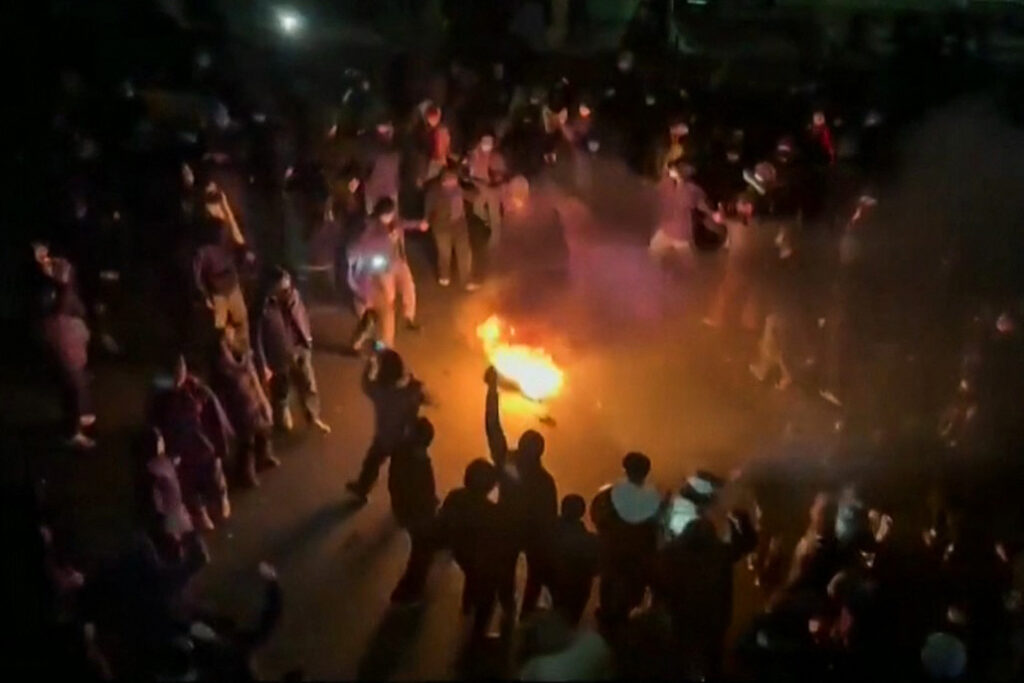
In many respects, we’ve been here before. In both the 2009 Green Movement and the “Women, Life, Freedom” uprising of 2022 — and numerous other bouts of unrest in between — countless Iranians took to the streets of cities across the country to protest an entrenched and increasingly unpopular theocratic regime. Their dissent exposed the failings of Iran’s decaying revolutionary project and the widespread frustrations of Iranians yearning for greater freedoms. They were met with crushing repression: Information blackouts, mass arrests and deadly crackdowns.
Maybe the same story will play out in the coming days, as protests continue in all 31 of Iran’s provinces. Hundreds of people have been killed, rights groups say, and hundreds more swept up by security forces. A prominent human rights group monitoring the situation warned Saturday that “a massacre is unfolding.” The state violence has yet to quell the unrest, which was sparked a couple of weeks ago amid anger over the depreciation of the Iranian currency, the rial. The ire of furious merchants spread across a wide swath of Iranian society.
President Masoud Pezeshkian tried to push through some economic relief for poorer Iranians, but it did not lower the temperature. Instead, many signs point to the demonstrations only intensifying in defiance of the regime, fueled by a bolder and more exasperated younger generation of protesters.
“Demonstrators’ slogans have demanded a fundamental change to their political system,” my colleague Yeganeh Torbati reported over the weekend. “Several of the videos from Friday evening showed people holding the flag of Iran’s monarchy, deposed in the 1979 Islamic revolution, and one showed a man spray-painting a pro-monarchy slogan onto a large city billboard in Tehran.”
Iran’s rulers are not just facing a clamor from within. The past couple of years of strife in the region have left the Islamic Republic more vulnerable. Its proxies in Lebanon and Syria have either been extinguished or enfeebled, while Israel’s brazen strikes within Iran — including targeted assassinations — illustrated how vulnerable and compromised the regime may be. The country’s supreme leader Ali Khamenei still casts the Iranian state as a vanguard of “resistance” against American hegemony and Israeli plots, but a growing number of ordinary Iranians see a corrupt establishment circling the wagons, riven with incompetence and incapable of keeping the country safe.
“What distinguishes the current moment is a profound collapse of legitimacy and people’s increasing demand for regime change,” noted Abbas Milani, an Iranian American historian at Stanford University, adding that authoritarian systems rely on “fear,” as much as “coercion,” but in the case of Iran, “that fear has visibly weakened.”
Add to the mix President Donald Trump’s stated willingness to take action against the Iranian regime — underscored earlier this month by the operation to remove Venezuelan President Nicolás Maduro — and Tehran’s strategists face a deepening crisis. “The Islamic Republic is in a vise, squeezed by the external threat from the US and Israel and the internal threat of a mass uprising,” wrote Vali Nasr, a professor of Middle East studies at Johns Hopkins University. “There is no easy escape from this impasse. A total collapse of the Islamic Republic is not necessarily imminent, but Iran’s revolution is now nearing its end.”
Karim Sadjadpour and Jack Goldstone, writing in the Atlantic, laid out how the current situation satisfies many specific conditions for a revolution, including the country’s economic unraveling, growing divisions among the regime’s elite power base and signs of a widespread popular revolt.
“The Islamic Republic is today a zombie regime,” they wrote. “Its legitimacy, ideology, economy, and top leaders are dead or dying. What keeps it alive is lethal force. The most important element still missing from a full revolutionary collapse is the repressive forces deciding that they, too, are no longer benefiting from, and hence no longer willing to kill for, the regime. Brutality can delay the regime’s funeral, but it’s unlikely to restore its pulse.”
What comes next is complex and fraught. The specter of U.S. action raises new questions. Symbolic strikes against certain regime targets may be easy to withstand. A wholesale decapitation of top leaders would risk a spiraling conflagration where even more hard-line forces could emerge in control. “If the U.S. does too little, it might not be able to move the needle,” observed Ali Vaez of the International Crisis Group. “If it does too much, it might break the needle with unpredictable consequences for all.”
The uncertainty could compel Western government to prioritize diplomacy over intervention. “The Islamic Republic faces an array of challenges: the lingering specter of renewed war with Israel, upheaval over the eventual succession of a replacement for Ayatollah Khamenei, the supreme leader, and the likelihood of continuing protests,” wrote Holly Dagres, senior fellow at the Washington Institute, a think tank focused on Middle East policy. “Many U.S. and Western policymakers and analysts recoil at the prospect of change in Iran out of fear of the unknown.”
Some figures are optimistic, most prominently Reza Pahlavi, the son of the shah deposed in 1979, who wrote a recent Washington Post op-ed trumpeting his readiness to help steer a “responsible transition” in Iran toward democracy. “History rarely announces its turning points in advance,” he said. “But today, the signs are unmistakable.”
Not all share that confidence. “This regime is capable of cracking down on the protesters particularly since there is no organized and determined force of opposition,” Abbas Amanat, a professor emeritus of history at Yale University and an acclaimed historian of Iran, told me. “Pahlavi, despite all the publicity, is a deceptive mirage. He neither has the personality, nor the organized support.”
In an interview with Variety, the celebrated Iranian filmmaker Jafar Panahi living in de facto exile abroad, cautioned against Trump’s aggressive rhetoric and his promises for foreign intervention at a moment when the Islamic Republic has lost its legitimacy at home.
“This regime has fallen already. … The people who are carrying out the protests in the streets, they want to make that happen,” Panahi said. “International support can make a difference. But until people themselves decide to do something or not, nothing is going to happen. … It has to come within, from within the country, by the will of people.”
Sign up to receive WorldView, a free, thrice-weekly email newsletter from the international desk of The Washington Post.
The post Iran’s protests seem different this time. Is the regime on the brink? appeared first on Washington Post.