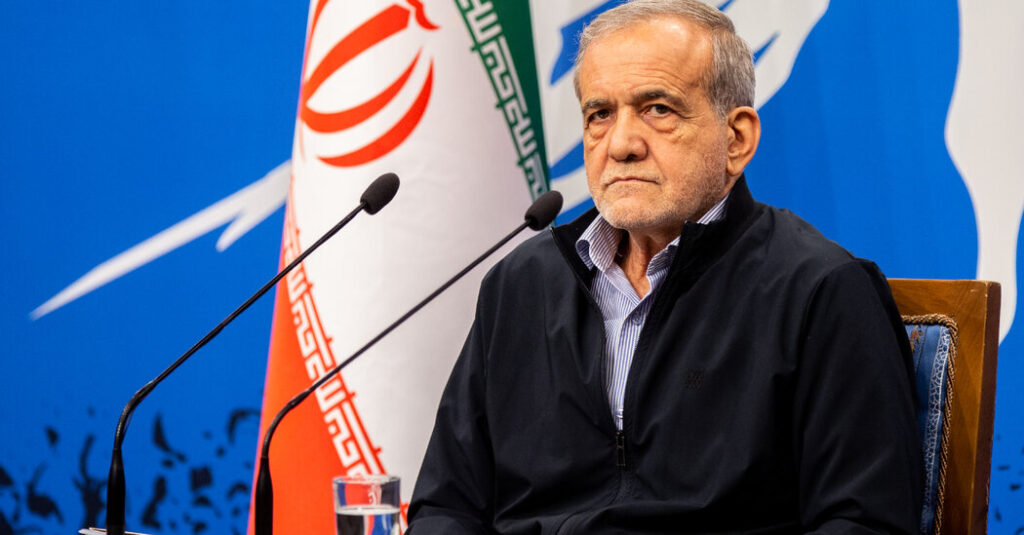
Facing a swell of anti-government protests nationwide, Iran’s president promised to address economic grievances but warned that the state also had a “duty” not to allow the country to be destabilized.
“Our responsibility is to solve and address people’s grievances. But we also have a duty not to let rioters destabilize the country,” the president, Masoud Pezeshkian, said in an interview with Iranian state television on Saturday. He spoke as protesters in Iran face an intensifying and deadly crackdown by the authorities.
Demonstrators took to the streets starting two weeks ago, spurred by economic distress over a sudden plunge in the value of Iran’s currency. Over the past few days, the protests have broadened into a mass movement, with many calling for the overthrow of Iran’s authoritarian clerical rulers.
The death toll since the protests began rose to at least 192, according to the Iran Human Rights Organization and HRANA, two U.S.-based rights groups.
As the protests escalate, Iran’s theocracy looks increasingly vulnerable and senior officials have sought to lay the blame on the United States and Israel, saying they are backing the protesters.
Iran’s military and nuclear facilities were battered by a 12-day war with Israel last June, and the country has been sinking into a severe economic crisis after the reinstatement of U.N. economic sanctions last year.
Adding to the pressure, President Trump has said he could strike Iran if the authorities kill peaceful protesters, and several U.S. officials told The New York Times on Saturday that he has been briefed on new options for military strikes.
Such threats feel particularly potent in the aftermath of U.S. forces’ capture of Venezuela’s president, Nicolás Maduro, earlier this month.
“If the United States takes military action, both the occupied territories and U.S. military and shipping lanes will be our legitimate targets,” Mohammed Ghalibaf, Iran’s speaker of parliament, said in a statement on Sunday, according to Iran’s semi-official news agency, Tasnim. Both U.S. and Israeli military bases could be targets, he added.
Israel’s army said it was “prepared defensively” for any attack, while the country’s prime minister, Benjamin Netanyahu, commended the protesters.
“Israel supports their struggle for freedom and firmly condemns the mass killings of innocent civilians,” he said. “We all hope that the Persian nation will soon be liberated from the yoke of tyranny, and when that day comes, Israel and Iran will once again be faithful partners.”
The Iranian authorities have played a delicate balancing act in their response to the protests, acknowledging economic grievances and attempting to take measures to address them, while also accusing both the United States and Israel of supporting “rioters” who they portray as hijacking the demonstrations.
The protests in recent days have not only grown significantly in size, they appear to have become increasingly violent on both sides. Government buildings have been set ablaze, while Iran’s chief of police, Brig. Gen. Ahmadreza Radan, blamed the deaths and injuries on “unpaid soldiers of Iran’s enemies.”
“A significant portion of those killed died from bladed weapons and knife wounds. In cases involving gunfire, the shooting distance was very close, indicating that these actions were not carried out by security forces, but by trained and directed elements,” General Radan said.
Assessing the violence and size of protests is challenging because the Iranian authorities have imposed a near total internet blackout for the past three days, and has cut off international phone calls.
Unlike some Iranian security officials and even the supreme leader, Ayatollah Ali Khamenei, Mr. Pezeshkian has previously tried to take a tone of government responsibility for the economic pain many Iranians are feeling, offering small reforms, though economists say they are not enough to address the severity of the crisis.
“Do not look for America or anyone else to blame,” he said during a visit to southwestern Iran last week. “We must serve properly so that people are satisfied with us.”
His latest comments suggest the president may now be toughening his stance.
“The enemy has brought trained terrorists into the country. Those causing disturbances and riots are not protesting citizens,” he said.
On Saturday, Mr. Trump said in a post on social media that “Iran is looking at FREEDOM, perhaps like never before. The USA stands ready to help.”
Mr. Pezeshkian urged the people of Iran — a major oil-producing country — not to be taken in by the U.S. president’s comments. Referring to the U.S. plans to control Venezuela’s oil production after Mr. Maduro’s capture, he said: “Someone who shamelessly steals a country’s presidency and then says he was after that country’s oil is not someone who cares about you.”
The post Iran’s President Warns Protesters Not to Destabilize the Country appeared first on New York Times.