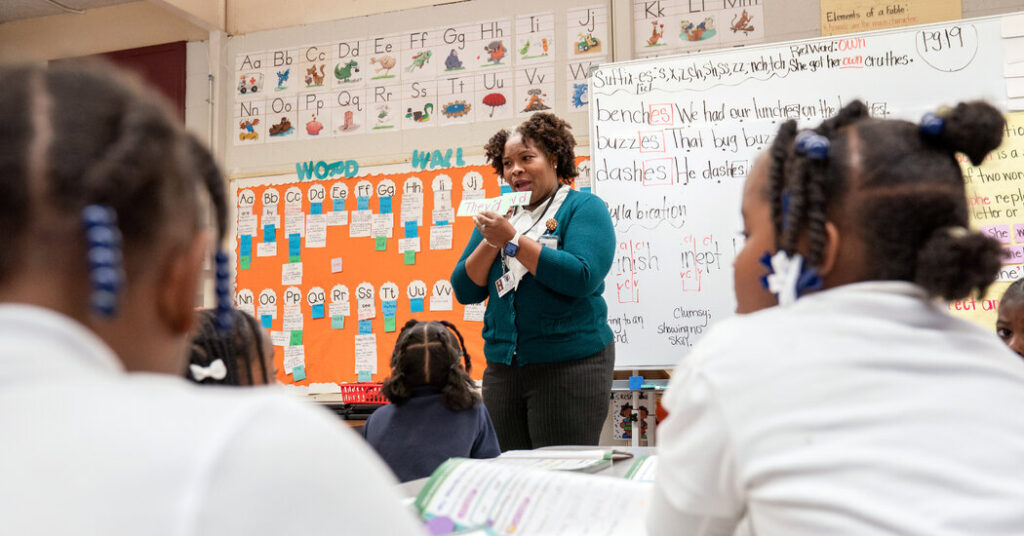
In Kim Luckett-Langston’s first year as principal of Hazlehurst Elementary School, one of the lowest performing schools in what had been one of the lowest performing states, she quickly diagnosed the problem.
Children at her school, outside Jackson, Miss., were suffering from what she calls A.B.T.: “Ain’t been taught.”
Kindergartners arrived not knowing their letters from their numbers. After a few years in school, they were still far behind. A decade ago, just 12 percent of Hazlehurst students were reading on grade level.
Today, Hazlehurst has clawed that figure to 35 percent. And Mississippi has emerged as one of the best places in the country for a poor child to get an education.
Mississippi has gone from 49th in the country on national tests in 2013, to a top 10 state for fourth graders learning to read — even as test scores have fallen almost everywhere else.
Poverty remains a driving factor in student achievement, and wealthy states like Massachusetts still have the highest share of students proficient in reading and math.
But adjusted for poverty and other student demographics, Mississippi is No. 1 for fourth grade reading and math, and at or near the top in eighth grade, according to the Urban Institute, a left-leaning think tank.
“If you want to ask the question, ‘Which states are helping kids coming from difficult circumstances learn as much as they can?’ Mississippi is now doing much better than many other states, including wealthier states in affluent progressive areas,” said Michael Petrilli, president of the Thomas B. Fordham Institute, a center-right think tank.
Mississippi’s gains have been confined mostly to the early years, where the state has focused its efforts. The system revolves around standardized testing, and the gains have not always persisted. By raw scores, Mississippi eighth graders still rank 41st on national tests for reading, and 35th for math.
Yet Mississippi has figured out something almost no other state has, and it has involved far more than just changing the way reading is taught, the most common explanation for its success.
Even as schools elsewhere have focused on issues like school funding, social justice and mental health in recent years, Mississippi schools like Hazlehurst have made academics their North Star.
“At the end of the day, our job is teaching. Their job is learning,” said Ms. Langston, who added that no matter what is going on in a child’s life, the classroom is the one thing she can control. “If we don’t meet that need, we have failed them.”
More than just phonics
Mississippi’s progress has made it the envy of the education world, inspiring countless think pieces and recurring debates about whether the “Mississippi miracle” could be real.
How could Mississippi, with its low education spending and high child poverty, pull it off?
It did not do so by relying on some of the most common proposals held up as solutions in education, like reducing class sizes, or dramatically boosting per-student funding.
Rather, the state pushed through a vast list of other changes from the top down, including changing the way reading is taught, in an approach known as the science of reading, but also embracing contentious school accountability policies other states have backed away from.
“Science of reading is really important — it was a key piece of what we did,” said Rachel Canter, the longtime leader of Mississippi First, an education reform group, who now works at the Progressive Policy Institute, a center-left Washington think tank. “But people are missing the forest for the trees if they are only looking at that.”
In addition to the reading overhaul, Mississippi raised academic standards and started giving each school a letter grade, A to F.
But unlike No Child Left Behind, the Bush-era federal law that set a goal of having every child in America be proficient in reading and math, Mississippi also measures how much students progress toward proficiency. Schools get credit if students show improvement — and double credit for the improvement of students in the bottom 25 percent.
The state also takes an unusually strong role in telling schools what to do.
The Mississippi Department of Education sends literacy and math coaches into low-performing elementary schools, with the goal of teaching teachers, not children. And state officials vet and approve curriculum used by the vast majority of districts, unusual in a country that prizes local control of schools.
Mississippi also made other changes, like investing in pre-K, and holding back third graders who cannot read well, one of its most debated policies. The state was able to muscle through some changes, in part, because it has weak teachers’ unions, which have traditionally resisted accountability linked to standardized testing.
“The state is actually pushing more of its districts to get that progress,” said Marguerite Roza, director of the Edunomics Lab at Georgetown University, an education policy research group. “Whereas in other states, it is left to chance.”
‘If we can do it, anyone can’
At Hazlehurst Elementary, the walls of Ms. Langston’s office are covered in flashcards: green for students who are already proficient, pink for those who are behind.
There is still too much pink, a reality in a place where many children arrive at school with few academic advantages. In Hazlehurst, a rural area 35 miles south of Jackson, more than half of children live in poverty and two in three adults don’t have a college degree. A chicken plant and the local Walmart are two main employers. The elementary school serves about 625 students, mostly Black or Hispanic. All are eligible for free or reduced price lunch.
It is the kind of school that might have been punished and labeled as failing during No Child Left Behind.
Today, it is flooded with support.
Hazlehurst’s literacy coach, Summeral Newman, is at the school several times a week, planning lessons, co-teaching and offering teachers feedback.
Teachers love it.
Lexy Arickson, a first-year teacher, said that instead of wrestling with a problem alone, she can simply ask, “What would you do?”
State training has helped Hazlehurst confront one of its biggest challenges: teacher inexperience. It’s not easy to recruit to a rural area, where even experienced teachers make less than $60,000 a year.
One year, the district asked all teachers to take the state test that their students would be expected to take — only four scored proficient or above.
In the past, teachers had also been left to cobble together their own lessons or relied on curriculum that lacked rigor, a national problem especially in low-income schools. Kindergartners, for example, could go through the whole year without learning all of their letter sounds.
Now, all teachers use the same curriculum, myView Literacy, by the publisher Savvas, one of several options recommended by the state.
The change helps keep students on pace. So does a firm schedule. Up to two hours is dedicated to reading each day, along with 30 minutes of catch-up time.
The work has been painstaking, and a bit like Whac-a-mole. Hazlehurst struggles with students with disabilities, for example. But on her walls over the last decade, Ms. Langston has watched more students inch closer toward green.
“If we can do it,” she said, “anyone can.”
School is for learning
For as much progress as Mississippi has made, it may only be staving off national trends. Last year, at Hazlehurst and statewide, scores dipped for the first time outside of the pandemic.
“We have searched high and low to figure out what the cause is. We really don’t know,” said Wendy Clemons, Mississippi’s chief academic officer.
Schools everywhere are wrestling with problems like student absenteeism and fragmented attention in the age of technology.
Mississippi is doubling down on its approach. This year, the education department is asking state lawmakers for $9 million to expand literacy coaching beyond the early elementary grades. The state is also raising the bar for what it will take to become an “A” school.
Other states have gone in the opposite direction, backing off accountability and lowering proficiency standards, sometimes in the name of equity. But a handful, including Louisiana and Alabama, are seeing promising results using a similar set of strategies as Mississippi.
At Hazlehurst, children spend nearly all day focused on reading, math or science. Even music class includes vocabulary words, like “falsetto.” Students take tests every two weeks.
There is also joy and satisfaction in the learning itself. Preschoolers sort letters into cans of “alphabet soup.” First and second graders clap, stomp and tap out syllables: dis-a-ppoint-ment, blame-less-ness. Students track their own testing data. “I like it,” said a 10-year-old named Johnny. “If I make a bad grade, but I’m going up, it’s like a staircase.”
The stakes are especially high in third grade, because students who do not pass the state tests at the end of year are held back, with certain exceptions. There is little evidence that retention artificially inflates scores, as some have suggested. About 6 to 9 percent of Mississippi third graders are held back each year, and students still take the test the following year.
But the policy can be unpopular because of its emotional impact. One boy, now 11 and in fifth grade, winced recalling the exam that would determine if he could move on. “That was hard,” he said.
Mississippi leaders point to the academic upside: Some research suggests retention can help in the short to medium term, with at least some of the benefit coming from the extra support children receive before ever being held back.
At Hazlehurst, students are screened from an early age, and parents are notified if a child is behind. Struggling third graders get extra help after school. On test day, parents line the hallways with pompoms, cheering test takers on.
Ms. Langston wishes children could wait until they were a bit older to take such a high-stakes exam. But she is unapologetic about squeezing all she can out of the school day.
While more affluent families may desire less structure and more free play at school, she said that is not a luxury her school can afford, nor is it what she believes her students need most to succeed.
“We are a school,” she said. “Students are here to learn.”
Sarah Mervosh covers education for The Times, focusing on K-12 schools.
The post How Mississippi Transformed Its Schools From Worst to Best appeared first on New York Times.