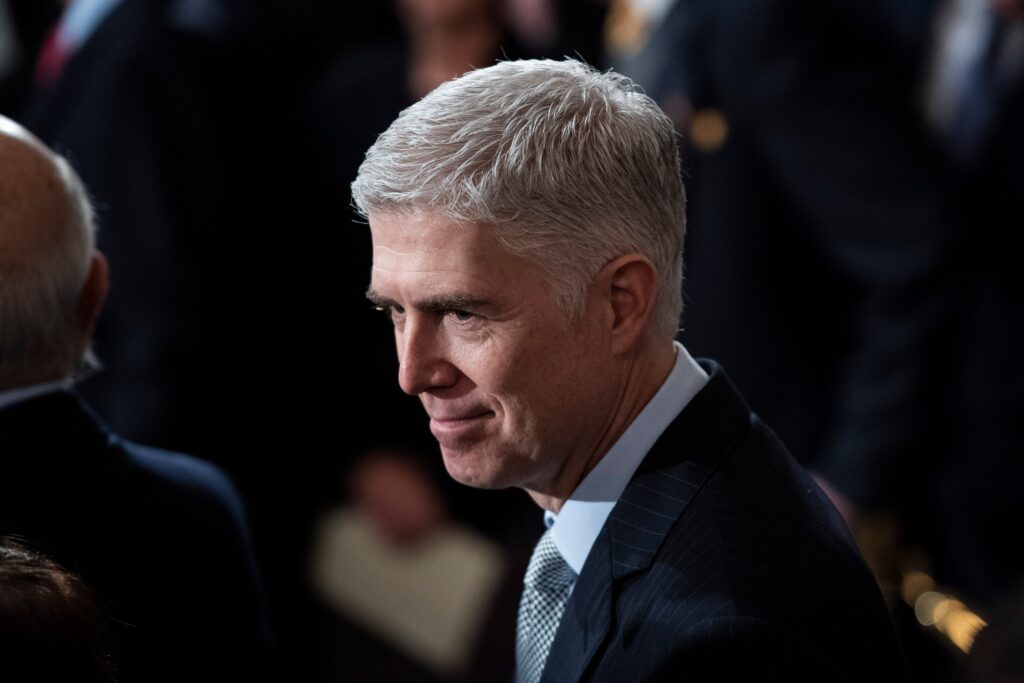
Justice Neil M. Gorsuch surprised many in 2020 when he wrote one of the Supreme Court’s most consequential rulings expanding legal rights for gay and transgender people.
The 6-3 decision in Bostock v. Clayton County held that the ban on sex discrimination in a core federal civil rights law, Title VII of the Civil Rights Act, covers discrimination against gay and transgender people.
“That’s because it is impossible to discriminate against a person for being homosexual or transgender without discriminating against that individual based on sex,” Gorsuch wrote.
Conservatives were aghast. Some said the ruling heralded the “end of the conservative legal movement.” Liberals praised Gorsuch’s opinion. Some even speculated that Gorsuch, appointed by President Donald Trump, would take on the role of former Justice Anthony M. Kennedy — the Reagan-nominated justice who was critical in landmark gay rights rulings, including establishing the right to sex-same marriage.
With the Supreme Court set to weigh the question of transgender athletes this week, Gorsuch is again in the spotlight. Supporters of allowing transgender women and girls to play on women’s sports teams have a difficult task persuading the conservative-majority court. They see winning over Gorsuch as key and appear to have crafted their arguments with him in mind.
Lawyers involved in the two cases before the court expect that Chief Justice John G. Roberts Jr., who joined Gorsuch’s opinion in Bostock, might side with him again. Together with the court’s three liberals, that would be enough for a narrow majority.
“It’s difficult to imagine how Gorsuch and Roberts would come out differently on this particular issue,” said Shiwali Patel, senior director of education justice at the National Women Law Center, which filed an amicus brief supporting the trans athletes at the center of the cases.
Gorsuch and Roberts, however, have more recently handed defeats to advocates for gay and transgender rights. In June, Roberts wrote the 6-3 ruling that upheld state bans on gender transition care for minors. Gorsuch and Roberts also joined a 6-3 majority that sided with Maryland parents who wanted to opt their children out of lessons featuring LGBTQ+-themed books.
Because of that, as well as polling that suggests views on trans issues have become more conservative in recent years, some see Bostock as an outlier.
“Gorsuch is truly a man on his own,” said Josh Blackman, a professor at the South Texas College of Law at Houston, referring to the justice’s reputation for sometimes taking unconventional positions. “On the other hand, he’s living in 2025, and it’s not 2020.”
The court will hear arguments in the two transgender cases on Jan. 13. One concerns Lindsay Hecox, a trans woman and Boise State University student, who challenged a 2020 Idaho law that bars trans women from playing on female sports teams. She says the law violated the Constitution’s equal-protection clause when it stopped her from joining the university’s cross-country team.
The second case concerns 15-year-old Becky Pepper-Jackson, a transgender high school athlete from West Virginia. Unlike Hecox, Pepper-Jackson argues the law in her state barring trans athletes from women’s sports violates Title IX, the federal civil rights law that bans sex-based discrimination in federally funded schools. That law is worded similarly to the one Gorsuch ruled on in Bostock.
In their court filing in Pepper-Jackson’s case, the American Civil Liberties Union and Lambda Legal quoted Gorsuch far more than any other justice. They directly quoted his Bostock opinion more than a dozen times and also cited other opinions of his, including a 2012 case dating from Gorsuch’s time as a judge on the court of appeals.
Karen Loewy, interim deputy legal director for litigation at Lambda Legal, a prominent advocacy group for gay rights, said the approach was not about Gorsuch in particular. Citing his Bostock opinion was necessary for Pepper-Jackson’s arguments about discrimination against transgender people being sex-based discrimination.
“It really is not a Gorsuch-specific thing,” Loewy said. “He happens to have the gems that really underscore our arguments.”
Other observers say the strategy is clear.
“Of course” Pepper-Jackson’s lawyers are working to persuade Gorsuch, said Steve Vladeck, a professor of law at the Georgetown University Law Center who regularly writes about the Supreme Court. “The harder question is whether that’s actually going to work.”
Gorsuch’s rulings since Bostock raise doubts.
His votes in the Tennessee case on gender-transition treatments and the Maryland schoolbook case indicate that it’s “unlikely Gorsuch views the trans athletes cases the way he sees Bostock,” said Blackman, who was among the conservatives who criticized Gorsuch following the Bostock ruling.
Americans have become more supportive of restrictions for transgender people in the past few years, according to a Pew Research Center survey published in February. Fifty-six percent of Americans supported bans on providing gender transition care for minors, up 10 percentage points from 2022, the study found. And 66 percent favored or strongly favored laws that require trans athletes to compete on teams that match their sex assigned at birth, up eight points from 2022.
Even before the shift in public opinion, a majority of Americans opposed allowing transgender female athletes to compete against other women at all levels of sports, according to a Washington Post-University of Maryland poll.
“The climate of views of trans rights is different today than it was five years ago,” Blackman said.
Title VII, which was at the center of the Bostock case, made it illegal for employers to discriminate against workers based on race, national origin, religion or sex.
“[F]ew pieces of federal legislation rank in significance,” Gorsuch wrote in his 2020 opinion. He wrote that it was “clear” that discriminating against gay and transgender workers meant discriminating on the basis of sex.
Lawyers for Pepper-Jackson say the same logic should apply to their case.
“Like an employer who fires employees for being transgender, a school administrator who discriminates against students for being transgender ‘must intentionally discriminate against individual [students] in part because of sex,’” Pepper-Jackson’s lawyers wrote, quoting Gorsuch’s opinion.
But lawyers for the state of West Virginia say sports is different from the workplace — an argument that allows them to court Gorsuch’s support without asking him to disavow his Bostock ruling.
Sex should be irrelevant at work, but “sex is relevant in sports, often requiring sex-differentiated opportunities to ensure fairness and safety,” West Virginia’s lawyers wrote in their brief to the justices. Transgender women have inherent advantages in women’s sports, they argue, and should be banned to ensure equal opportunity for women.
John Bursch, senior counsel with Alliance Defending Freedom, a conservative legal organization, said he’s confident Gorsuch and Roberts will be part of a majority upholding the bans in Idaho and West Virginia.
Alliance Defending Freedom represents Madison Kenyon and Mary Kate Marshall, Idaho State University track and cross-country athletes, who are asking the Supreme Court to uphold the Idaho ban alongside the state’s governor, Brad Little.
Bursch agreed with West Virginia’s argument. In the context of student sports, he said, “you have to take sex into consideration.”
The post Eyes are on Gorsuch as Supreme Court weighs rights of trans athletes appeared first on Washington Post.