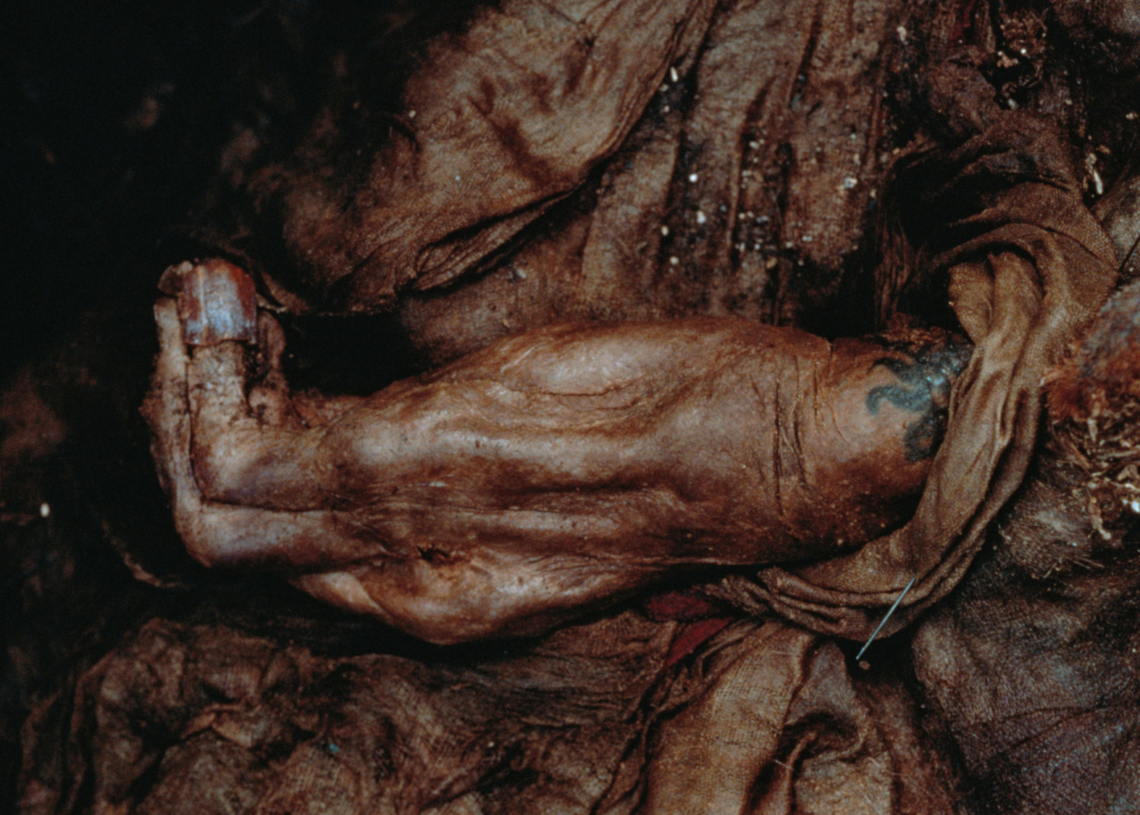
The freezing cold in northeastern Siberia does something strange to time. It preserves it in nearly perfect form.
That’s how archaeologists ended up standing over the grave of a woman who died more than 250 years ago and still carried the vibrant imprint of her life with her. She was buried in a hollowed tree trunk, layered in clothing meant to be seen, not hidden. A red wool dress made from imported blankets stood out immediately. So did the horses buried nearby. This burial wasn’t modest. It announced her importance.
The details got even stranger once researchers looked at her DNA. In a study published in Nature, scientists revealed that the woman, believed to be one of the last Siberian shamans, was born to parents who were closely related. Second-degree relatives, according to the genetic data. That level of relatedness is rare in the remains examined and raised immediate questions about who she was and why she mattered.
The woman, referred to as UsSergue1, lived in what is now Yakutia, one of the most unforgiving environments humans have ever occupied. She died in her 30s in the late 18th century, well after Russia had begun pushing into the region and pressuring Indigenous Yakut communities to abandon shamanism in favor of Christianity. Her grave suggests that didn’t go as planned.
“We interpret UsSergue1 as an embodiment of her clan,” Ludovic Orlando, a molecular geneticist at France’s National Center for Scientific Research, told Live Science. He explained that burying her with ritual objects and symbolic animals may have been a way for her community to protect its spiritual identity during a period of outside control.
The inbreeding finding surprised the research team. Out of 122 Indigenous Yakut individuals recovered from graves dating between the 14th and 19th centuries, UsSergue1 showed the strongest genetic signal of parental relatedness. Orlando stressed that this wasn’t typical among shamans. Other ritual burials did not show the same pattern, suggesting her lineage carried significance beyond spiritual role alone.
The larger study puts that single grave into context. Despite centuries of Russian presence, the Yakuts’ genetic profile barely changed. “The analyses show that Yakut genetic heritage has remained stable from the 16th century to today,” study co-author Perle Guarino-Vignon said in a statement. Siberia’s brutal climate likely limited large-scale settlement, making conquest harder to enforce at a biological level.
Researchers even examined ancient dental plaque and found that the Yakuts’ oral microbiome stayed largely the same over centuries of outside influence.
UsSergue1’s preservation wasn’t luck. The cold kept her intact, but continuity kept her culture alive.
The post Ancient Siberian Mummy Was an Inbred Shaman, DNA Reveals appeared first on VICE.