Some years ago now, a very senior Mercedes executive in the US confided in me that CES was “the second-most important car show in the world, after Detroit.” Before the auto world’s full-on EV boom, this was quite the thing to admit—shocking, in fact—but it marked the subsequent carmaker takeover of the world’s largest tech show. This year in Las Vegas, however, the cars were almost nowhere to be seen.
Oh, there were plenty of automotive announcements. “Physical AI” was the buzz phrase from chipmakers. Alongside new AI Cosmos models used to train humanoids and other robots, Nvidia launched Alpamayo, a model designed for autonomous driving that focuses not just on perception but reasoning, to drive more like us fleshy humans do. BMW confirmed that its in-car Intelligent Personal Assistant will now use Alexa+ (but we told you this already).
Ford revealed that it will offer eyes-off, hands-free driving on its new Universal EV Platform in 2028, as well as a new AI assistant—and, according to CEO Jim Farley, a “new in-vehicle high-performance compute center” unifying infotainment, advanced driver assistance systems (ADAS), audio, and networking into a single, compact powerhouse unit—much like BMW has just done and Jaguar is now doing.
Hyundai‘s main-stage reveal was not a car but a robot. Atlas made its first public appearance to physically demonstrate how the dextrous humanoid droid would help in “real manufacturing environments”—in other words, in vehicle factories.
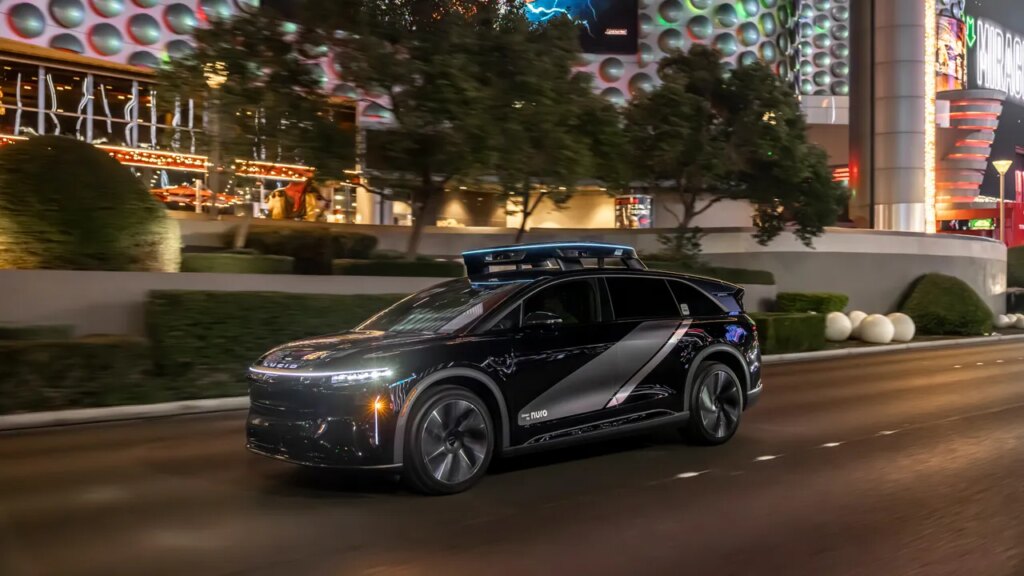
But actual cars? There were precious few. Lucid, Uber, and Nuro showed off an early look at their Gravity SUV competitor. And, in what is starting to feel like the automotive world’s slowest rollout in history, Sony and Honda yet again wheeled out the Afeela 1, but promised it’s finally coming to customers later this year. They also revealed an SUV sibling to follow.
“A decade ago, you wouldn’t have thought CES would be for cars—but then, at one point, every car manufacturer was there,” says Philip Nothard, Cox Automotive’s Insight director. “[For auto] CES has now probably had its day.”
There’s also no getting away from it—this absence of CES autos is a glaring symptom of the lagging state of the US car industry right now. Not only are sales numbers falling in general, it looks like there will be no respite in 2026. And, while America cools on EVs after the tax credit’s death, global electric sales jumped more than 20 percent last year. BYD has now overtaken Telsa. While China’s auto industry readies to bring fleets of new EVs to market this year, staggeringly, Jeep and Chrysler have announced they’re discontinuing production of all plug-in hybrids in the US.
“CES is an American show, and the American market is now in a very tricky situation,” says Daniele Ministeri, senior consultant at automotive analysts JATO. “Also, Trump is open more and more to the combustion engine. And [US] OEMs are now investing more in conventional power—solutions you would not bring to a show like CES. From European and Asian OEMs, why should they bring new models to CES? They don’t know the future of these models in the American market.”
Ministeri adds that Chinese OEMs, ahead in software compared to Western makers in terms of autonomous driving tech, he believes, weren’t on show because right now they cannot launch any vehicles in the US. CES, therefore, is simply no longer “the right for stage for them.”
Andy Palmer, former COO of Nissan and former CEO of Aston Martin Lagonda, goes further. “CES used to matter to carmakers because the industry was borrowing technological credibility from Silicon Valley. Today that relationship has flipped. Automotive tech is no longer an exciting novelty, it’s to be expected,” he says. “Electrification, software, and ADAS are now industrialized technologies. They are no longer concept-stage theater pieces that need a Las Vegas stage.”
More importantly, Palmer, Nothard, and Ministeri all state that the center of gravity for the auto world has moved—both technologically and geographically—to, of course, China. This makes China’s main auto expo, which alternates each year between Shanghai and Beijing, now the location where carmakers must posture and preen.
Indeed, as WIRED pointed out in May last year, Shanghai 2025 wasn’t just a car show—it was a warning to the West. Having poached some of the best Western auto talent, China’s car industry set about showing how it was going to dominate globally in charging rates, ranges, design, tech, and sheer volumes. Detroit and Munich were put on notice. It was blindingly obvious to all in the industry where the new power lay.
“Shanghai has become more strategically important than CES for many manufacturers,” Palmer says, “because that’s where the fastest innovation cycles, supply chains, and consumer demand now sit. If you want to signal the future of automotive, that’s increasingly where you do it.”
Chinese automakers aren’t merely content with showing off on home turf, though. So with CES out of the question, they’ve been looking for a replacement. Step forward Munich’s IAA Mobility, now Europe’s largest car convention following the death of the Geneva Motor Show. “The Chinese are looking for a platform to show off their products outside of China,” says Ministeri. “When you’re Mercedes or BMW, and you see China investing in the IAA, you have to be there. So they make huge investments. This year, at IAA, was the most beautiful stand for Mercedes I’ve seen in 10 years going around motor shows.”
For CES, and perhaps by extension US auto brands, to get back to a place of dominance in the global car business, another truly seismic change in evolution of vehicles will have to take place. And, what’s more, the rate things are going, an annual event such as a car show will very soon come too late to keep pace with progress in China.
“Look at Chinese manufacturers’ lead time: from R&D to deliveries in two years on average,” Nothard says. “They’re bringing cars to the market very quickly. A traditional manufacturer’s average is seven years. So now you can’t have enough shows to deliver your new product. BYD, they’ve got a whole line of products on the horizon. Masses of new BYD product will be in the market before the next shows are even started to be created.”
“CES was at its peak point when software and interface, and software-defined vehicles became the pinnacle of everything that was happening in the auto sector, alongside EV technology. We’re now past that,” Nothard says. “It’ll take another big shift in the evolution of the car for CES to be put on the radar again.”
The post Where Are All the New Cars? appeared first on Wired.