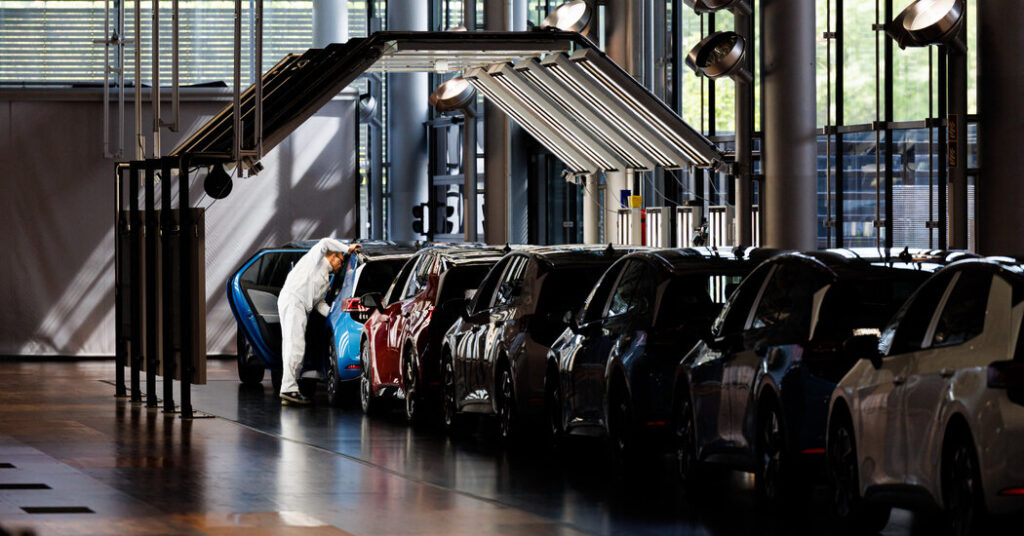
Perhaps no carmaker has been hit harder by shifting political winds in Washington and tumult in the global auto industry than Volkswagen. The German automaker’s sales in the United States fell 20 percent in the last three months of 2025 because of tariffs, trade conflict and the withdrawal of incentives to promote electric vehicles.
Volkswagen’s travails are an extreme example of the difficulties foreign carmakers have had in the U.S. car market as it diverges sharply from the rest of the world. Sales of electric vehicles are growing in China, Europe and elsewhere but slumping in the United States after Republicans in Congress and the Trump administration ended tax credits and other incentives. Policy now promotes fossil fuels.
The divergence makes it difficult for foreign automakers to offer models that cater to American consumers while also appealing to other buyers and fending off Chinese automakers, which are making inroads in Europe and Asia.
In addition to policy whiplash, Volkswagen and other importers are harder hit than domestic manufacturers by President Trump’s tariffs. The levies on imported cars and parts raise Volkswagen’s costs and force the company to choose between raising prices, which hurts sales, and sacrificing profit.
The auto tariffs will remain in place even if the Supreme Court strikes down many of Mr. Trump’s other tariffs, which are based on a different law, in a ruling expected soon.
Volkswagen’s problems are the latest setback to the company’s long-running quest to become a major player in the United States.
Globally, Volkswagen is second only to Toyota Motor in the number of cars it sells. But it’s a niche brand in the United States, selling 330,000 vehicles last year, 13 percent fewer than 2024. Toyota sold more than 2.1 million cars in the United States in 2025, an 8 percent increase. And the Japanese automaker’s luxury Lexus brand sold nearly 400,000 vehicles.
Hyundai, which is based in South Korea, also withstood the headwinds facing foreign automakers. Its U.S. sales rose 8 percent in 2025, to 900,000 cars.
In the 1960s, during the heyday of the Beetle, Volkswagen was the leading car importer in the United States. But it was pushed aside by Asian brands and has been trying to recapture its glory ever since. Volkswagen is also still trying to rebuild its reputation after a diesel emissions cheating scandal that came to light in 2015.
“It’s clear that 2025 brought real challenges to the industry and us,” Kjell Gruner, president of Volkswagen Group of America, said in a statement. “As we enter 2026, we do so with momentum and a renewed commitment to the U.S.”
The company predicted that sales will improve in 2026 when the company begins selling a new version of the Atlas sport utility vehicle, which is made in Chattanooga, Tenn. The company declined to comment further.
The Atlas is insulated from tariffs. But models like the Tiguan, Golf and Jetta are imported from Mexico or Europe and are vulnerable to trade tensions.
Volkswagen’s problems in the United States feed into larger woes. The company, which is based in Wolfsburg, Germany, reported a loss of 1.1 billion euros, or $1.25 billion, in the third quarter of 2025, placing the blame, in part, on tariffs.
Volkswagen is not the only German carmaker struggling in the United States. Sales of Mercedes-Benz vehicles fell about 10 percent last year, according to analyst estimates; the company has not yet reported sales figures for 2025. Mercedes manufactures sport utility vehicles in Alabama, but its luxury sedans, as well as many components, are imported.
BMW fared somewhat better. Its U.S. sales rose 5 percent in 2025 from the previous year, although a 3 percent decline in the fourth quarter may point to difficulties in 2026. It makes two popular sport utility vehicles, the X3 and X5, in Spartanburg, S.C.
“It’s clear that they are in better shape,” Stephen Reitman, an analyst at Bernstein in London, said of BMW.
The U-turn in Washington policy on electric vehicles has been a problem for most carmakers.
General Motors said on Thursday that its profits would be hurt by a $7.1 billion loss in the last quarter of 2025 primarily to reflect the diminished value of its investments in electric vehicles. Ford Motor last month took a $19.5 billion hit to its profits related to electrical vehicles.
But for Volkswagen, policy changes undercut its plans to use electric vehicles to gain a bigger share of U.S. car sales.
In 2022, Volkswagen became one of the first foreign carmakers to manufacture an electric vehicle in the United States, banking on Biden administration climate and auto policies. But sales of that car, the ID.4, made in Chattanooga, fell 60 percent in the fourth quarter after Congress eliminated tax credits of up to $7,500 for people who bought or leased electric vehicles.
Recently Americans have been snapping up hybrids, which offer some of the advantages of electric cars but do not need to be charged. Volkswagen does not offer hybrids in the United States.
“We are in a hybrid era right now,” said Ryan Rohrman, chief executive of Rohrman Automotive Group, which has 22 dealerships in the Midwest selling brands including Toyota, Hyundai and Volkswagen. Mr. Rohrman said he did not understand why Volkswagen had not offered hybrid models.
By contrast, nearly half of all Toyota cars sold in the United States were hybrids, according to company figures.
Volkswagen has also suffered from a two-speed auto market. Sales of luxury vehicles remain fairly strong because affluent people still have money to spend. But middle-class buyers are strapped, hurting sales of moderately priced vehicles like the Jetta and Golf.
“They’re positioned in a middle market that’s evaporating,” Erin Keating, executive analyst at Cox Automotive, said in an email. “Buyers are either trading up to established luxury or trading down to value.”
Volkswagen owns Audi, but that luxury brand is also struggling. Audi’s U.S. sales fell 16 percent to 165,000 cars last year. Porsche, also a part of Volkswagen, has not reported its U.S. sales for the full year.
Mr. Rohrman, the car dealer, said Volkswagen could be as successful in the United States as it was in the rest of the world if company executives tried harder to understand the market.
“Toyota, Honda, Lexus — they want to own North America,” he said. “If Volkswagen was that hungry, I think they would have it.”
Jack Ewing covers the auto industry for The Times, with an emphasis on electric vehicles.
The post Volkswagen Suffers More Than Rivals From Auto Industry Woes appeared first on New York Times.