This article contains spoilers.
In the publishing world, Emily Henry is a tour de force. Her books have sold more than 10 million copies. Her fans are loyal and ravenous.
Now, the 35-year-old author is hoping that fervor translates to the screen: Adaptations are confirmed for five of Henry’s six contemporary romance novels, including film versions of “Happy Place,” “Beach Read,” “Book Lovers” and “Funny Story.”
But the first to actually make it onscreen, in the form of a Netflix movie that premiered on Friday, is “People We Meet on Vacation”: the friends-to-lovers tale of Alex, an uptight English teacher, and Poppy, a free-spirited travel writer, who take platonic vacations together each summer. After a period of estrangement, the pair reunite at a wedding and finally confront their true feelings.
In casting the romantic comedy’s two stars, the director Brett Haley scanned the internet to see which actors the book’s fans wanted, but “all of those people were either unavailable or not interested,” he said in a phone interview.
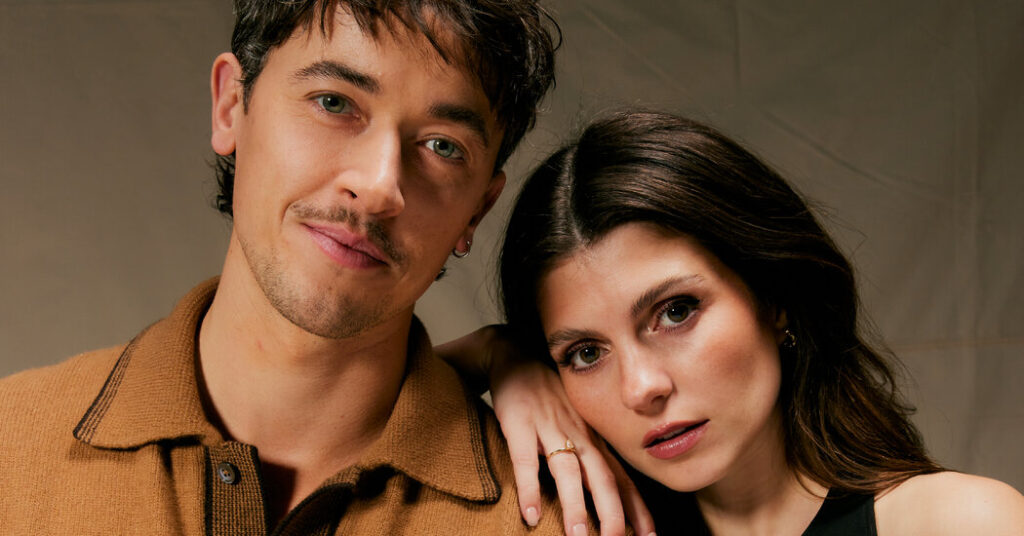
Instead, after seeing hundreds of actors, the filmmakers cast Emily Bader, 29, best known for starring in the Amazon series “My Lady Jane,” and Tom Blyth, 30, who broke out as Coriolanus Snow in “The Hunger Games” prequel, “The Ballad of Songbirds & Snakes.”
“Going through the casting process was really, really scary,” said Henry, who also served as an executive producer. “There were a lot of names thrown out who I was just like, ‘I don’t see that,’ and, more importantly, ‘I don’t think the readers will be excited about it.’” After Bader and Blyth were cast, she said, “that’s when I was like, ‘It’s going to be OK.’”
Still, there were inevitable challenges in adapting a roughly 400-page tome into a two-hour movie.
Some plots were cut or changed. For practical reasons, the film scrapped a prominent Palm Springs, Calif., setting and shot almost entirely in Spain and New Orleans, with those places doubling for locales in British Columbia, Tuscany, Boston and Ohio. “We don’t have a James Bond budget, unfortunately,” Haley said.
Over a video call in December, the author and the lead actors discussed the book-to-screen changes and the merits of romance.
These are edited excerpts from our conversation.
Readers often get attached to the versions of characters they imagine in their heads. What traits of Alex and Poppy were the most important to carry over to the screen?
EMILY HENRY Poppy could so easily be absolutely insufferable, and I think most people would have played her insufferably. It was really important that you could tell that when she’s razzing Alex, his whole thing is to be this stick-in-the-mud, but it’s just this game they play. [The actors] both really naturally understood that.
EMILY BADER Poppy is this Energizer bunny of a person. I wanted to make sure not to shy away from that in a fear of being insufferable. We put a lot of judgment on young women characters.
TOM BLYTH For Alex, his stick-in-the-mud quality was something I was a bit nervous of at first. How do you make him endearing when he’s naysaying her? Because as a reader and as a watcher, I felt I’d be on Poppy’s side.
HENRY You are so much more Poppy in real life.
BLYTH I’m way more Poppy! Well, sometimes. I’m not feeling very Poppy today. But I think I was just a little too fixated on, “How do I make him likable?” Any character you play, you have to learn to love their downfalls, weaknesses and the injuries in the past that have made them how they are now.
Emily H., when you first read the script, what changes from the book were you the most nervous about?
HENRY We did not end up with drafts [from the screenwriters Yulin Kuang, Amos Vernon and Nunzio Randazzo] that made me nervous. I was paying the most attention to things I thought went against the ethics of the book’s worldview.
There were a lot of drafts and moments where I felt the script was being too hard on Poppy. There were moments that I felt there wasn’t room being left for the fact that Alex is also failing.
Spoiler warning: In the book, Alex and Poppy have a falling-out after sharing a drunken kiss and almost having sex on a trip to Croatia. The movie ditched Croatia and incorporated some of what happens into another trip adapted from the book, Tuscany, where an almost-kiss after a pregnancy scare is now enough to derail their friendship.
What went into the decision to alter what led to Alex and Poppy’s friendship breakup, and how do you feel about that shift?
HENRY This was, I think, the hardest thing for the screenwriters to crack. There were so many different versions. For a lot of the process, the Tuscany pregnancy scare was not in the [film], and that’s one of my favorite moments in the book because you realize how scared Alex is of losing her. So, I kept getting in Brett’s ear being like, “I think you need Tuscany.” They figured out how you could pull that into the almost-kiss. In Croatia, I don’t remember if they just kiss or have sex ——
BADER [Laughs.] I love that you can’t remember your own book!
HENRY It’s been a while, you guys. They hook up in some capacity. I actually feel like it was such a smart edit to get all of that into just one scene. My only hard-line, because I’m coming from publishing, was that they can’t actually kiss [in Tuscany] because romance readers tend to have very strong feelings about infidelity. It’s really hard for them to root for characters who have stepped over that line.
BLYTH Maybe this just speaks to how messy I am — I remember seeing that change [removing the kiss] and going, “What? That’s the crux of the drama, that they do cross the line.” I was definitely in the corner of “They should make out.” I’m like, “We need stakes.” But what I loved about it was that Brett and the writers, with your guiding hand, were able to find a way to make it happen where the sexual tension, the romantic tension, is all still there without them actually crossing the line.
Emily H., you’ve referred to some of the changes as “universe expansion.” Have you considered writing more Alex and Poppy stories?
HENRY Just the other night, Brett and I were having dinner, and we were talking about all the characters, like, “I wonder what else is happening with them?” It was spinning out of control very quickly. There have been text messages about it since, so we’ll see. I think there’s a fun idea to be had.
BLYTH Can you please write a story about Buck [a boat tour guide played by Lukas Gage]?
HENRY Oh, my God!
BADER I think Sarah [Alex’s on-again, off-again girlfriend, played by Sarah Catherine Hook] deserves something, too.
HENRY Sarah, for sure, deserves her own. Also Miles Heizer and Tommy Do, who played David [Alex’s brother] and Nam [David’s fiancé], are so funny and so charming, and I kind of want a prequel of them.
Romance books and movies are often undervalued or overlooked. What is the appeal of this genre for all of you?
BADER Romance doesn’t always make the Letterboxd Four, but oftentimes those movies hold some of the strongest memories and the most rewatchability. I mean, this isn’t a rom-com, per se, but “Pride and Prejudice” — —
HENRY It’s a rom-com, in my opinion.
BADER I remember watching it on a bed with my sister and my mom and like 17 dogs countless times. I think as much as movies are there to challenge us and open our brains, they’re also there to comfort us.
BLYTH [To Henry] The stories that you’re writing are hopeful but they’re also sexy and fun, and the characters are modern, flawed people. I think anything that people consume as entertainment, or whatever you want to call it, that gets people feeling empathetic, it’s a real public service.
HENRY Well, thank you. This is where I can get onto a long rant. I hear a lot of feedback from people who aren’t really romance readers, who think of it as sheer escapism, and that has not been my experience as a writer or a reader or a watcher. The reason I love romance so much is because it takes the brightest parts of life and the darkest parts of life, and it puts them side by side in a way that feels safe because you have that safety net of a happy ending.
I have a real issue with the fact that a tragic love story is treated as more important or more artistically valuable than a love story that ends in a place of hope and optimism. Because, in real life, if you are a person who wants a monogamous, long-term relationship, your best-case scenario is you meet someone, you fall in love, you love each other your entire life and then one of you dies, and it is the worst, most excruciating pain. By putting that end cap on the moment that they’re happy and they’re hopeful, you are — I’m getting teared up. This always makes me emotional because it makes me think about my dogs, honestly. You are saying that the value, the important part of the story, is this moment when they are happy and they are together.
And that’s my worldview. It’s like, things really suck a lot of the time, but love is the thing that makes this all worth it.
BADER Oh, my gosh, I’m actually crying.
HENRY Try not to think about it too much because it can ruin your life.
BADER That was actually so profound. It’s something that we don’t talk about that often. To be vulnerable, to choose to love, is to choose pain.
HENRY The only way to break your heart is to let yourself love. You can end the story in the sad, tragic moment, or you can end it in the beautiful, happy moment. And that doesn’t mean the sad, tragic moment doesn’t happen. It just means this is the moment that matters.
The post Unpacking ‘People We Meet on Vacation’ With Emily Henry and the Stars appeared first on New York Times.