President Trump prodded American energy executives to quickly tap Venezuela’s vast oil reserves on Friday, hours after the United States military intercepted another tanker carrying Venezuelan oil.
The tanker, which American forces boarded in the Caribbean Sea early Friday, was the fifth that they have boarded or seized in the past month, as the Trump administration seeks to control Venezuela’s oil exports.
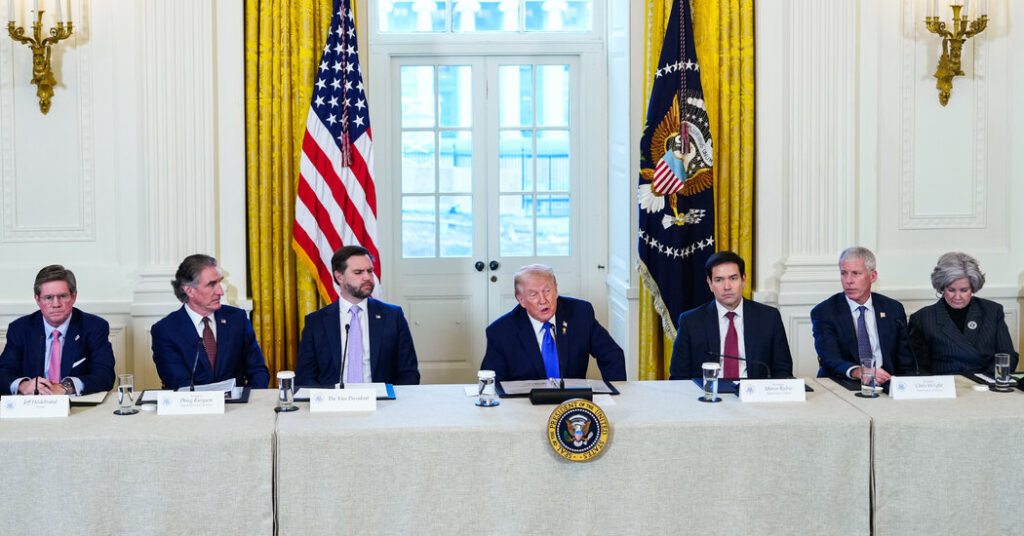
Mr. Trump said Friday afternoon in a meeting with oil executives at the White House that he did not expect more U.S. attacks on Venezuela after American commandos captured its president, Nicolás Maduro, in a raid on the capital, Caracas, last weekend. Mr. Trump praised the country’s interim leaders but said that American warships — which he called an armada — would stay in place off the Venezuelan coast.
Trump administration officials have outlined a sweeping but bare-bones plan to take over Venezuela’s lucrative oil industry and have said they expect the country’s new leaders to follow orders from Washington. Mr. Trump has said that U.S. oversight of the country could last years.
In the meeting with American oil executives, Mr. Trump said their companies would “rapidly rebuild Venezuela’s dilapidated oil industry and bring millions of barrels of oil production to benefit the United States, the people of Venezuela and the entire world.” He said that U.S. oil companies would invest at least $100 billion in Venezuela.
But it is not clear that oil executives are prepared to commit to that investment.
Darren Woods, the chief executive of Exxon Mobil, the largest U.S. oil company, emphasized the opportunities that Venezuela presents — and the big hurdles it would need to clear to return to the country.
“We’ve had our assets seized there twice, and so you can imagine to re-enter a third time would require some pretty significant changes,” Mr. Woods said at the White House meeting. “Today it’s uninvestable.”
He said that Exxon Mobil was prepared to send an exploratory team to Venezuela within the next few weeks if it received security guarantees.
Other executives were similarly cautious.
When pressed by the president, Harold Hamm, one of his closest oil-industry allies, also stopped short of committing to work in Venezuela.
“It excites me as an explorationist,” he said. “Everybody has that in their blood.” But, he added, Venezuela has “got its challenges.”
Some oil executives have privately discussed the possibility of seeking some form of financial guarantee from the federal government before agreeing to establish or expand production in Venezuela, according to people familiar with their thinking.
Oil executives are concerned about political instability in Venezuela, since oil investments are often measured in decades, and companies would need to be confident that any deal would last long enough for them to turn a worthwhile profit.
They point out that Venezuela has in the past seized foreign assets valued in the tens of billions of dollars. Exxon and ConocoPhillips are among the companies still pursuing substantial claims against the country’s government.
“It’s not that oil companies don’t operate in risky places,” said Luisa Palacios, a former chairwoman of Citgo Petroleum, a U.S. oil refining company owned by Venezuela’s state oil company. “It is the inability to assess the risk at this moment.”
The energy secretary, Chris Wright, suggested earlier Friday on Fox News that the U.S. Export-Import Bank might provide “credit support” for companies making large investments in Venezuela. The independent federal agency offers financing when private capital is not available.
He spoke hours after U.S. forces boarded the tanker, this time in a predawn operation in the Caribbean Sea that was carried out by Marines and sailors working with the Coast Guard.
The American forces launched from the aircraft carrier Gerald R. Ford, a nuclear-powered vessel, and apprehended the tanker, the Olina, “without incident,” the U.S. Southern Command said in a statement.
“Once again, our joint interagency forces sent a clear message this morning: There is no safe haven for criminals,” it said.
The Olina had been sailing under a false flag registered to the small Asian nation of Timor-Leste, according to the International Maritime Organization, a tactic that the U.S. military has previously cited as grounds for interception.
The tanker had loaded roughly 700,000 barrels of oil in late December and early this month at Venezuela’s José Terminal, according to Kpler and TankerTrackers.com, two firms that track global oil shipments, whose findings were independently verified by The New York Times. A video of the U.S. forces boarding the vessel, posted by the U.S. Southern Command, showed the vessel sitting low in the water, indicating it was carrying cargo. It left Venezuelan waters late last weekend, defying a partial U.S. blockade on Venezuelan oil exports.
On Wednesday, U.S. special operations forces took control of two other tankers, including one, the Marinera, that was flying a Russian flag and was seized between Iceland and Britain and had been subject to seizure under a warrant issued by a U.S. magistrate.
The U.S. authorities did not have a court-issued warrant to seize the Olina, according to an official familiar with the operation who was not authorized to speak publicly. But last January, the United States placed sanctions on the vessel, then named Minerva M, accusing it of helping to finance Russia’s war in Ukraine by moving Russian energy exports to foreign markets.
With Mr. Maduro ousted from power, the United States and Venezuela said they were moving to re-establish diplomatic ties.
A team of U.S. officials that included diplomatic and security personnel arrived in Caracas on Friday “to conduct an initial assessment for a potential phased resumption of operations” in Venezuela, the State Department said. The United States has not had an ambassador to Venezuela since 2010 and closed its embassy in Caracas in 2019, after accusing Mr. Maduro of electoral fraud.
Venezuela’s interim government said on Friday that it was initiating its own “diplomatic exploratory process” with the United States and would send a delegation of diplomats to Washington.
Venezuela has released at least nine political prisoners since Thursday, in what the head of its National Assembly called a gesture of peace. Rights groups estimate that 800 to 900 political prisoners are imprisoned in Venezuela, many under harsh conditions.
The United States has also pressured the Venezuelan government to expel official advisers from China, Cuba, Iran and Russia, American officials said.
Despite that push, Cuba’s foreign minister, Bruno Rodríguez Parrilla, traveled to Venezuela on Thursday and paid tribute to the Cuban and Venezuelan combatants who were killed on Saturday while trying to protect Mr. Maduro during the U.S. military raid.
He attended a ceremony with Venezuela’s interim leader, Delcy Rodríguez, and other senior government officials, underscoring the depth of the relationship the two countries have built over the last 25 years.
“We are united in love,” Ms. Rodríguez said at the ceremony on Thursday. “Our concept of homeland is that the homeland is humanity. We are not warmongers; we are statesmen and women.”
Amid escalating threats from Mr. Trump and others across the globe, Pope Leo XIV used an annual address on Friday to the diplomatic corps at the Vatican to condemn “a diplomacy based on force” and a “zeal for war.”
Leo did not mention any world leaders by name. But his remarks were notable, coming after the U.S. operation in Venezuela and threats against Greenland, and on a day when Russia said it had attacked Ukraine with a nuclear-capable intermediate-range ballistic missile.
Reporting was contributed by Jack Nicas, Emma Bubola, Genevieve Glatsky, Nicholas Nehamas, Christiaan Triebert, Motoko Rich and Elisabetta Povoledo.
Rebecca F. Elliott covers energy for The Times.
The post Trump Urges Oil Companies to Speed Work in Venezuela appeared first on New York Times.