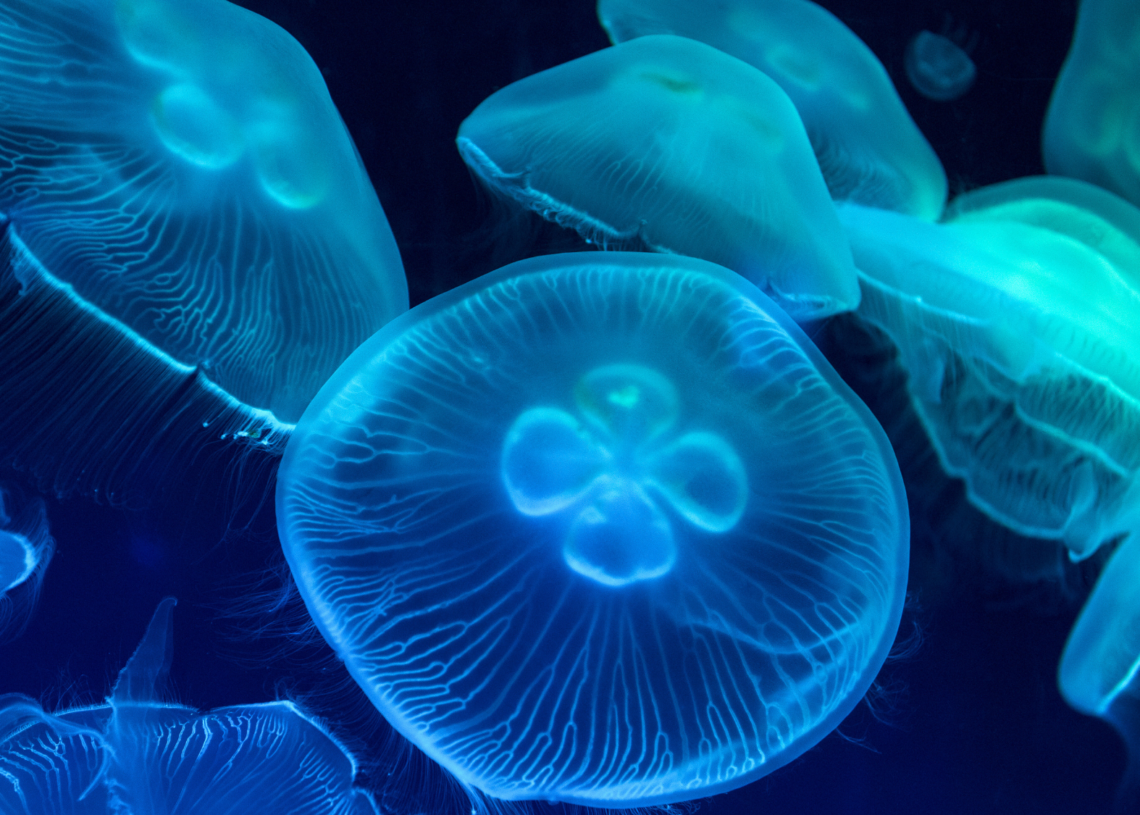
Jellyfish get tired, too. They may look like living grocery bags, but they’re just like us in at least one very specific way. According to the research, if jellyfish don’t get some rest, they start breaking down at a cellular level.
A new study from researchers at Bar-Ilan University in Israel, published in Nature Communications, found that jellyfish sleep for about a third of their day, roughly matching human sleep patterns. Interesting, because they don’t have brains, or spinal cords, or even an anus like us. They are so unlike us yet share our need to rest, and do it just as much as we do.
They operate with a decentralized nerve net spread throughout their bodies that, while it functions completely differently from our system, will still shut down and become less responsive if they don’t follow regular sleep cycles.
This is a big deal because jellyfish are so split from our evolutionary lineage, with billions of years of divergence from most other living creatures, yet if they need a ton of sleep, then it seems that sleep itself likely evolved very early, long before complex brains like ours showed up.
The researchers also wondered why a free-floating animal that can be gobbled up by a passing predator would even need to sleep so much. Wouldn’t that be dangerous?
In experiments involving upside-down jellyfish and sea anemones, researchers found that sleep deprivation led to increased DNA damage in neurons. The damage appeared both in lab settings and in natural environments, suggesting this isn’t an artificial side effect of captivity.
Even more interesting, when the animals experienced environmental stress, they slept more. When treated with melatonin, a hormone we humans naturally produce to regulate sleep, but supplement with pills or gummies to help us knock out when we need it, they also slept longer and showed reduced DNA damage. That suggests jellyfish may rely on a melatonin-based system a lot like ours, tied to day-to-night cycles.
All of this suggests that sleep didn’t evolve simply to recharge our batteries. It evolved because staying awake too long literally breaks the neurons inside of us. Catching some Z’s is the only way to keep that from happening.
The post Jellyfish Sleep Kind of Like Humans. Here’s What That Tells Us appeared first on VICE.