Iranian cities were braced for more nights of unrest over the weekend as anti-government protests continue to rock the country despite an escalating crackdown from the Iranian authorities, who have vowed to quell the protests.
The demonstrations began in late December in response to a currency crisis but have since spread and grown in size, fueled by anger at Iran’s authoritarian government.
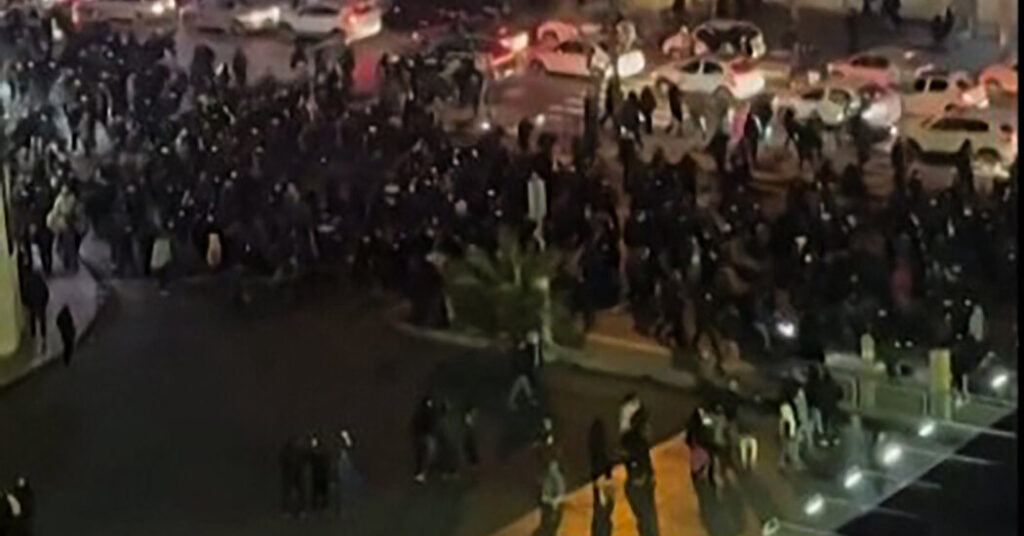
On Friday, the Iranian capital, Tehran, and other major cities were convulsed by a second consecutive night of turmoil despite an internet blackout. Protesters chanted slogans against the Islamic Republic’s rule, lit bonfires and, in some cases, set buildings on fire, according to witness interviews and videos that were verified by The New York Times or appeared on BBC Persian television.
The authorities have threatened to exact tough measures against protesters. On Saturday, Iran’s armed forces said in a statement it would protect “strategic infrastructure and public property.”
Dozens of protesters have been killed since the protests started in late December, according to human rights groups.
Iran’s supreme leader, Ayatollah Ali Khamenei, said on Friday that the government would “not back down” and called the protesters vandals who were trying to “please” President Trump.
Mr. Trump has pledged that the United States would come to the aid of protesters if the government used lethal force against them, although it is unclear whether he will follow up on that threat.
On Saturday, Secretary of State Marco Rubio wrote on social media, “The United States supports the brave people of Iran.”
Why are Iranians protesting?
Iran’s economy has been under sustained pressure for years, largely as a result of U.S. and European sanctions tied to its nuclear ambitions. A 12-day war with Israel last June further drained Iran’s financial resources.
When the currency plunged against the U.S. dollar in late December, amid persistently high inflation, merchants and university students staged days of protests.
But as the rallies grew, the protests became a broader criticism of the rule of Iran’s theocratic government. Across social media and television, protesters were seen chanting slogans including, “Death to the dictator” and “Iranians, raise your voice, shout out for your rights.”
How intense are these protests?
Demonstrations have spread to dozens of cities across Iran, according to tracking by the U.S.-based Institute for the Study of War.
On Friday, videos posted on BBC Persian television showed thousands of people marching in Tehran, drawing supporters from what residents said in interviews was a cross-section of working-class, middle-class and wealthy neighborhoods.
Amnesty International, a rights group, on Thursday said that at least 28 protesters and bystanders, including children, had been killed between Dec. 31 and Jan. 3. Three other groups that document and track human rights put the toll higher, at more than 40 since protests began.
Amir Reza, 42, an engineer, said in an interview from Tehran on Friday that he could hear gunfire and had decided to go home after riot police officers and militias in plainclothes began firing in the air and chasing crowds to disperse them.
A video on Friday verified by The New York Times showed at least seven people lying motionless on the floor of Al-Ghadir Hospital in Tehran, appearing to be dead.
How has Iran’s government responded?
The Iranian authorities have reacted harshly to the protests.
The Revolutionary Guards warned in a statement on Friday that its “red lines” included “the protection of the achievements of the Islamic Revolution and maintaining the security of society.”
The government initially signaled a willingness to listen to protesters’ demands. Earlier this month, it announced plans to provide most citizens with a monthly payment equivalent to around $7.
President Masoud Pezeshkian has acknowledged what he called the public’s “legitimate” grievances. He appointed a new head of the central bank and has said that “any violent and coercive behavior” should be avoided.
Yet Iranian officials have hardened their stance in recent days, echoing previous rounds of unrest when the authorities used mass arrests and violence to suppress demonstrations.
The Supreme National Security Council in Iran released a statement on Friday saying that although the protests were set off by “market instability,” they had since been steered by Iran’s foreign adversaries, namely Israel and the United States.
“The security forces and the judiciary will show no leniency whatsoever toward saboteurs,” the statement added.
What has been the international reaction?
Iran’s government is weakened on the international stage and dealing with the gnawing fear among many Iranians of another round of U.S. or Israeli military strikes.
Israeli officials have spoken out on behalf of the protesters, and Mr. Trump said this month that the United States was “locked and loaded and ready to go” if the Iranian government used lethal force against demonstrators.
But Mr. Trump — who has touted his ability to use military might to strike or coerce nations — was evasive on Thursday when asked if he intended to force a regime change in Iran.
“I don’t want to say it, but I will tell you they’re not doing well,” Mr. Trump said, referring to Iran’s government, in a talk show interview.
Iranian officials said that they would react to any interference from the United States, including by potentially targeting American bases and forces in the region.
The unrest has brought some attention back to Reza Pahlavi, the son of the deposed shah of Iran, who lives in exile in the United States. In a video on Saturday, he urged Iranians to attend evening protests over the weekend and called on workers in key sectors like oil and gas to go on strike. But some experts question the extent of support for Mr. Pahlavi in Iran.
Aurelien Breeden and Sanjana Varghese contributed reporting.
Abdi Latif Dahir is a Middle East correspondent for The Times, covering Lebanon and Syria. He is based in Beirut.
The post Iran Braces for Weekend of Protests. Here’s What to Know. appeared first on New York Times.